
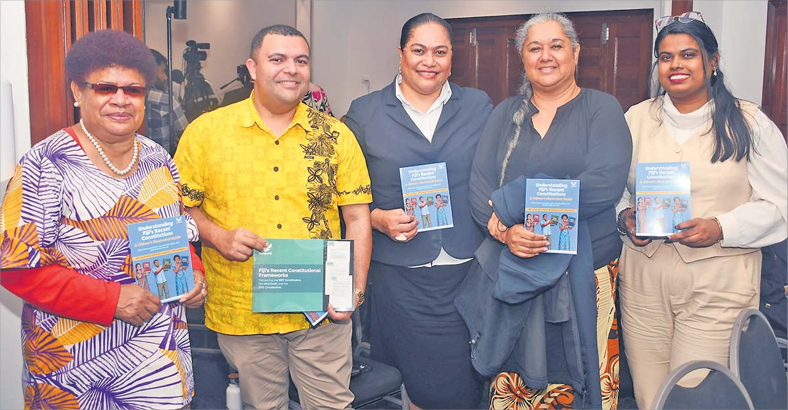
Dialogue Fiji has launched two new publications to help Fijians compare recent constitutional frameworks.
The publications are Recent Constitutional Frameworks: A Comparison between the 1997 Constitution, the Ghai Draft and the 2013 Constitution, and Understanding Recent Constitutions: A Citizen’s Illustrated Guide.
Dialogue Fiji executive director Nilesh Lal said the publications aimed to shift debate from tribal politics and personalities to knowledge of provisions, noting that the test for any constitution was in how it protected rights and how it controlled power.
Deputy Prime Minister Manoa Kamikamica said the publications did not tell readers which constitution was best and did not advocate for any amendments or replacements.
“They lay out what each constitution says, to allow citizens to compare for themselves,” Mr Kamikamica said.
“That restraint is not a weakness, it is the publication’s strength.”
He said that a constitution was a social contract, that legitimacy and public trust were inseparable from the openness of the process.
“Fiji has learned sometimes the hard way that a constitution handed out is a constitution contested, while a constitution built together is a constitution that can truly unite,” he said.
He said the process must belong to the people, not to any office, any party, or any individual, and when farmers in Tailevu, fishermen in Kadavu, market vendors in Ba and students in Suva all access the same information, the whole nation gets better.
University of the South Pacific Political Professor Dr Sandra Tarte said she found the shift from ethnic-based electoral rolls, which were a prominent feature of the 1970, 1990 and 1997 constitutions, to the common roll, which features in the Ghai Draft and the 2013 Constitution, particularly interesting.
“Also, the role of the President – from having certain legislative and executive powers under the 1997 constitution to a proposed advisory role in the Ghai Draft to being totally absent from the 2013 Constitution,” she said.
“We know of the debate around Section 131 of the 2013 Constitution which grants overall responsibility to the RFMF to ensure at all times the security, defence and well-being of Fiji and all Fijians. This has proved somewhat controversial as it may be interpreted as allowing the military a form of super constitutional authority.”
Dr Tarte said the value of the publications was that they gave Fijians the tools to make that judgment for themselves.
Both publications are now available to the public to support informed public discussion.

