
Fiji and other Pacific nations are receiving push-back from developed and oil-producing states against efforts to anchor stronger climate commitments in international law at COP30.
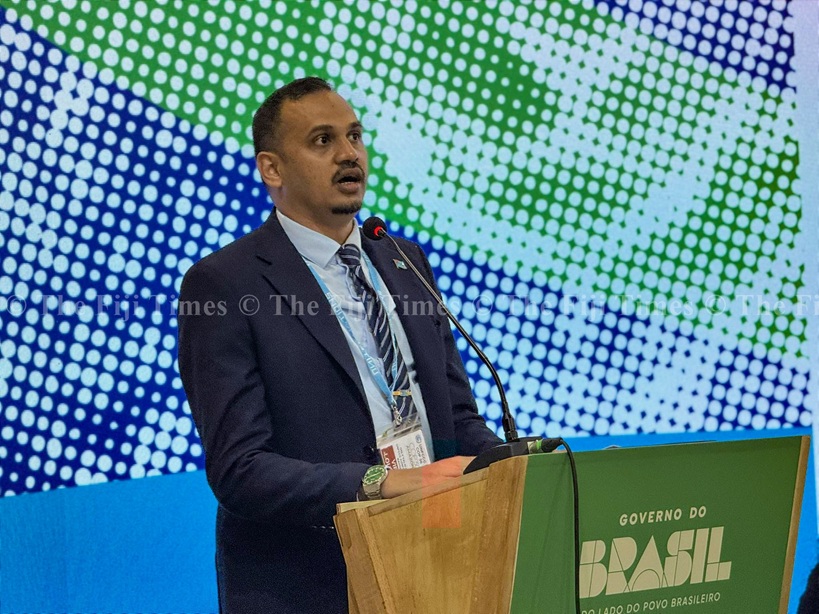
Speaking at a COP30 press conference, Permanent Secretary for Environment and Climate Change, Sivendra Michael said Pacific negotiators are using the ICJ’s findings to counter opposition in negotiating rooms, particularly around scientific references and the 1.5°C limit.
Dr Michael stressed that while the ICJ Advisory Opinion is not legally binding, the legal principles it interprets are.
“While the ICJ AO itself is not legally binding, the law upon which it is advising is absolutely legally binding,” he said.
“In the rules, you would hear blockages on IPCC being the best available science.
“The ICJ AO makes 411 references to the IPCC reports. And four times in particular, it mentions that IPCC is the best available science and the most comprehensive.”
Dr Michael said Pacific negotiators were leaning on this to rebut attempts to dilute references to IPCC findings in the COP30 decision text.
The ICJ, he said, had clearly acknowledged the IPCC’s assessment that climate change was an “urgent and existential threat,” with judges highlighting the escalating risks of warming and the narrowing window to secure a livable future.
A second major area of push back, he said, concerns the 1.5°C limit.
Despite some parties’ attempts to weaken its prominence, Dr Michael said the ICJ Advisory Opinion “established the 1.5-degree limit as the primary temperature goal and as a legal standard under the Paris Agreement for all state climate policies.”
Dr Michael said the advisory opinion also strengthened the legal grounds for holding states accountable if they weaken, retract or fail to implement climate commitments consistent with 1.5°C.
“By adopting the 1.5 degree limit as a legal benchmark, the ICJ AO provides a stronger basis for holding states accountable for inaction, which could be deemed an internationally wrongful act.”
Tuvalu’s Attorney-General, Laingane Italeli Talia, echoed this position, saying the advisory opinion now serves as leverage for the Pacific.
“The court has made its pronouncement. We have to honour, that is our responsibility,” she said.
“Everyone should be taking on the responsibility to embed this into the negotiation rules, to have this reflected in decision texts, in resolutions, in political declarations.” |

