
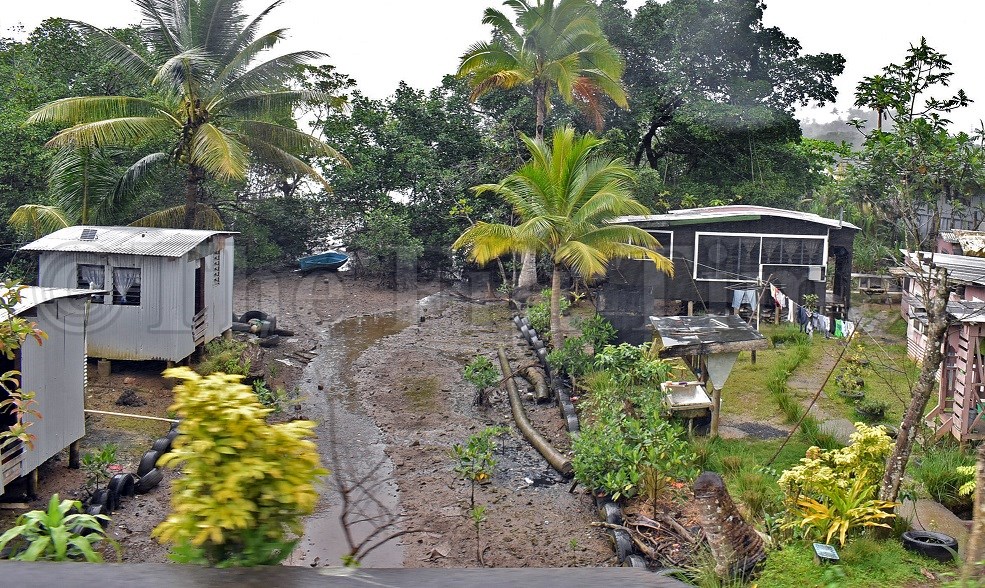
Informal settlement dwellers in Kalekana and Namuka-i-lau are caught between a rock and a hard place. Located a mere 10km outside of Suva City and adjacent to the Queens Rd, they are facing a crisis that many think is primarily an issue for coastal rural and maritime areas.
The rising sea level brought about by climate change – and the fallout from human activity – are challenging their very existence. Many fear their homes could fall apart around them but they also don’t know where to relocate to.
Living near the sea has not only provided affordable accommodation, it has also given them sustenance over the years. Josefa Volivolikigau has been a resident of Kalekana settlement near Lami since 1997.
He said he had personally witnessed the sea slowly claiming the shoreline and threatening the very foundations of his home. Mr Volivolikigau said he built his home next to mangrove wetlands in a way that pre-empted the rising sea level.
But those measures were no longer working. “I just recently extended the back of my house because water can almost reach up to the doorstep of my house,” the 70-year-old said. “My house is held up by wooden poles and this was done to ensure water does not come inside.
“In the past, the water level wasn’t that bad, but as of two years ago, the water level started to rise.” Mr Volivolikigau said when there was a full moon, the water would inundate his land and almost enter his home.
“I have a pigpen at the back of my house and the water is almost reaching the floor. I will have to rebuild it because it is coming apart because of the strong waves.” Mr Volivolikigau said he was considering moving to another location with his family because he feared the water would continue to rise.
“We can’t do anything to stop the water from rising because it is inevitable, considering the geography of our area. If it wants to, it will.”
Five minutes down the road from Kalekana lives Jeremiah Cakau, a resident of Namuka-i-lau settlement for the past 10 years.
The 69-year-old man was facing the same dilemma. He extended his home because of the rising water level from the mangrove swamp his house was constructed within.
“We initially lived in the house in front but had to extend our home because of the water,” he said. Mr Cakau said over the years his family had to deposit gravel at the back of their property to stop soil erosion with the receding tide.
“But even that is not working due to the force and level of the water the gravel has become displaced and is slowly being pushed further inland.
“We had to put gravel because when it floods, the water would loosen chunks of soil and push it out into the mangrove swamp.
“Our house is held up by wooden poles and cement-filled drums which provides a strong foundation.” He said his family used the swamp as a source of food and often went searching for little crabs called kuka in the mangroves.
“At the beginning of the pandemic, kuka was in abundance but now, when we go fishing, we don’t see that much and I think it is because of the sudden weather changes.”
When asked by The Fiji Times team if he had any plans to relocate, Mr Cakau said they had invested too much in their home.
“We will not move as we have spent a lot to build our house, so we will have to keep bringing in more gravel and sand and hopefully it will keep us going.” He also claimed climate change was not the only issue affecting them. Mr Cakau said development in the area had contributed to flooding in the settlement. “There is one quarry nearby and they are causing more problems when they dig up the gravel.
“The soil from their extraction blocks the river mouth, which causes a backflow when the tide comes in.
“Their mangroves are wetlands and then you have excess water from the developers which seep into the drains and combine with the incoming tide to cause flooding.
“They are gaining financially but the environmental impact of what they are doing affects the people who live near the sea.
“No one can stop the water that’s coming in and no one can change the weather, so we will just have to adapt and learn to live with it.”

