LAST week we featured the first part of a talanoa with music diva Michelle Rounds.
Today, we delve deeper into the music scene in Suva in the 1990s and what life was like for artists back then.
At a time when Fiji most needed support for live music and the musicians who relied on it for a living, the live music scene was dying a long, slow and agonising death.
Musicians who witnessed the unfortunate trend at the time said there were a number of contributing factors to the decline.
They said it was because of the onset of deejays, a lack of commitment and support from local radio stations to play original English music produced by Fijian artists and, to a certain extent, the ignorance of local artists to what was unfolding around them.
Live music in Fiji from the ’50s to the early ’80s was thriving and Fiji was considered the music hub of the Pacific.
There were dozens of bands performing every weekend at the Golden Dragon, Lucky Eddies, Old Town Hall, Suva Civic Centre, St John’s Hall, the QVS Club, Phoenix Theatre, Lambert Hall, the Royal Suva Yacht Club and the Bowling Club, among others.
When deejays were introduced in the ’70s, it killed the live music scene and by the ’80s and ’90s, live bands were few and far between.
The radio stations had a lot to do with it because they refused to play local original music so people did not know of the bands and their songs.
The few bands that stubbornly refused to give in got all the attention but even they were struggling to get paid what they were worth or being given the recognition they deserved.
While this was the reality on the ground, Michelle said she remembered the period as an “ideal time to be a live musician” and the support they received from the few faithful was what kept them going.
“There was so much support,” she said.
“Traps, Lucky Eddie’s, the Suva Travelodge (now Holiday Inn) — these were some of the places that supported us and of course the Golden Dragon.
“Ken Janson has been amazing, he’s possibly one of the biggest supporters of live music ever. He always had live music, bands, when the deejays came in, he had them too but he always had a place for live bands.”
Michelle said electronic music had taken the world by storm and “some of it is really good”.
But, according to her, nothing beats watching and listening and being immersed in a sea of live music and to know a living and breathing musician “is making the magic happen before you”.
“I’m still a huge supporter of live music. Don’t get me wrong, I know there’s a lot of exciting stuff out there but I like live musicians, I like real musicians.”
Before the advent of the internet and social media, there was very little to do after a long, hard day’s work and so the neon lights of the many watering holes that dotted the Serengeti that was Suva at night, beckoned many a tired soul for a stiff drink and the opportunity to unwind.
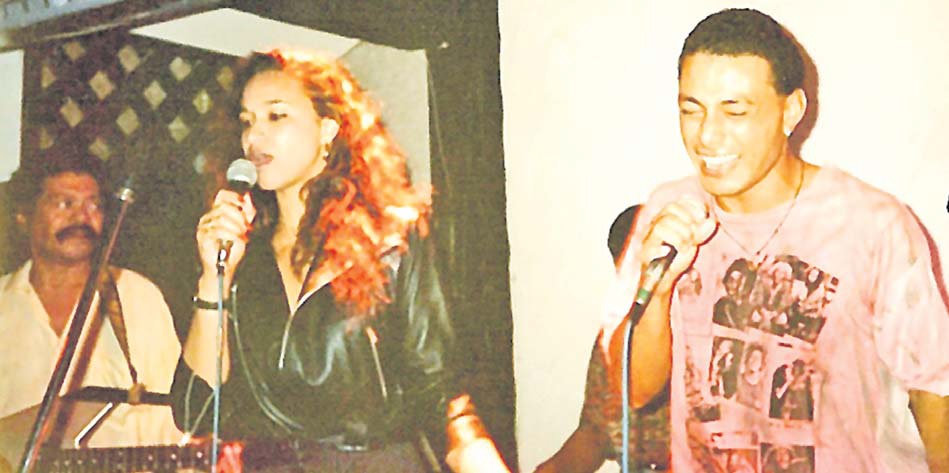
Working as a singer means gigging, and Michelle said she did a lot of gigs.
“Back in those days I had a regular gig at the Suva Travelodge and I was playing every Thursday with Fiji’s jazz guitar legend Tom Mawi, Peter Rabaka (bassist) and his son Sami (pianist).
“It was called something like ‘Thirsty Thursday’ and it was a jazz night.
“I had a regular gig at Traps, the guy that owned and ran the joint, my late cousin Gary Apted, was also a great supporter of live music.”
She, Tom Mawi and renowned pianist Tui Ravai got together and did a sophisticated jazz gig on Thursdays at Noble House’s Jackson’s Bar (now the Yue Lai Hotel).
“Nothing was electronic, nobody had laptops or computers, I was listening to cassettes and we would try to record songs off the radio.
“I sang the wrong lyrics for decades because there was no Google to check on the lyrics, we just sang what it sounded like.”
She chuckled and said the lyric issue was still common today but for her and fellow artists it wasn’t always funny, especially when covering other artists’ songs and being corrected by those who knew the real lyrics well.
Gigging in Suva was one thing, taking the show to the West was another.
“We used to go to the West in a carrier. Tui and I would sit in the front next to the driver but sometimes we’d be in the back.
“We’d stop at Sigatoka at 2am for a bathroom break but at that time of the night there are no toilets to use so you have to go on
the side of the road. That’s the toughest I’ve done but that’s not tough as some others are faced with I suppose.
“I’ve never done the whole ‘load the gear and get in the bus’, never.”
Michelle said one of the saddest aspects of being a musician was the fact that a career in music was always considered “a side
hustle” and not a breadwinning job.
She said this was an attitude that persisted to this day.
“Fiji has never taken music seriously, it’s not a job – it’s something you do when you can’t do anything else.
“My uncle, Victor Rounds, who is a famous musician in Australia and has brought his kids up and bought a house and done everything based on his earnings from playing the bass — they still say to him ‘oh you still a band boy’.
“We are living off this. I’m a real singer, I don’t have a day job and this is what I really do. This is what I live off and this is how I
brought my son up.
“That attitude really hasn’t changed in Fiji. People still don’t view music as a serious job, it’s a fun thing and you don’t need to
be paid for it because it’s a fun thing.
“Fijians have the view that everybody can sing and play an instrument. But let’s be real and let’s be honest.
“Anyone can do it but when you take it to the next level, that’s when things change. Fiji doesn’t seem to understand the line between playing at home and performing on an international stage.”
Michelle said it was this attitude, on top of artists being ripped off for their hard work, that Fijian artists continued to struggle to make a living and support their families by doing what they loved and did so well.
Michelle has been living and performing in Cairo, Egypt since 2009, she has performed at the Cairo Opera House and is a regular performer at the Cairo Jazz Club.
In 2014, she began giving vocal training to Egyptian children and adults.