
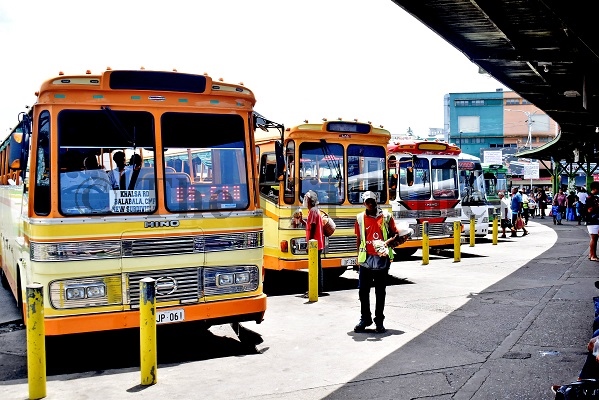
The Fiji Bus Operators Association claims the Minister for Economy, Aiyaz Sayed-Khaiyum used his parliamentary privilege during the debate on the revised national budget last Friday to attack bus operators simply because they raised their voices about the reality of the matter regarding an industry that is in economic distress.
The Association released a statement yesterday to set the record straight about the true state of the industry and about the measures taken to keep services going, after comments in Parliament by Mr Sayed-Khaiyum.
Bus operators spokesperson Priscilla Serevi said “The minister said bus operators were not telling the public that they could go through the Fiji Competition and Consumer Commission (FCCC) to request a fare increase. This is false.
“The news release he was reacting to specifically stated that bus operators would be meeting with the FCCC in the coming week and hoped for a positive outcome from that meeting.
“The minister implied that bus operators had threatened the government and Fijians and wanted ‘special conditions’ given to them. This was not the case. The industry red-flagged that if no assistance is provided then the industry will come to a halt as operators will not be able to pay for fuel, leave alone other expenses.
“Other industries, like shipping, are given government support to remain viable, but when bus operators request the same consideration, they are made out to look like they are ungrateful and demanding.
“Government support was requested to minimise the impact of a large bus fare increase on the travelling public; this has been the government’s concern.
“The minister further suggested that some bus operators had previously misused government assistance to the industry for their personal gain. If he has evidence of such dealings, these operators should be prosecuted since nobody is above the law. It is unbecoming of a minister in his position to launch such an attack when the targets will not be able legally to defend themselves. Putting this matter into perspective, the assistance referred to was terminated in 2015.
“The minister’s comments detract from the real issue, which is that bus operators simply cannot continue to function in a safe and efficient manner because economic realities always trump political expediency,” Ms Serevi said.
“Several bus companies are already on mortgagee sale, with more surely to follow. Even if bus operators can miraculously keep refuelling their buses, when banks and other creditors start taking action because of unpaid debts, bus services will be disrupted and operators will be out of business anyway.
“It is sad that the Minister of Economy chose his parliamentary platform to respond to operators after more than a decade of them trying to get the attention of the powers-that-be focused on the state of the industry.
“He told Parliament that bus operators had employed ‘nudge-nudge, wink-wink’ tactics to get their fare increases. This is false,” she said.
“Bus operators had been pursuing the correct regulatory avenues for years, to no avail. The economy minister seems to suggest that it was wrong for operators to seek discussions with the minister responsible for transportation about their issues, including their request for a fare review. He also suggested it was wrong to meet the prime minister when all reasonable avenues to seek redress were exhausted.”
Previously, the Land Transport Authority (LTA) was responsible for setting bus fares and bus operators had in August 2018 applied for a fare review, almost 10 years after the last bus fare increase. LTA refused to accept the application. The regulatory rules were then suddenly changed, and the FCCC was given the responsibility to set the fares.
Bus operators then made their application to FCCC through its Independent Bus Fare Review Committee. This review committee required bus operators to submit financial accounts, which bus operators complied with. Bus operators even adopted a resolution at its 2019 AGM for operators to have their accounts audited annually, before the government required this of them.
After complying with FCCC demands, there was another long wait with no explanation for the delay until early 2020 when, after renewed calls from bus operators, the FCCC suddenly announced a nominal fare increase without any explanation for how these increases were calculated.
Only on 11 March 2022, did bus operators finally get the chance to discuss the proposed bus fare regulatory framework with the FCCC in a workshop in Suva. It was then that operators found out that a formula had yet to be finalised and that FCCC could not adequately explain the basis for the minimal fare increase given in early 2020.
“Bus operators have no intention of working against the government; we only want a fair hearing and consideration of our issues to enable us to continue serving the travelling public. It is no secret that cost of living and business operating expenses have increased exponentially over the years and bus operators are legally not able to pass on any of these cost increases to the travelling public, without an approved fare increase. The only way we can continue to operate is if the government gives us a lifeline.
“Buses provide daily transportation to about 70 per cent of the population and we are highly aware of the impact on a great number of people if the bus industry collapses, and that is the last thing we want,” Serevi said.

