
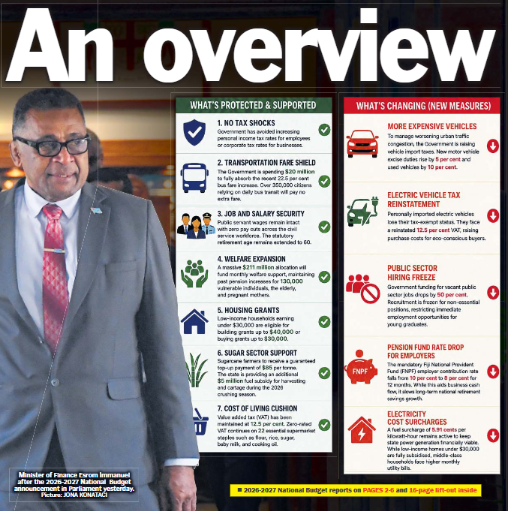
FOR now, the success of Government’s latest national budget (FY 2026-2027) theme: “A responsible budget for a sustainable future” will have to remain on the shelf as a possibility that may or may not eventuate.
Given the very volatile state of play in the current geopolitical crisis in the Middle East and the unprecedented energy crisis that it has created, coupled with the fact that this is an election budget, not to mention signs of financial strains within Fiji’s national airline – the main actor in Fiji tourism, a sector that contributes around 40 per cent of Fiji’s GDP –to have been able to draft a “responsible” budget would have been, in itself, a challenge.
To balance a very limited fiscal space, limited resources, high costs of debt servicing, essential public service delivery and growing social protection commitments against static projected revenues this year is certainly no walk in the park.
With its total net deficit of $1.045 billion out of a total revenue of $3.82billion and a total expenditure of $4.87billion, this budget sits on the nexus of “responsible” and “sustainable future” if it is able to deliver on its promises.
Mitigation
While there are efforts to mitigate as much as possible the impact of the current global energy crisis to consumers and businesses alike – such as no significant tax moves, not even a hint of the annual tendency to bump up excise duties for cigarette and alcohol despite the “very big contribution from that part of the economy”, according to Fiji Revenue and Customs Service (FRCS) chief executive officer Udit Singh, no reduction in civil service wages, fuel subsidies to Energy Fiji Ltd and other companies, continuation of subsidies to the social sector, measures to keep Fiji’s national airline afloat as the prevailing high global jet fuel price eats into its cash flow – Government is acutely aware of the challenges ahead. Setting the tone for a “sustainable future” will depend on how successful it can navigate its way forward while maintaining its mitigation strategies.
In its own words, it expects to face a significant financing challenge in the medium term and projects fiscal deficits to remain above five per cent of GDP, “equivalent to around $1 billion annually”.
“Over the past five years, a substantial portion of financing requirements has been met through highly concessional policy-based loans, with almost $2.5 billion secured from development partners, including the ADB, World Bank and Japan International Cooperation Agency (JICA),” it stated in its Medium-term fiscal strategy and 10-year fiscal framework that accompanied this budget.
“However, access to such financing is becoming increasingly constrained as development partners place greater emphasis on deeper structural, governance and public financial management reforms.
“While many of the more readily achievable reforms have already been implemented, the remaining reform agenda is more complex, politically sensitive and institutionally demanding.
“As a result, progress on several reform commitments underpinning the FY2025-2026 policy-based lending program has been significantly delayed.
“The financing challenge is further compounded by the limited capacity of the domestic market to absorb substantially higher levels of Government borrowing.
“As concessional external financing becomes less readily available, Government will increasingly need to rely on domestic sources to finance large deficits.
“However, given the already elevated level of public borrowing and limited investor appetite for additional Government debt, raising financing on sustainable terms is expected to become progressively more difficult.
“This could place upward pressure on interest rates, crowd out private sector investment, constrain economic growth and increase fiscal and refinancing risks.
“In this increasingly constrained financing environment, reducing fiscal deficits has become an economic necessity rather than a policy choice.”
$8.9billion pipeline
Enter: the private sector, the key to unlocking Fiji’s “sustainable future”. Recognising its own limitations, Government is looking to the private sector for reprieve – now more than ever.
“Given the limited scope for further fiscal stimulus, the private sector must increasingly become the primary driver of economic growth, investment and job creation,” it stated. “Government’s role should focus on creating an enabling environment for private sector activity by addressing key constraints to productivity and competitiveness, while prioritising investments in critical economic infrastructure.
“This includes improving transport connectivity through roads, ports and airports; strengthening energy security through renewable energy investments; expanding water and wastewater systems; and investing in essential social infrastructure such as hospitals, schools and housing.
“By pursuing gradual fiscal consolidation alongside targeted growth enhancing investments and structural reforms, the domestic economy can be placed on a sustainable path of growth, resilience and fiscal stability over the medium to long term.”
Fiji has an investment pipeline of $8.9billion, according to Minister Immanuel.
A total of 254 significant projects actively supported by Investment Fiji, Government’s foreign investment arm.
They span key sectors including tourism and hospitality, real estate and urban development, digital infrastructure, renewable energy, agriculture, and manufacturing.
Of these, 107 projects are currently under construction and are projected to become operational within the next three years, 95 are in advanced pre-development stages and are expected to break ground in the near term while the remaining portfolio comprises projects in planning, feasibility and approval stages.
If Government can keep its end of the bargain as it recognises the need for fiscal consolidation, right-sizing the civil service, cutting bureaucracy to improve efficiency in service delivery and cost of doing business, and achieving meaningful expenditure reform, then the private sector with its project pipeline of $8.9billion is well placed to unleash serious economic potential that will lift Fiji’s growth and help resolve multitudes of longstanding economic and social issues, ensuring that “sustainable future” promised by this year’s budget.

