
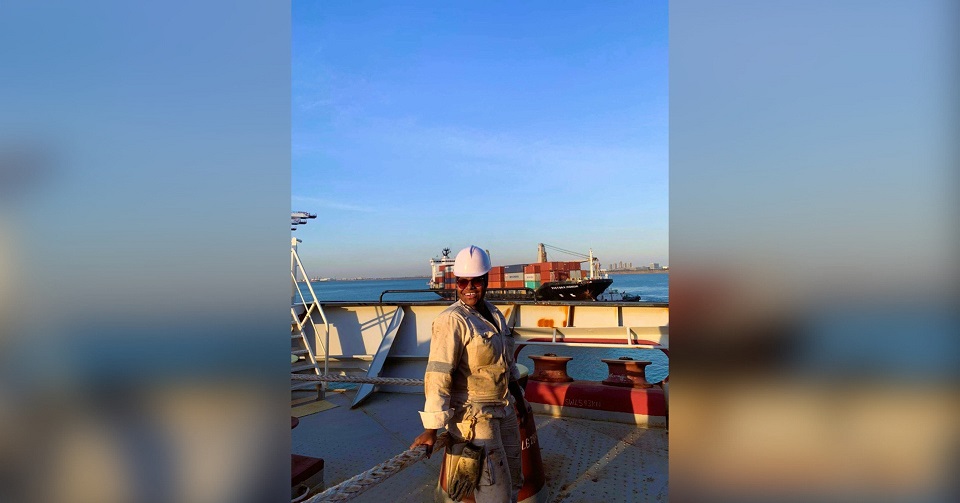
Being a seafarer involves more than just breathing unadulterated ocean breezes and seeing golden sunsets.
For the most part, it exposes one to stress, fatigue, harsh elements and isolation that may impact on one’s health.
The challenges are many, which is why it is considered a man’s world.
But women are slowly making their mark in the maritime industry, breaking through the many barriers and gender stereotypes that have dominated this profession for centuries.
Josifini Lutu is one woman who is challenging that status quo.
The 23-year-old works as a deck cadet for Swire Shipping Ltd and is the first in her family to be a seafarer.
Since she was a child, Josifini loved the outdoors and preferred hard labour over cooking and washing up in the kitchen.
Little did she realise her innocent inclination would turn out to be one of the influencing factors behind her career path
“I’ve always been a city girl,” she said.
“I hadn’t been to my village and it was through this career that I was able to set foot there.”
Josifini hails from Dravuwalu, Totoya in Lau with maternal links to Navulau, Bureta, Ovalau.
Her parents were teachers so she attended a few schools during her education journey.
In her final year in school, the former Dudley High School student attended an open day at Nabua Secondary School, where a Fiji Maritime Academy (FMA) booth manned by a Cpt Henry was set up.
“I don’t know if he meant what he said or was just trying to lure females into the maritime industry, but he said I looked like I would make a great seafarer,” she reminisced.
“I didn’t think too much about Cpt Henry’s words so when it came to writing down the three choices for FNU (Fiji National University), my first choice was mechanical aircraft engineering, then landscape architecture, and the third was nautical science.”
Funny enough Fiji Maritime called her first, she enrolled in the diploama in natutical science program and her journey as a seafarer set sail.
“So, I spent on year with Captain Cook Cruises Fiji as deck cadet before I returned to uni for my stage 3.”
Josifini was worried about finding a place to complete her practical requirements, however, luck struck when she was of the few selected by the school to work on a ship..
“They had this three-month program set for cadets ashore and the other three months on board their big vessels.
“So, in the first three months, I was basically in the workshop doing maintenance work, then I got the chance to go on day and sunset cruises.”
Working with Captain Cook allowed Josifini to travel to the Mamanucas, the Yasawas, Lau, Taveuni, Makogai and other islands.
During this time, Josifini was renting a flat in Nadi with three other cadets.
Living with peers gave her the space and independence she needed but nothing was as exciting as spending life at sea.
She said working as a seafarer helped her learn more about herself.
“I love going out by myself and I enjoy being on my own.
“So I went out to sea, being in solitude .. gave me peace.
On the vessel, Josifini was roomed with another female cadet who was an engineer so most of the time their watch hours were different.
“She would go for hers from 12 to 6 and mine would be from 6 to 12,” she said.
“So when I would go up to the bridge for the watch, it was just myself and the equipment… I was in my own world.”
Josifini vividly remembers the first time she steered a vessel.
“For vessels, you know if a person who’s steering is a first timer by looking at the wake, which is usually snaky or dodgy.
“The wake is the path formed from the waves, so its usually a snake form and that’s when you know its a first time steerer.
“For the fun of it, I wanted to see what the vessel would do if I turned the steering wheel from side to side.”
She said the crew later informed her that this simple gesture told everyone there was a newbie steering the vessel.
“I was told to steady my course. Slowly I grew fascinated by how a small thing such as steering wheel could move a big vessel and I was basing it back to the bible and how the tongue can hurt someone and so how I compared it to the steering wheel moving that big vessel.
She said she was fascinated by how the Bible related to everything here in the world.
“Being at sea posed a lot of challenges because there was a lot of lives on my hands, and I was wondering if it was low tide and there’s a shoal somewhere and I might hit it.”
After completing her sea time for Captain Cook, Josifini was also selected to join Swire Shipping Ltd for cadetship.
Josifini said this was a blessing because it gave her the opportunity to work for the company and continue her studies.
During her first six month with Swire Shipping, she visited Thailand, Taiwan, Korea and China and Pacific Island countries such as Papua New Guinea, and Vanuatu.
Through her tribulations, one thing that has stuck with her was the thought that ‘if it’s God’s will then you don’t have to worry about it’.
Looking back at her journey, Josifini can’t stop acknowledging her parents’ support in putting her on the right path.
She said they had been the driving force behind her accomplishments right from when she was child up until when she became a seafarer.
The 23-year-old shared a simple word of advice and encouragement to women and girls.
“To all women and girls who want to take up seafaring as a lifelong career, I think you just have to possess a strong faith and willpower.
“I’m 23-years-old and I have never had a boyfriend … I mean its not bad to have one but its good to have a strong willpower and head straight out for the goal you set for yourself.
“If you do not have your head set straight on your goal, then you will just be drifting and when the current comes you won’t know where you’ll end up.
“I guess it’s all about having strong determination.”

