
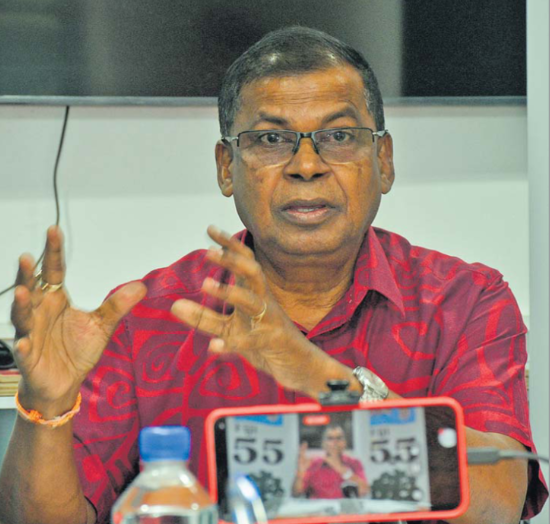
Former deputy prime minister and finance minister Biman Prasad has urged the Opposition and the public not to blame Fiji for rising prices, describing the situation as a crisis imposed on the country by global forces.
Speaking on the impact of ongoing tensions between the United States and Iran, Prof Prasad said the resulting economic pressure should not be seen as a failure of domestic policy.
“It was imposed on most of the countries that are struggling to put out policies and even communicate with the population,” he said.
“This is a crisis that is not created by Fiji or Government or some business entities or individuals. It is a crisis that is externally driven.”
He likened the situation to past global disruptions such as the 1970s oil crisis, the Global Financial Crisis, and the COVID-19 pandemic, noting their widespread economic impact.
Prof Prasad also called for political restraint, urging leaders not to exploit the situation.
“My message to everyone, including the Opposition, is not to play politics or think about elections and pick on individual events. We all knew that the prices will increase,” he said.
He added that even if hostilities were to end immediately, economic pressures would persist due to global supply chain disruptions.
“So even if the war ends tomorrow … there are a number of things that will continue to happen.”
His comments come in response to criticism from Opposition MP Jone Usamate, who described the recent fuel price surge as a betrayal of public trust.
Mr Usamate pointed to earlier assurances by Prime Minister Sitiveni Rabuka that there would be “no fuel price increase”, and by Finance Minister Esrom Immanuel that no hike would occur before May 2026.
“Yet, just two weeks later, Fijians are reeling from the largest monthly increase in our history, with petrol jumping by 49 cents and diesel skyrocketing by 75 cents,” he said.
Call for spending cuts
GOVERNMENT may need to significantly cut national spending if tensions in the Middle East continue to
escalate.
Former deputy prime minister and finance minister Professor Biman Prasad said there were several areas
where expenditure could be reduced, particularly in operational costs, as part of efforts to manage the
financial impact of a prolonged global crisis.
“The honourable Prime Minister has already, for example, said that Government travel needs to be
drastically reduced,” he said.
He noted that spending on travel, conferences, workshops and training programs could be reviewed and
scaled back to ease fiscal pressure.
Prof Prasad also suggested that some long-term capital and infrastructure projects could be delayed, especially those not directly affecting the immediate needs of households.
“These are economic infrastructure projects that are not necessarily infringing on the immediate and daily lives of households.
That could be delayed.”
He explained that such adjustments would allow the government to redirect funding toward more urgent
priorities, including support for vulnerable groups.
“There are a number of areas that one could look at and how we can rationalise expenditure.”
Prof Prasad also pointed to the potential role of international partnerships, particularly with Australia, in
helping Fiji navigate the economic challenges.
He said ongoing discussions around a security treaty could be expanded to include broader economic support, including budget assistance.
“Australia is a much bigger economy, it’s a very important partner for Fiji, Australia can also provide
additional support in terms of budget support.”
He further highlighted the importance of strengthening regional integration, including closer economic ties with New Zealand, to better withstand external shocks. Prof Prasad said the current situation presented an opportunity for Fiji and its partners to deepen cooperation, particularly in light of the anticipated mediumterm impacts of the global fuel crisis.
“We could derive a lot of support from Australia in terms of budget support for us to redirect some of those expenditures to appropriate areas.”

