
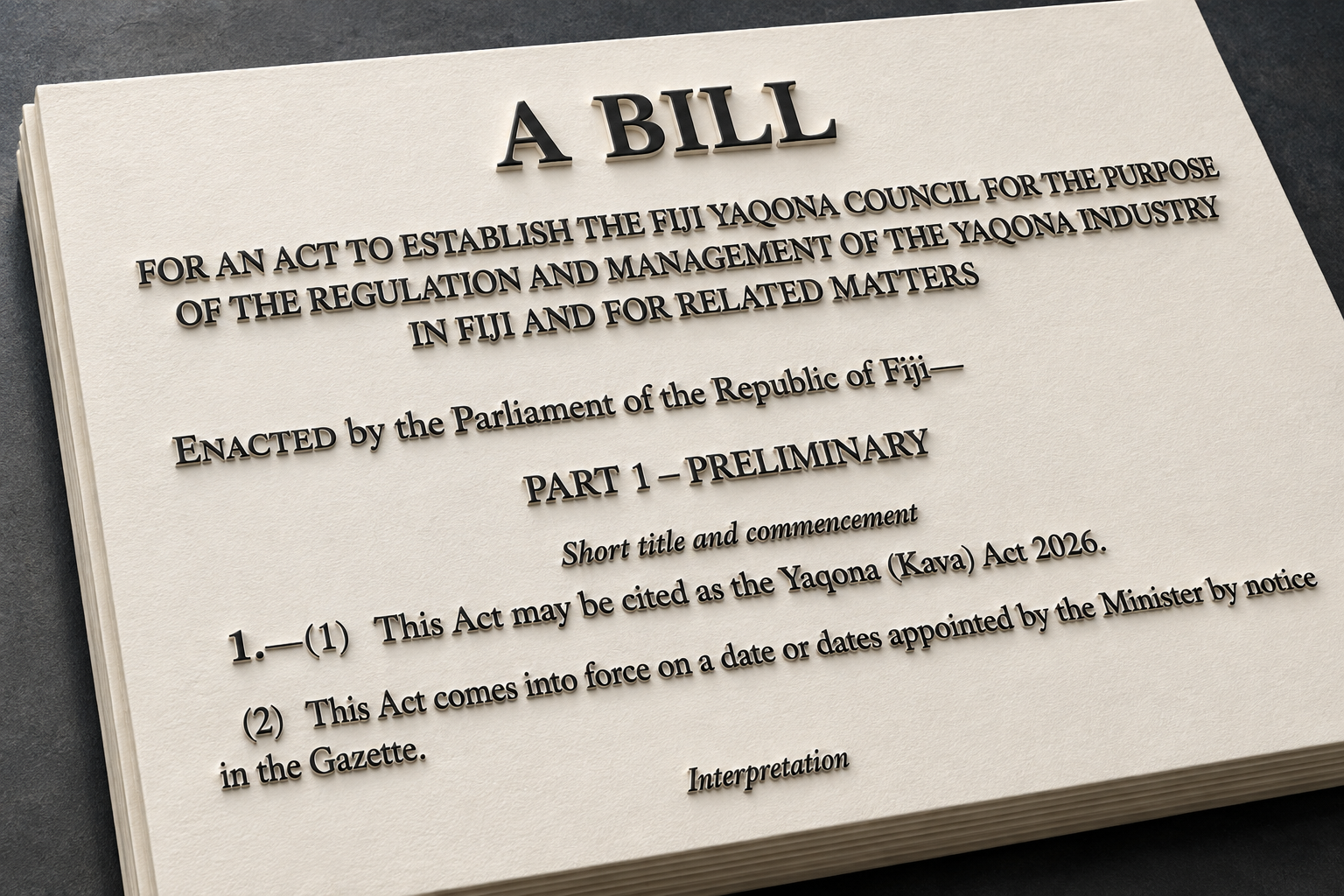
A 16-member Fiji Yaqona Council comprising government and private sector representatives would be established under the Yaqona (Kava) Bill 2026 tabled in Parliament yesterday.
The proposed legislation establishes the Fiji Yaqona Council as a corporate body with powers to oversee its affairs, own and dispose of property, enter into contracts, appoint agents and engage consultants.
Under the Bill, the Council would consist of eight ex-officio government members and eight representatives from the private sector, all appointed by the Minister.
The Permanent Secretary would serve as chairperson of the Council.
Other government representatives would include officials responsible for commerce, health, rural and maritime development, foreign affairs and iTaukei affairs.
The Chief Executive Officer of the Biosecurity Authority of Fiji, or a representative, would also sit on the Council.
Private sector representation would comprise four members nominated by the Yaqona Working Group and four additional yaqona operators.
The relevant sectors or bodies would nominate their representatives, with the Minister appointing members from among those nominated.
Private sector members would be appointed for terms of up to three years and would be eligible for reappointment.
However, they would not be permitted to serve for more than six consecutive years.
Ex-officio members would remain on the Council for as long as they held the government position through which they were appointed.
Members would also be able to resign by providing the Minister with at least 30 days’ written notice.
The proposed Council would have the legal capacity to sue and be sued, purchase and hold property, sell or lease property and enter into contracts.
It would also be able to appoint agents and attorneys, engage consultants and set charges and other terms for services and facilities it provides.
The Council would have its own common seal, with documents requiring the seal to be signed by the Chief Executive or another duly authorised person.
The establishment of the Council forms part of the broader regulatory framework proposed under the Yaqona (Kava) Bill 2026.

