
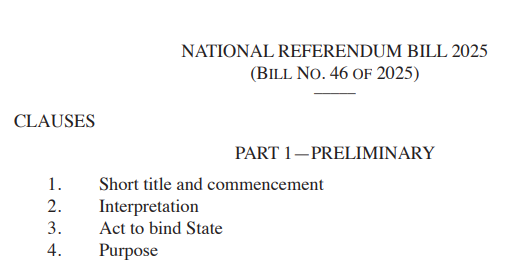
The Referendum Bill 2025 sets out the legal framework for when a national referendum may be held, who is eligible to vote, and how the process will be conducted, including confirming that polling day must be a public holiday.
Under the proposed law, a referendum may take place in two circumstances.
First, when a Bill to amend the Constitution has passed through Parliament in accordance with section 160 of the Constitution.
Second, when Parliament passes a resolution declaring a particular issue to be of sufficient national importance to require the direct views of voters.
Once either condition is met, the President must refer the matter to the Electoral Commission, acting on notification from the Speaker of Parliament.
The bill states that any person registered in the National Register of Voters is entitled to participate. Voters may cast only one vote, and anyone who attempts to vote more than once commits an offence.
The National Register of Voters is declared to be conclusive evidence of a person’s eligibility to vote in a referendum.
In terms of administration, the bill requires the Supervisor of Elections to adopt existing electoral and voting procedures from the Electoral Act 2014 for conducting a referendum.
Existing polling venues and polling station locations will also be used, although the Supervisor may create additional stations where necessary.
The Supervisor must also publish a notice in the Gazette at least five days before polling, listing the polling stations, referendum questions, and the symbols to be used on the ballot paper.
One of the key provisions in the bill is that referendum polling day will be a public holiday, ensuring voters have full access and opportunity to participate.

