
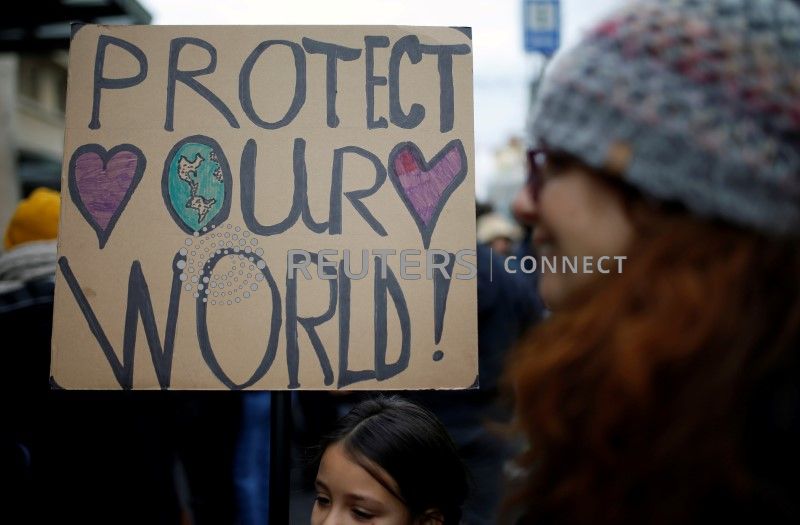
Many foreign leaders heralded resurgent U.S. interest in climate change after four years of backpedaling by former president Donald Trump. Intended as a prelude to a major United Nations climate conference in Scotland this November, the summit saw countries put forward fresh climate pledges as part of a push to reach global carbon neutrality by mid-century.
This isn’t the first time the United States — the world’s second-largest greenhouse gas emitter — has tried to catalyze global efforts to fight climate change. “Without the U.S. I think it’s hard to imagine a climate regime succeeding,” said Daniel Bodansky, an international law professor and climate change expert at Arizona State University. But Biden had to contend with an awkward backdrop: While the United States has often played a key role in driving international action on the issue , its record on implementing climate agreements is lackluster, and subject to the shifting impulses of a divided electorate.
The Framework Convention and the Kyoto Protocol
In 1992, the United States and more than 150 other countries signed the U.N. Framework Convention on Climate Change in Rio de Janeiro, promising to return emissions to 1990 levels by 2000. That goal remains unmet.
Five years later, diplomats and dignitaries convened in Kyoto, Japan, to hash out the details of what would become the Kyoto Protocol, an international treaty based on the U.N. framework that committed countries to reducing greenhouse gas emissions.
Addressing world leaders gathered in Kyoto, then-Vice President Al Gore urged them to “take responsibility” and promised the U.S. “remains firmly committed to a strong, binding target” for reducing emissions.
Recognizing that developed countries bore the brunt of responsibility for global warming, the agreement committed three dozen industrialized countries and economies in transition — plus the European Union — to legally binding emissions-reduction pledges.
These countries agreed to either cut back their own greenhouse gas emissions or reduce the global carbon footprint, by funding green development projects elsewhere, for example. Altogether, the targets added up to an average 5 percent emissions cut from 2008 to 2012 compared with 1990 levels, according to the U.N. The accord also established an adaptation fund for developing countries to mitigate the effects of climate change.
But the final agreement didn’t oblige developing countries to reduce emissions. The U.S. signed the accord, but the Senate — which had to ratify it — signaled it would be dead on arrival, so the Clinton administration never submitted it.
During his first presidential campaign, George W. Bush told voters the Kyoto Protocol would “affect our economy in a negative way”; shortly after his inauguration, he formally withdrew the United States.

