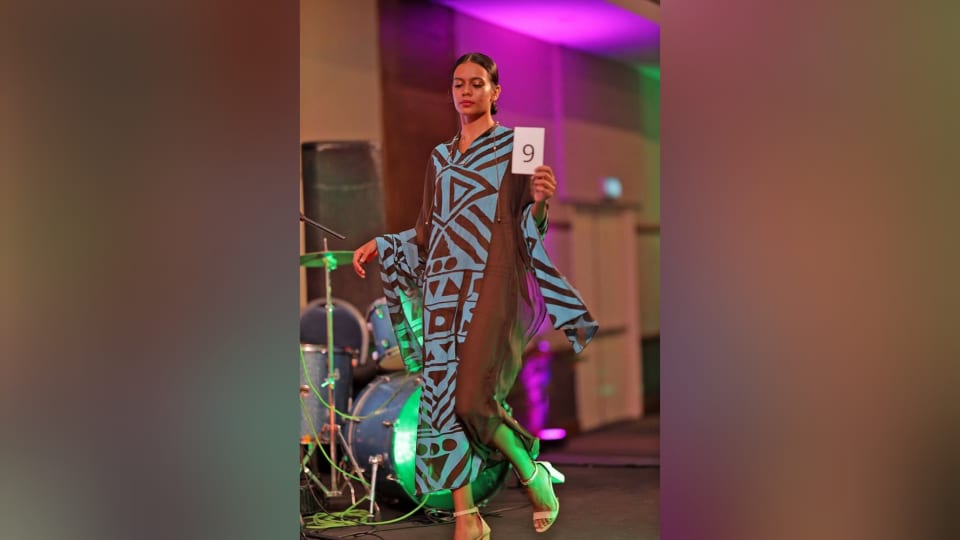
While the glitz and glamour are the hallmarks of the “premier event of the Pacific”, a title that Fiji Fashion Week (FJFW) has earned in its 15 years, the event’s real agenda often remains unseen.
Sustain our culture, make our future and celebrate it are clues that FJFW x Palmolive organiser Fashion Week Ltd (FWL) has made its mantra because “it perfectly describes the purpose of organisations like Fiji Fashion Week”.
“Yes, of course we love fashion, but we do what we do to ensure that our unique Fijian cultural heritage is preserved and sustained for the benefit of our culture, our people and the planet,” FWL managing director Ellen Whippy-Knight said.
“My team and I are driven by this purpose and I thank them for their hard work, commitment and determination for Fiji Fashion Week to succeed. They are the brains, brawn and strength of the organisation and I am ever grateful to be joined by such a dynamic, talented and energetic team who bring the vision of Fiji Fashion Week to life year after year.”
While the runways attract fashion enthusiasts, buyers and content creators, what FJFW hopes is that people will travel into the living rooms and backrooms of fashion boutiques designers’ homes.
“We go beyond simply presenting a runway show. We help to create livelihoods and opportunities for designers to succeed and that is a synergy shared by our biggest supporter and official partner, Palmolive.”
FJFW has partnered outside of the fashion community with corporates and the travel industry to innovate past the difficulties of the pandemic in order to continue to provide Fijian fashion designers with a market.
“We ran a virtual show at the peak of the pandemic where the fashion channel on YouTube blasted our show to millions of fashionistas around the world giving our designers much needed exposure and showing the beauty of this country we call home. $200,000 worth of orders came in from this single event,” she said.
FJFW has taken designers to Australian Fashion Week and Los Angeles Fashion Week and has given several local designers global appeal and recognition.
In partnership with the Australia’s development sector and diplomatic presence in Fiji, FJFW has advocated and lobbied for support for designer education and training.
Most designers who show at FJFW have since attained formal Australian qualifications either by studying there or the Australian Pacific Technical College (APTC) in Fiji.
“Our goal is to always create opportunities for designers, models, show production, photographers and other creatives in our industry and as our friends and sponsors now know, it goes well beyond the runway and camera.”
In its 15th anniversary, that direction has gone even further into Australia and New Zealand.
With the strategic support of Tourism Fiji, Fiji Airways, the Grand Pacific Hotel and the New Zealand (NZ) High Commission in Fiji, high value fashion guests will seat in the front row on May 27 and 28 at Laucala, Suva.
NZ High Commissioner to Fiji Charlotte Darlow described the characteristics of the New Zealand fashion industry that made it the right partner for post-pandemic fashion development in Fiji.
“The New Zealand fashion industry is innovative, adaptable and conscious. Fashion is a young industry with 13 per cent of businesses established after 2000. Small to medium sized businesses abound, this in contrast to the global fashion industry that is dominated by large fashion houses,” Ms Darlow said.
The high commissioner said most of the development work being conducted in Fijian fashion has focused on technical design skills too.
The commonalities between the two countries extend also into the value local societies place on tradition and culture which often become the main inspiration for fashion designers.
That same foundation has created a strong affinity towards the natural environment and by extension sustainable fashion.
“The NZ fashion industry has launched a new textile waste circularity scheme which aims to address climate change, improve how clothes are managed at end-of-use and reduce the 220,000 tons of textile waste that ends up in landfi ll each year,” Ms Darlow said.
She said COVID-19 had given NZ fashion designers the opportunity to re-design the industry’s value which had led to increased focus on championing local labels and local production and sustainability of the industry.
“During lockdowns we have seen NZ brands respond with manaakitanga and compassion,” Ms Darlow said.
FJFW has this year launched its own concerted effort to streamline sustainability into its work from events production through to designer development.
FJFW believes that love and care for the environment is intrinsic to Pacific designer lifestyle.
“These partnerships with top NZ fashion designers of Maori origin and fashion media who promote this work are critical to the way we chart Fiji Fashion design development into the future,” Ms Whippy-Knight said.
“The NZHC has extended a hand of friendship to Fijian designers by providing FJFW with funding to bring two of their best Maori designers and fashion sustainability advocates Kiri Nathan and Dr Bobby Luke, along with Dan Ahwa, the fashion editor of The New Zealand Herald’s VIVA Magazine and stunning Maori model Tia Woods.”
The NZ contingent to FJFW x Palmolive will conduct workshops where they share their skills and experience as part of their attendance between May 21 and 28.
- Lice Movono is a freelance journalist and independent public relations adviser