
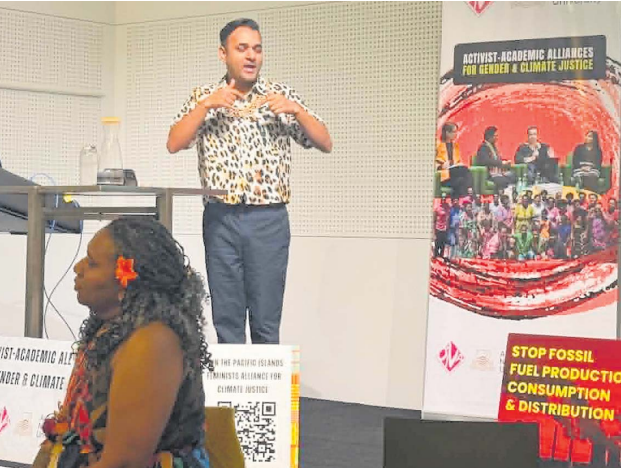
In a room driven by data, dashboards and tight deadlines, Krishneer Sen cut through with a simple but powerful reminder: people cannot be reduced to percentages.
At the “Building an Activist-Academic Alliance for Gender and Climate Justice: Transdisciplinary, Feminist and Urgent” session at the Women Deliver Conference 2026 in Melbourne, disability rights advocate Krishneer Sen of the Disability Pride Hub delivered a message that challenged the very way development work is done – who it serves, who controls it, and who gets left behind.
His words cut through the technical language of policy spaces and funding proposals, grounding the conversation in lived experience.
“People ask us for percentages and data, but they must dig deeper to see our stories – the inequalities behind the numbers,” Mr Sen, who is hearing-impaired, said.
It was not a rejection of data. It was a demand for depth.
The speed of funding, the slow violence of exclusion
Mr Sen pointed to a recurring tension in global development work: the pressure to deliver quickly.
Funders, he noted, often arrive with deadlines, targets, and pre-determined outcomes. But communities, especially deaf and disabled communities do not operate at the speed of project cycles.
“For us as deaf people, if you want to book a meeting, give us time.
“We need to find a good interpreter. We need to prepare. We want to participate properly.”
What sounds like a logistical detail is, in reality, a question of dignity. When time is compressed, inclusion becomes performative rather than meaningful. Meetings happen, reports are written, boxes are ticked but participation is shallow.
Mr Sen’s intervention reframed this as a structural problem: urgency without accessibility produces exclusion.
Inclusion is not influence: the warning against tokenism
One of the most striking parts of his intervention was his distinction between inclusion and influence.
“Inclusion, without influence, is tokenism.”
In many projects, communities are invited to “participate,” but not to shape decisions. They are photographed, quoted, and acknowledged but rarely empowered to change direction.
Mr Sen described how this often plays out in research and advocacy spaces.
Outsiders arrive with pre-set presentations, seeking information that confirms their own frameworks. Communities are expected to respond, but not to define the agenda.
The result is what he called “extractive research, studies that collect stories, data, and lived experience, but give little or nothing back to the communities they are drawn from.
The question he posed was simple but confronting: What do communities actually gain?
The quiet burden of representation
Mr Sen also spoke about the emotional and political weight carried by disabled and LGBTIQ+ leaders in Pacific spaces.
“These identities are not separate.
“They are part of who I am.”
For many activists, intersectionality is not an academic theory – it is daily life. It is navigating disability, gender, culture, and sexuality simultaneously, while also being expected to represent entire communities in high-level forums.
He described a growing burnout among Pacific disabled leaders: the emotional labour of constantly educating, translating, and advocating in systems that still treat accessibility as an afterthought.
There is also a persistent imbalance of power. International actors often hold funding and control, while local communities hold knowledge but not always authority.
Accessibility is not optional – it is infrastructure
A central theme of Mr Sen’s address was accessibility, not as an add-on, but as core infrastructure.
He highlighted the often-overlooked costs of inclusion: sign language interpreters, accessible communication formats, time for preparation, and culturally appropriate engagement methods. These are frequently excluded from budgets or treated as “extra expenses.”
But for deaf and disabled communities, they are not optional.
“They must be included in project design from the beginning. Not added later.”
This, he argued, is where many well-meaning projects fail – not in intention, but in planning.
Allies versus accomplices
Perhaps the most powerful framing his statement was the distinction between allies and accomplices.
Allies, he explained, support in principle but often remain within safe boundaries. They agree with inclusion but may avoid challenging systems that exclude.
Accomplices, however, take action.
“They use privilege to shift power, challenge structures, and stand with affected communities even when it is uncomfortable or risky.
“It is a distinction that shifts responsibility. Support is not enough; participation in change requires active commitment.”
From extractive engagement to shared ownership
Mr Sen called for a fundamental shift in how research and advocacy are conducted: from extractive engagement to shared ownership.
Too often, he said, communities are consulted, studied, and documented—but not meaningfully involved in outcomes. Reports are produced, but benefits rarely flow back.
Instead, he advocated for long-term relationships, resource redistribution, and accountability to communities, not just to funders or institutions.
“We need consistency. Not one-off engagement.”
Moving from awareness to action
The closing of her message was not a critique alone, but a roadmap.
Sen called for:
Resource redistribution that reflects real costs of inclusion
Policy change grounded in lived experience
Accountability mechanisms tied to communities, not just institutions
Investment in political education and intersectional understanding
A shift away from performative engagement toward long-term solidarity
Most importantly, he urged a rethinking of power itself.
“Don’t let society control you.
“But meet each other at the centre.”
A different measure of success
In a conference dominated by urgency – climate deadlines, funding cycles, policy targets Krishneer Sen’s intervention offered a different metric.
Not speed. Not scale. Not even statistics. But care. Consent. Accessibility. And shared power.
His message was clear: if gender and climate justice are to mean anything, they must be built with those most affected, not as subjects of research or targets of policy, but as equal architects of change.
And that requires something many systems still struggle with: slowing down enough to listen properly, and restructuring power so that listening leads to action.
n Cheeriann Wilson is a communications consultant. She is attending the Women Deliver 2026 Conference in Melbourne as a scholarship awardee.

