Fiji’s narrowed civic space
While Fiji’s civic space is ‘relatively positive’ compared to other countries in the Asia Pacific region, concerns remain about the continued existence of restrictive laws like the sedition provisions in the Crimes Act, Public Order (Amendment) Act 2014, which are inconsistent with international human rights law and standards, as well as the Online Safety Act which could facilitate digital repression and further lead to an atmosphere of censorship which could be used to criminalise legitimate speech.
This was the general observation of the global civil society alliance, CIVICUS, in its latest report released this week titled ‘People Power Under Attack’.
It highlighted censorship, the targeting of journalists, the detention of protesters and the use of restrictive laws to prosecute activists, as among the broader trends across the Asia Pacific region.
Fiji’s civic space
CIVICUS had rated Fiji’s civic space status as ‘narrowed’ highlighting the fact that despite our peaceful transition of government in 2022, restrictive laws which have existed that have created a chilling effect for those who want to exercise their civic freedoms, continue to restrict the right to peaceful assembly.
Serious concerns also revolve around the fact that there is lack of protection for human rights defenders, as well as the absence of a comprehensive freedom of information law.
The report specifically noted the contradiction that while freedom of association is generally respected in Fiji, whereby civil society organisations (CSOs) can register and operate, the existence of restrictive laws limit their ability to speak up and mobilise.
Strengthening freedom of association
In order to strengthen and protect freedom of association, CIVICUS is calling on the government to review or repeal all laws that are inconsistent with Fiji’s obligations under the International Covenant on Civil and Political Rights especially the sedition provisions and Public Order (Amendment) Act 2014, repeal Article 115 of the 2014 Electoral Act that effectively bars CSOs from engaging in broadly defined election-related activities and take effective steps to protect human rights defenders and journalists.
The sedition provisions
The sedition provisions in the Crimes Act of 2009 have been highlighted as problematic, given that these laws have been used in the past to target media outlets, lawyers and opposition politicians.
While the law has not been used by the current government led by Prime Minister Sitiveni Rabuka, it still creates a chilling effect and poses a risk for human rights defenders, journalists, and others who may be critical of the government.
The Public Order (Amendment) Act 2014
In relation to the Public Order (Amendment) Act of 2014, the government can refuse permits for any public meeting or march deemed to prejudice the maintenance of peace or good order.
Thich is inconsistent with international human rights law and standards which only requires for protest organisers to notify the police and not seek permission to exercise their right to peaceful assembly.
It has been often misused by the authorities to restrict or block peaceful gatherings and demonstrations in the past.
Recent examples of permit refusals under the Act cited by CIVICUS are the denial of Palestine solidarity marches on several occasions, including one organised by students in November 2023 and one organised by the NGO Coalition on Human Rights in Fiji in October 2024.
In August 2023, police denied a permit for a march to call for the repeal of the 2013 constitution, organised by lawyer and former parliamentarian, Niko Nawaikula through his group Stand With Niko (SWN) Advocacy, on grounds of national security concerns.
Activists and protesters faced restrictions in holding a march in Suva, to mark the conclusion of the 16 Days of Activism against Gener-based Violence on International Human Rights Day, December 10, 2024.
A permit for the match was only granted following the intervention of Minister Lynda Tabuya. Additionally, police removed people carrying banners or wearing shirts in support of the people in Palestine, Kanaky/New Caledonia and West Papua.
UN position
CIVICUS stated that the UN has called for the repeal of restrictive provisions that hinder the right to peaceful assembly including the requirement for a police permit for protests, the government must instead review the law to only require protesters to notify the police of a protest and take steps to facilitate such a protest.
Any restrictions of protests however must meet the three-part test of legality, legitimate aim, proportionality and necessity.
Risks faced by activists
The report highlighted concerns about the safety and inclusion of women human rights defenders and the urgent risks they face.
These activists, as well as journalists face various risks in Fiji in undertaking their work, as noted by the UN they face criminalisation because of the existence of restrictive laws.
They also often face technology-facilitated gender-based violence, including cyberbullying, and further exacerbating the issue, is the absence of women in designing, implementing, and monitoring laws, policies, and budgets for the advancement of women and gender equality.
The Online Safety Act
Drawing attention to the Online Safety Act that was passed by parliament in 2018, CIVICUS explained that the concerns around it stems from the atmosphere of censorship it has created and how it could be misused to criminalise legitimate speech.
The offence in Section 24 of ‘causing harm by electronic communication’ is vague, subjective, and overly broad. It risks criminalising legitimate political criticism, satire or commentary.
This creates a chilling effect where people begin to self-censor out of fear. CSOs have raised strong concerns about the law, including its lack of guiding principles to define and determine the scope of powers and the discretion of the Online Safety Commission when receiving assessing and investigating complaints.
The Information Act
In-terms of the Information Act which was also promulgated by parliament in 2018, the fact that it has never been operationalised has a tremendous negative impact on freedom of information.
CIVICUS highlighted that without an effective piece of legislation, citizens and civil society in particular are not able to obtain information about government projects and activities.
Journalists are also not able to seek information to report effectively on national and local issues.
This clearly has an impact on transparency and holding the government to account. It is imperative that the government, immediately consider passing, in the next session of parliament, an effective freedom of information law and ensure it meets international standards.
Proposed reforms
In-order to allow for Fiji’s gradual transition from a ‘narrowed’ to ‘open’ civic space, CIVICUS has outlined three major reforms to be implemented. Firstly, the government must repeal all laws to ensure the legislation is consistent with the ICCPR and other international law and standards in the area of the right to freedom of expression, peaceful assembly and association.
Secondly, it must ensure human rights defenders and journalists are able to carry out freely their activities without fear of reprisals or undue hindrance, obstruction, or harassment of themselves or their families.
Lastly, it must, at the earliest, pass legislation on freedom of information and ensure such laws meet the highest standards and ethics.
These three significant actions will not only ensure greater levels of transparency and accountability from those in power but also facilitate broader and genuine participation of our citizens in all levels of society, harnessing their talents and collective wisdom for the benefit of all.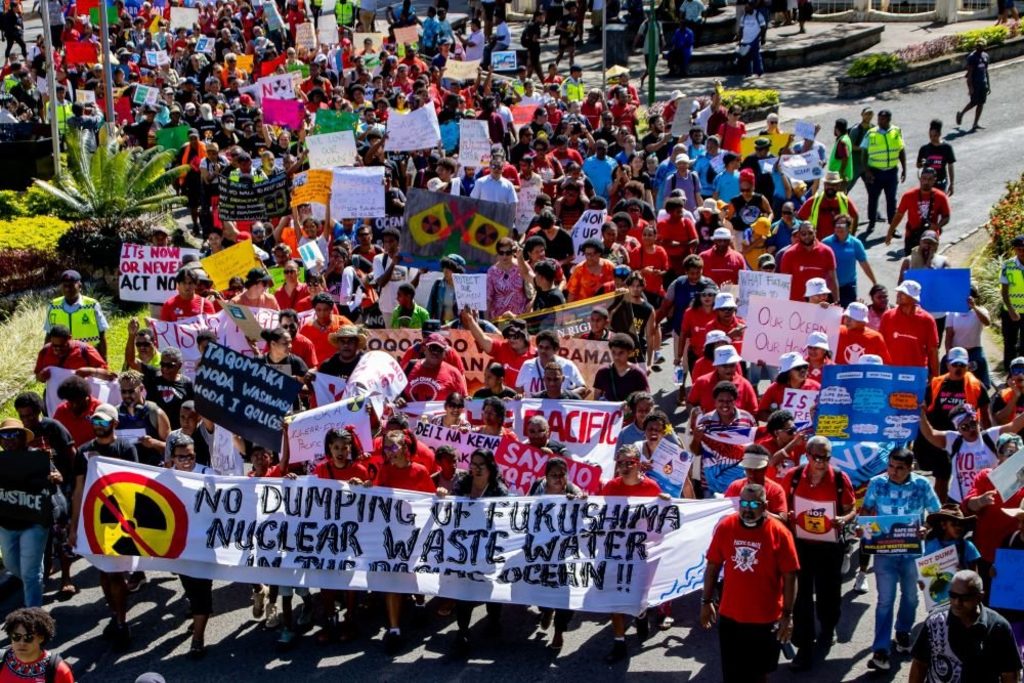
The freedom of assembly must be respected by the state, according to CIVICUS. Picture: SUPPLIED