
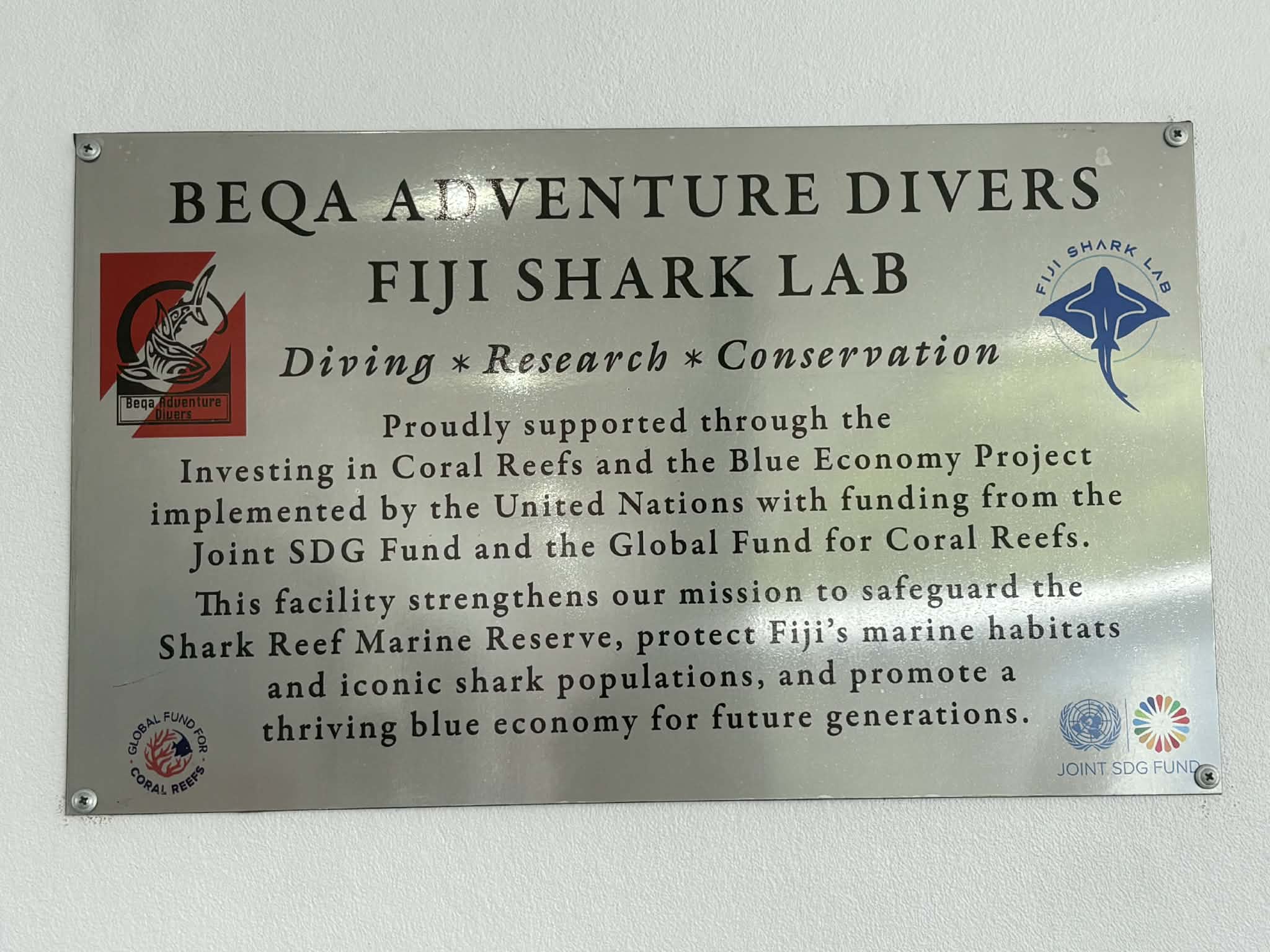
FIJI has taken a bold step in marine conversation with the opening of the Beqa Adventure Divers (BAD) Dive, Research and Conservation Compound, a facility designed to merge tourism, scientific research, and community engagement.
The compound also houses the Fiji Shark Lab, the nation’s first biological field station focused on shark and ray research, conservation, and education.
It was established with support from the Investing in Coral Reefs and the Blue Economy (ICRBE) Project, implemented by the UN Development Programme (UNDP) in collaboration with the UN Capital Development Fund (UNCDF) and UN Environment Programme (UNEP). Through financing support from the Global Fund for Coral Reefs and the Joint SDG Fund, UNCDF deployed concessional loans in the sum of $720,000 as part of its blended-finance architecture aimed at unlocking sustainable and inclusive investment.
Beqa Adventure Divers principal director Mike Neumann said the goal was to recover and thrive in the long-term, underscoring the facility’s role in fostering both environmental sustainability and community resilience.
UNDP resident coordinator Dirk Wagener said the occasion marked more than the opening of a facility.
“We gather not only to unveil a plaque, but to acknowledge a powerful idea, that safeguarding the ocean — our shared inheritance — requires collaboration, innovation, and a willingness to think beyond traditional boundaries,” he said.
“What makes today’s celebration meaningful is not only the result, but the approach: locally driven, scientifically grounded, community-connected, and enabled by catalytic financing.”
The compound forms part of the broader Integrated Coastal Resilience and Blue Economy (ICRBE) Project, which supports multiple initiatives across Fiji’s blue economy sector.
These include the creation of the country’s first dedicated blue lending facility with the Fiji Development Bank and the conversion of western division dump sites into sustainable waste collection centres to reduce land-based marine pollution.
By combining research, tourism, and community involvement, the BAD facility serves as a practical example of how Fiji is positioning itself as a global leader in sustainable ocean governance.
Its establishment demonstrates that environmental protection, economic opportunity, and social development can be achieved together through partnership driven investments.
Mr Wagener said the event should be seen not as the end of a project, but as the beginning of a stronger, more coordinated effort to protect Fiji’s ocean spaces.

