
How often do you hear 12-year-olds today pause and wonder about the serenades that make a movie truly cinematic?
Music is such an integral part of any film, that to separate it from storytelling feels almost unnatural, much like trying to imagine our daily lives without it.
And if there is one industry that has mastered the art of weaving narrative and melody into a single thread, its Bollywood.
For many Fijians who grew up in the early 2000s, this connection is deeply familiar.
It lives in memories of watching the classics with parents or grandparents, glancing sideways only to find tears quietly streaming down their faces or the occasional flying sasa broom at Savita Tai while watching Pavitra Rishta.
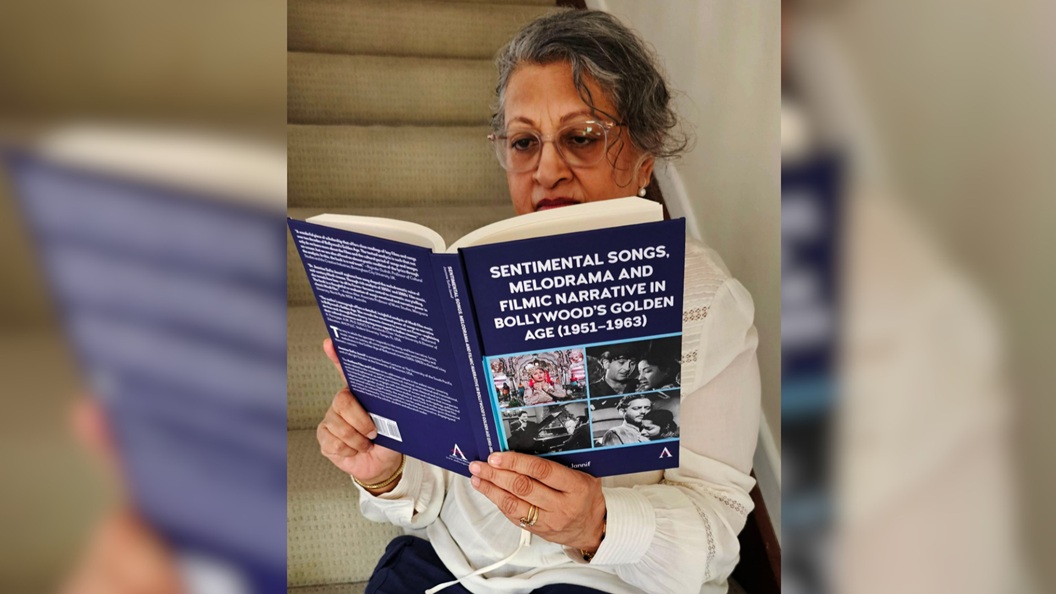
Exploring this emotional and cultural phenomenon on a deeper level is Fijian academic and educator Dr Jasmine Sofia Jannif Dean, whose recently published book “Sentimental songs, melodrama and filmic narrative in Bollywood’s Golden Age (1951–1963)” examines the powerful role of music in shaping cinematic storytelling.
But behind the academic rigour lies something far more personal, a story rooted in family, memory, and a lifelong love affair with song.
A life shaped by music and education
Starting as a high school teacher in the early 1970s, she would go on to build a distinguished career at the University of the South Pacific, serving from 1975 to 2004 as a lecturer, later rising to senior lecturer and head of department.
Her academic path is equally impressive, holding a Diploma in Teaching from Sydney Teachers’ College, a Master of Science from the University of Wisconsin, and a PhD from Macquarie University.
In 1993, she was also awarded a Fulbright Scholarship at the University of Wisconsin–Stout.
Yet, despite her formal training in education and later computer-aided design, her heart had always belonged elsewhere.
For Ms Jannif, music was never just entertainment.
“A journey which began at a very early age within the comfort zone of an affectionate and a music-loving family,” she said.
“My initiation to black and white Hindi films was through film songs and not through films themselves.
“My late maternal grandfather was a ghazal and qawwali singer in his own right as well as an accomplished harmonium player for which he had no formal training.”
She also recalled her mother, who according to Dr Jannif had a melodious voice and later learned the accordion and a household where music was ever-present, even if none of the children inherited those same talents.
At the centre of it all was her father, Ben Mohammed Jannif, a man she describes as a Bollywood fanatic, a music enthusiast, and a “bathroom singer.”
“He would say, ‘I will eat two meals a day, but I will make sure I educate my children,” she recalls.
A hardworking small businessman, he laboured late into the night to support his six children, ensuring each one received an overseas education. But alongside discipline and sacrifice, he passed on something else, an enduring love for music.
“I once asked him why music played such a huge part in his life.”
His reply stayed with her: “Beta, imagine a world without music and songs. Life would be unimaginably bland and lonely”.
At 12 years old, she admits, she did not fully understand. But she never forgot.
Sundays, records, and rituals
Dr Jannif said their home was a sanctuary of sound.
Her father owned 76 rpm records, fragile discs made of shellac, each carefully stored in labelled folders inside a custom-built wooden cabinet.
On top sat a record player, delicately covered with a white crochet doily. Every Sunday became ritual.
From 10am to 5pm, Dr Jannif would play records while her father worked, 10 songs at a time, then flipping them over to continue. She was given complete freedom to choose the music.
“As a family, we were constantly surrounded by songs. With this background, it is not surprising that I developed a kind of curiosity towards film songs.
“My late dad was a small businessman at that time who on Sundays would do his bookkeeping as well as photo restoration manually. There were no computers or photo shops at that time.
“For me, it was a joyous honour to play records for dad every Sunday while he worked.”
Even outside the home, music followed her. Twice a week, she said she would tuck a transistor radio beside her bed to listen to Bhoole Bhikre Nagma, a late-night radio program dedicated to forgotten songs of yesteryears.
“I would absolutely immerse myself in these songs, the lyrics, the music, all of it.”
Questions that led to a lifelong pursuit
Naturally, as the years passed curiosity began to take hold.
What role did these songs play in films? How did they shape narrative? What emotions were they meant to evoke?
These questions lingered as she left Fiji in 1966 to study abroad, spending two years in Auckland and four in Sydney.
“For the first three years I had no connection with songs.
“For the second half of my studies, my late Aunty Saira gifted me a tape recorder player and she would every now and again post a recorded tape for me.
“On my return to Fiji, I found out that she had paid a lot of money to get those songs recorded by one Shiu Sound System.
“Following my return in 1972, I would frequent the movie theatres with my dad to see the latest releases but sadly after so many years of being away, I could not relate to the latest songs.
“In my opinion they lacked the emotional connection. They just didn’t match up to the songs I had grown up with.”
However, In 1979, everything changed. Her father purchased one of the first VHS players imported into Fiji.
Suddenly, a new world opened up. Each weeknight, they would watch one or two black-and-white films together — borrowed from a local video library.
Films such as Shabaab, Baiju Bawra, and Albela became more than entertainment, they were answers.
“I realised then what dad was trying to explain.”
She said music was not just sound but a fundamental tool for human connection and emotional expression.
Passion to scholarship
Despite her deep personal connection, Dr Jannif never formally trained as a film scholar.
It wasn’t until early retirement that she pursued a doctorate, supported by an Australian Postgraduate Scholarship.
Under the guidance of ethnomusicologist Professor Andrew Alter, she began examining Bollywood cinema through an academic lens.
“If his was an intellectual engagement, mine was different.
“It was personal.”
Her research focused on Bollywood’s Golden Age (1951–1963), a period shaped by post-partition trauma and disillusionment.
Through this lens, she discovered something striking.
Dr Jannif said songs were not just decorative, they were central to storytelling. They carried emotional weight, advancing plot and deepening narrative They gave voice to collective grief, longing, and social realities
In fact, her research found that 42 per cent of songs from this era were dominated by the rasa of mourning (karuna).
“These songs told human stories.”
Her work highlights how songs function as both emotional and narrative devices.
In films like Mughal-e-Azam, nearly 25 per cent of the runtime, 49.02 minutes, is dedicated to songs. These sequences are not interruptions, but essential storytelling tools.
As legendary filmmaker Raj Kapoor once said: “If you miss a song, you have missed an important link between one part of the narration and the next”.
Different filmmakers approached this differently, Guru Dutt with quiet intensity, Raj Kapoor with theatrical flair but the purpose remained the same.
Songs connected the audience to the story in ways dialogue alone could not.
Homage in a book
Dr Jannif’s book is more than academic analysis.
It is a tribute. To her father, who first introduced her to the world of Bollywood. To her family, who filled her childhood with music. And to the enduring power of song itself.
“I realised that a world without songs would be emotionally barren.”
Through her work, she reminds us that music is not just an accessory to life, it is its heartbeat. And perhaps, the next time a 12-year-old pauses to wonder about the power of a song in a film, they are already beginning a journey much like hers.
For those who want to purchase a copy of her book you can find it on Amazon or email her at sofiajannif@gmail.com

