
Sunday trading was a rare activity back in the early ’90s as many people, particularly Christians, considered it a day of rest.
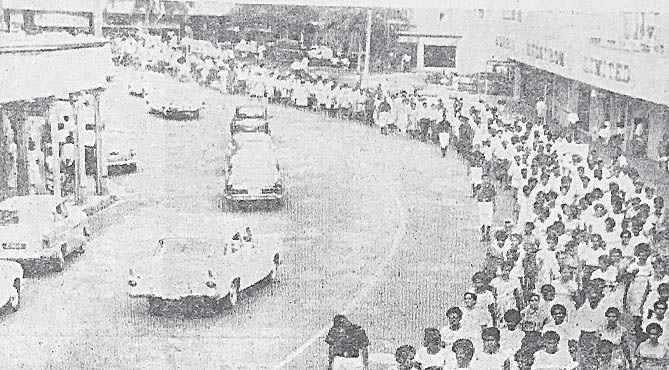
When the idea for Sunday trading was made known, a lot of people showed their distaste through a protest march in the Capital City of Suva.
The protest march against Sunday trading was organised on December 9, 1965 and had more than 4000 people marching through Suva.
The march, in particular, had a strong Methodist representation.
The event route was from Rodwell Rd straight to the main gates of Government House.
The Fiji Times article on December 10, 1965 reported that the march was organised by the Fijian Advancement Party.
According to the article, at the Government House gates the acting secretary, Meli S Baleilakeba, handed a two-page petition to the police guard commander to be submitted to the Governor, Sir Derek Jakeway.
When the march began, only about 2000 people were taking part but then the number soon began to build up when the procession moved through the city, the article reported.
After the petition was handed over, Mr Baleilakeba invited the Rev Setareki Nasilivata and Kameli Cerelala, of Suva to lead a short prayer for the marchers.
A detachment of policemen under two officers controlled the traffic during the day and watched the procession.
The Fijian Advancement Party protesting strongly to Sunday trading, stated in the petition that Section 9 of the Regulation of Hours and Employment which gave power to the local authority to determine shop hours, especially on Sundays, should be deleted.
The article reported that the reason given was because Sunday trading would involve many Fijian people, as well as many thousands of other races who were Christians.
The petition stated the party recommended that the power to determine shop hours on Sundays should be left solely in the hands of the Legislative Council.
Among the many spectators at the end of the march was the secretary for Fijian Affairs and Local Government, Ratu Penaia Ganilau, his wife, Adi Laisa, and Adi Lala, wife of the member for Natural Resources, Ratu Kamisese Mara.
According to a later article published on Saturday December 11, members of the Standing Committee of the Methodist Church of Fiji recognised that Fiji held people of different creeds, many of whom did not recognise as sacred the Christian Lord’s Day.
“Nevertheless, we believe that the teaching of the scriptures that men and women are entitled to a regular rest from their work applies to all sections of the community,” the standing committee said.
“Recently trends indicate that the profit motive is replacing the true welfare of the people as a factor in determining public policy.
“Therefore we view with concern the growing practice of Sunday trading, and urge our people to refrain from it.
“We support the intention of the recent protest march in Suva, namely that the control of trading hours be withdrawn from the local town councils and reserved to the Central Government.”
The resolution was passed on December 11 by the committee.

