
News of Fiji sending a 188 contingent to a peacekeeping force for Bougainville made the front page of The Fiji Times on Tuesday, September 20, 1994.
The Bougainville operation code-named Operation Lagoon was to be led by a senior army officer Colonel Savenaca Draunidalo who was appointed the Ground Forces Commander of the peacekeeping force on troubled Papua New Guinea.
On September 19, Col. Draunidalo left on a reconnaissance mission to Bougainville. According to this newspaper report, Col. Draunidalo was accompanied by the Commander of the intended peace mission, Brigadier General Peter Abigail, from the Australian Army and Tongan Army Commander, Colonel Fetu Tupou who was to be the deputy force commander.
Speaking from the PNG capital of Port Moresby, PNG foreign secretary Gabriel Dusava said Fiji would make up the bulk of the peace force.
He said Vanuatu and Tonga would make up the rest. Mr Dusava said logistic support would be provided by Australia and New Zealand.
He said the Bougainville Revolutionary Army had been informed of the make-up of the peace force and was happy with its composition.
According to the report, Col. Draunidalo was expected to return to the country where he would brief the Army Commander, Brigadier General Ratu Epeli Ganilau, of the Bougainville situation.
Brig-Gen Ratu Epeli would then brief Cabinet. Cabinet would then endorse Fiji’s participation in Bougainville.
The report highlighted that the final decision to send the Fijian troops to Bougainville will rest with president Ratu Sir Kamisese Mara as head of state.
The 188 Fiji soldiers comprised 10 officers and 178 men of other ranks. They were expected to leave the country in early October.
The soldiers had already started the preparatory training program at the Fiji Military Forces headquarters, the Queen Elizabeth Barracks, in Nabua, Suva on September 19. Col. Draunidalo said the men should be stationed in their respective Bougainville locations by October 10. “They would be armed,” he said.
On-field allowances for the soldiers to be involved, Col. Draunidalo said the matter would be up to the Cabinet to decide.
The report stated that the peace force was expected to spend at least 45 days on the troubled island.
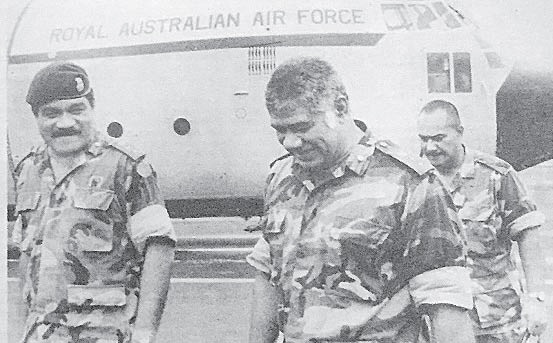
A Royal Australian Air Force plane picked up Col. Draunidalo and his staff officer, Captain Mason Smith from Nausori airport on September 19 and onboard the plane were Brig-Gen Abigail and Col. Tupou, who was with his staff officer Major Saia Ma’afu.
The aircraft later left Nausori for Vanuatu, where Defence Force Commander Colonel Takal Seule boarded the plane for Port Moresby. Mr Duisava met the group at Jackson Airport.
Fiji’s participation in the force would be the second time Fiji soldiers were going to be stationed on Bougainville. Fijians were first on Bougainville during World War I.
They were deployed on Bougainville from April to August 1944.
It was on June 23 when Corporal Sefanaia Sukanaivalu was killed while defending his comrades during a shoot-out with the Japanese army at Bougainville.
Corporal Sukanaivalu received a posthumous Victoria Cross, the highest military decoration in the British Army, for his bravery.

