
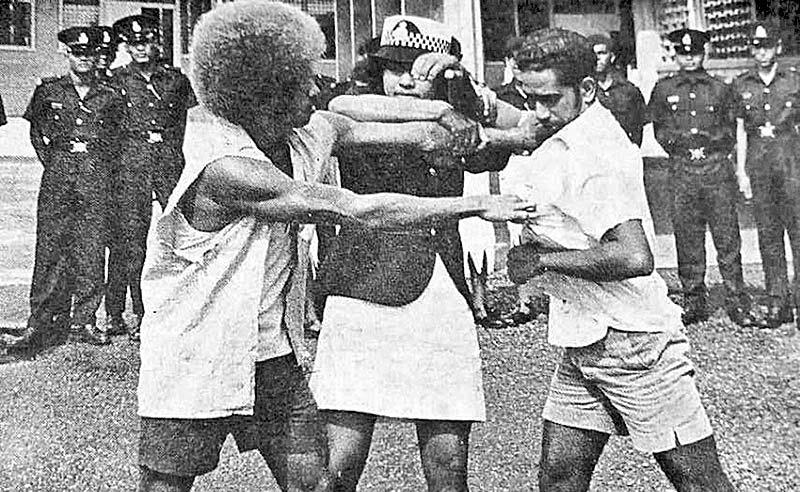
On Friday, June 4, 1976, The Fiji Times reported that 127 young men and women graduated from training school as fully-fledged members of the Royal Police Force.
There was a 20-week basic training period at the police school in Nasova, Nasese, where the group met as strangers. According to the school commandant, they hardly knew how to stand up straight.
Twenty weeks later, they were well trained and well-disciplined constables, ready to handle anything they came across when they went on beat for the first time.
Apart from classroom and field training from the school’s full-time teaching staff members of one chief instructor, four inspectors, one sergeant major and seven sergeants and 15 corporals, the recruits received training in many other specialised fields.
There were lectures from senior police officers such as the public relations officer and the crime and accident prevention officers. Organisations from outside the force also rendered their services to train the country’s police officers.
Harry Charman of Charman’s All Races Club, taught them self-defence, the St John’s Ambulance Brigade ran a first aid course and lectures were given by Suva Fire Brigade, the pathological section of the CWM Hospital, the Lands and Survey Department, the Social Welfare Department and the Office of the Director of Public Prosecutions.
The recruits, who passed out on that day, were the biggest intake in the history of the school. Of the 127 new Constables, there were 14 women Constables and two Constables from the Tuvalu Constabulary.
The Commandant, Superintendent Ambika Prasad, explained this had been possible because the number of people who had applied to join the force allowed him to enlist a higher standard of recruits.
All recruits had a minimum education of up to Form 4 standard, many had passed Fiji Junior, 35 had passed a number of subjects of the New Zealand School Certificate Examination and one had passed the GCE examination.
Superintendent Prasad said by the time they had the next intake in August, the training period would hopefully be reduced from 24 weeks to 20 weeks. And hopefully all those enlisted had the minimum of a Fiji Junior pass.
He said the higher standards meant the recruits had a better understanding academically and were better equipped to understand instructions, both in the classroom and on the field. The number of new recruits would only be 27.
But the appeal that a career in the police force has for young people in Fiji can be seen by the fact that 1300 boys and girls throughout the country applied to be among that 27.
“I interviewed 1298 applicants for the August intake, more than the present strength of the entire force”, the Commandant said.
He said many of the applicants he interviewed told him they wanted to join the force because of the security it offered, the chances of advancement and an attractive salary.
The recruits lived together throughout the training period, the girls in one barrack and the boys in another at Nasova.
Recruits from Suva lived in Nasova as well. Even two recruits who were from police families living in the Nasova compound had to live with their fellow recruits in the barracks. Superintendent Prasad said the training period was divided into three parts.
During the first part, the recruits are taught general subjects to broaden their knowledge plus some law.
In the next stage, they are taught law and the practice of law which would contribute to their day to day work as Constables. In the last stage, the recruits spent the bulk of the time doing practical on what they had already been taught.
During this period, they spent some time doing duties at police stations and on patrols.
There were weekly tests on Fridays throughout the training and final exams, both practical and written, at the end.
The girls received exactly the same training as the boys, except in weapons training.
The boys learnt how to handle a rifle while the girls learnt how to use a pistol.
The typical day of the trainees was a long one, from 5.30am to 8pm.
They must be up at 5.30am and in uniform and on the parade ground by 6.15am.
Then there was an hour’s drill before breakfast, then into the classroom at 8.30am until 12.30pm.
The trainees were free until 2pm when training started again until 5pm, but the afternoons were more often spent outside than in the classroom.
There was self-defence and lifesaving instruction, physical courses, confidence courses, road running and games in the gym. Dinner was from 5pm to 6.30pm before another hour of study or an educational film.
The commandant himself was an “old boy” of the school. He said after the passing-out parade, the recruits were seen crying as they said goodbye to each other before being sent to their various stations.
“When they arrived they are lonely, but when they leave, they are all one family.”

