
As the modern world has moved past slavery, there are fragments of it that lingers in songs and stories, evolved through time.
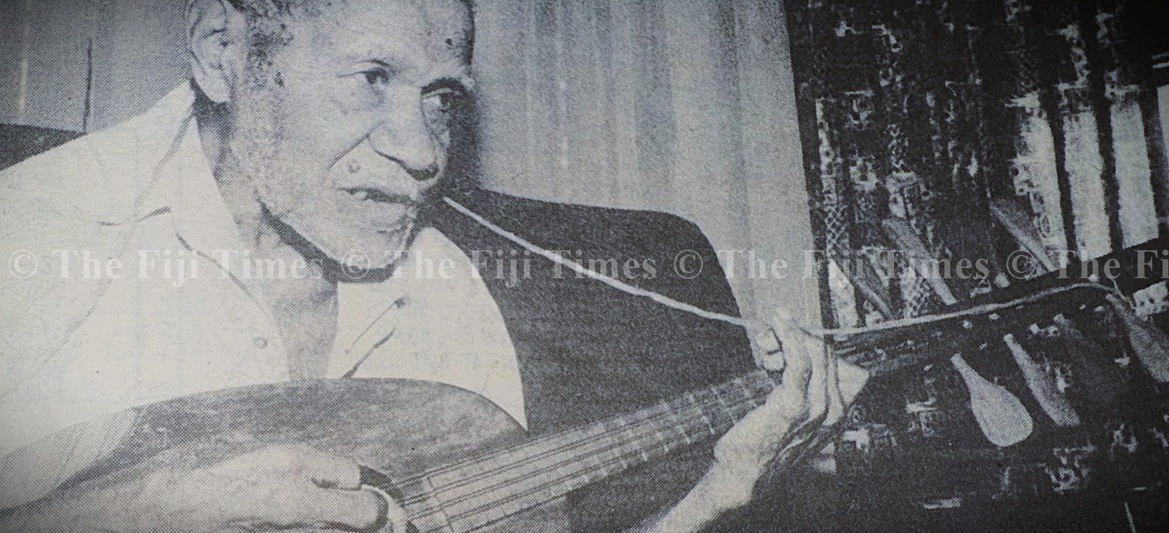
As a boy, Joji Robo (Qoliyasi) worked by day at a planation and studied by night.
According to The Fiji Times article published on July 19 1997, he later went on to be a skilled carpenter, artisian and engineer while making instruments such as violins, pan pipes, banjos and guitars for his clientele.
His father, who came from Malaita, in the Solomon Islands, was one of the thousands of islanders brought to Fiji between the 1860s and 1870s when blackbirding was a lucrative trade in the Pacific.
Joji said his father was put to work on the sugar and cotton plantation and later made to work on building a road west of Viti Levu that would ultimately become the Queen’s Highway.
As a boy, he remembered listening to the older generation of Solomon Island labourers sing old folk songs about their people and legends.
Blackbirding was introduced in the Pacific as a direct result of the American Civil War which ironically, sought to abolish slavery in the South, one of the many factors that led to the war.
The ban on buying cotton from the South, imposed by the North, pushed up the price for cotton leading to a boom in cotton farming in Fiji. The indigenous people were unwilling to work on the plantations so the planters found it easier to buy labourers from visiting trading ships.
During the blackbirding era, islanders from Vanuatu, the Solomons Islands and Kiribati were often kidnapped or coerced into ships and taken to Queensland, Australia and Fiji as demand for labourers grew.
Some tactics used to capture the labourers was to drop heavy iron on board their canoes, smashing it and snatching the survivors, others were to lure them on board with talk of giving them gifts, guns and trinkets then capturing them in the hold of the ship. There were incidents where enraged islanders broke out of the hold and killed most of the crew on board.
However, there were examples of islanders coming of their own free will to join family and friends.
The labourers would be lined up on a beach in Levuka, Ovalau and there sold to their prospective owners.
Protests from missionaries and honest traders began to have an effective and it was heeded by the British Government which sort to phase out the trade by 1872.
Some labourers were taken back to their islands as part of their contract while others opted to stay.
For those who returned, some of them never made it back to their homes. The trading ships wanting to spend as little as possible on transportation, dropped them off at the nearest islands.
Those who stayed back in Fiji, married indigenous people and Indian indentured labourers who came later to work on the sugar plantation. Today their descendants could be found all over Fiji.
Joji Robo was a descendant. So is Taraivini Naicegulevu, the head teacher of Saint Johns Primary School and Mere Makaleni both of Wailoku.
Taraivini’s grandfather came from Malaita in the Solomons. He came of his own free will to join his grandfather and three brothers.
His grandfather worked in a plantation at Tailevu and later married a woman there.
Ms Makaleni’s grandparents came from Lau in the Solomon Islands. Her grandparents also worked in plantations planting coffee, cotton, coconut and cocoa. Mere was the youngest of a family of eight.
On July 1, 1996, there was an exhibition “Australian South Sea Islanders”, focusing on the labour trade in the Pacific.
The Fiji Museum in conjunction with the Australian National Maritime Museum and the Australian Embassy sponsored the travelling exhibition.
At the opening of the exhibition in Nadi, the then minister for Education, Children, Culture, Science and Technology, Taufa Vakatale, sang a song about a boy who, while out on a visit, was kidnapped by a foreigner and brought to Fiji.
The song Lai Tei Dalo ko Tamaqu, was made famous by a band in Yarovudi in Ovalau, Caucau ni Delai Tomuna.
Such songs are abundant not only in Fijian society, but also in the Indian society where such incidents have no doubt led to the creation of folksongs re-telling historical events.

