
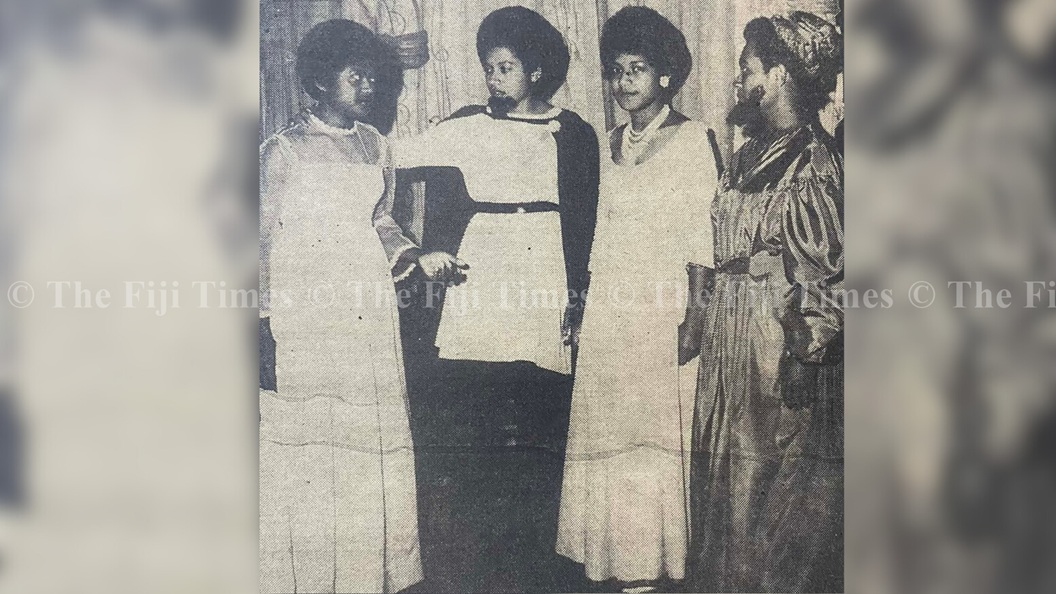
In 1956, students of Adi Cakobau School regretfully abandoned their practice of annually presenting one of Shakespeare’s plays because the boys of Queen Victoria School had also turned to the Bard of Avon.
A report in The Fiji Times on February 1964 said the girls from ACS felt there was no room for two Shakespearean productions each year.
However, as the girls demonstrated at the Suva Town Hall, it was a serious loss to many people, not only to lovers of Shakespeare.
Adi Cakobau presented five scenes from The Taming of the Shrew.
It was considered a happy idea to bring the production to Suva, and it deserved a larger audience than it received that night, when only about 50 people, mainly Fijians, attended.
Condensed Shakespeare was not everyone’s cup of tea, and inevitably there was a lack of continuity. However, the story of the taming of the wild-eyed, bad-tempered Katharina by her suitor Petruchio held together and could be followed easily by the audience.
The Fijian spectators enjoyed the performance and laughed merrily at Shakespeare’s mischievous sallies that sparkled amid his peerless verse.
The girls imparted a charming freshness and amusing naivety to the story. It would certainly have delighted Shakespeare himself.
Histrionically, there might have been room for more experience, but who, a couple of decades earlier, would have imagined Fijian girls holding the stage with aplomb, without a trace of nervousness, complete mistresses of their roles, word-perfect and even playing men’s parts.
That was a sound reason why the European Community could have profitably supported the show.
The Fijian girls, along with Tongans and others who attended Adi Cakobau School, were taking their rightful place in the modern world. They were surprising those who had known Island girls simply as house girls.
The producer, Taufa Bole of Ba, who had played the part of Petruchio when the school presented The Taming of the Shrew in 1954, made a few minor mistakes in casting.
All the principals had their lines perfectly. There was a complete absence of gaucherie, no missed cues and, perhaps more importantly, their English enunciation was first-class — better than had been heard from their opposite numbers at Matavatucou.
Nanise Waqa, as the rich gentleman from Padua and father of the two girls, undertook the task of wearing the mantle of a father and wore it well. She displayed authority and ease of movement, which helped her overcome the drawback of portraying a bearded character.
Jiko Cavu, as Lucentio, the lover of the gentle daughter Bianca, also had a hirsute obstacle to overcome, but managed the task well, perhaps because her role was not overly wordy and required little wagging of her goatee.
Honours went to Seruwaia Kunabuli as Petruchio, the shrew-tamer. She had the most demanding role and much of the stage to command, but she filled her part with credit. She was convincing, confident and a perfect shrew-tamer.
The shrew, played by Marica Bainivalu, was perhaps not shrewish enough, although such a character portrayal would have required more dramatic intensity than most schoolgirls possessed. To descend into a tearing, screaming rage with flashing eyes and scolding tongue was a great deal to expect of a Fijian schoolgirl.
Sophia Tuitoga, as the gentle Bianca, was mild and demure as required, and was ably supported by Mere Naseka as Hortensio, Petruchio’s friend; Kolora Nasaubuli as Rosina, who appeared attached to Hortensio; Sereima Diqamu, a natural comedienne in the role of the servant Grumio; Ana Dreu as the tailor; and Asinate Uanisocake as the tutor, who drew an early laugh when she was crowned with a guitar by the shrew.
Others who contributed to the success of the production were Litiana Cama, Bonita Simmons, Laisa Ulamila, Seini Kulanikoro and Elenoa Tau as servants, and Lusiana Ganilau, Siteri Wilhelmena, Lisikoveni Vodotiko, Gavula Bainivualiku, Kasaya Tinanivonu, Temalesi Rabuka, Milika Vesikula, Kelera Dewa, Mere Naidrodro, Mere Colati, Tirisiyani Cakau, Veniana Lewasedre and Lavenia Vulavinaka, whose dance could have lasted longer.
The scenery, which probably faithfully portrayed a Paduan nobleman’s house, was also the work of the girls.
The play was repeated at the town hall on February 7 that same year.

