
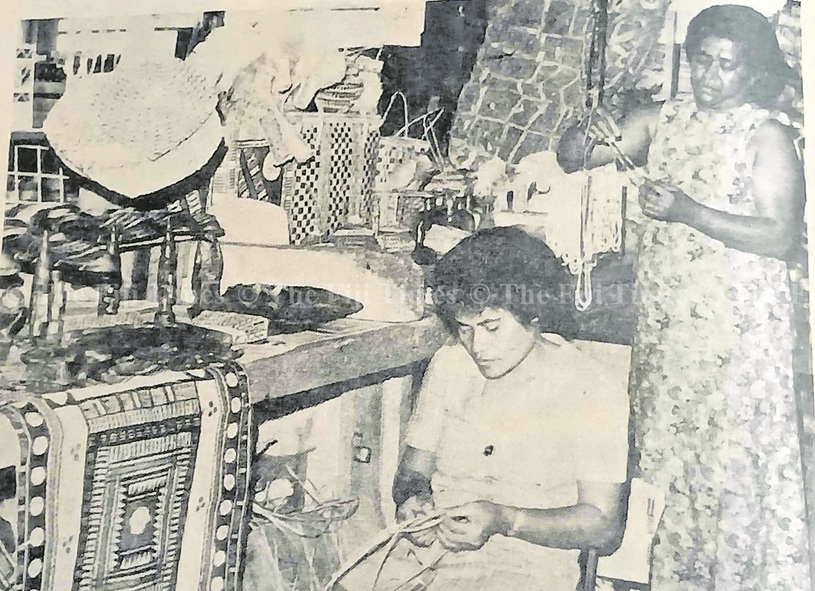
Fiji handicraft vendors should be able to sell at least $1million worth of their goods to Australia each year instead of the $3000-a-year business they were doing.
This was according to an article published by The Fiji Times on October 2, 1976. It stated that Australian Trade Commissioner William McCabe had mentioned this to about 60 Suva vendors and dealers at a meeting he called to discuss Fiji’s share of the $16million a year Australian market for curios and handicrafts.
H
e said the trade commission would arrange for a preliminary market survey in Australia and, with the help of ideas from the meeting, set up a positive exporting program.
The vendors agreed there were good reasons for building up a strong handicraft industry.
It would help to keep old skills alive, promote tourism, and stop people moving to towns from the country, as many curio workshops were in rural areas.
The secretary of the Suva Market Curio Vendors Association, Narayan Banan, said dealers should set common prices for the goods they sold locally.
“This must be done before we embark on large-scale exports to Australia,” Mr Banan said.
He supported the idea of a national association to handle and promote the industry.
Representatives would also look at the possibility of the National Marketing Authority handling handicraft sales as it did with agricultural and fisheries products.
Mr McCabe said under Australian Customs regulations, handicrafts were allowed into the country free of duty but only if they were wholly or at least mainly handmade.
“This does not mean other handicrafts cannot be sold in Australia,” he said.”
“The Australian handicraft trade has accepted a much broader definition to include products of cottage industries, ethnic fashion, and gift products which are at least partly handmade and possess either utilitarian or artistic features.
“Australia got most of its handicrafts from India, Taiwan, the Philippines, Spain, and Mexico.”
He said importers were looking for more expensive items, particularly in giftware, but there was a continuing demand for unusual objects.
Fiji Visitors Bureau general manager Paddy Doyle said this meant more authentic products of Fiji should be made, such as strong, huge war clubs.
He told the vendors they should crack down on “junk handicrafts which are bringing a bad name to Fiji”.
He said many objects in the Fiji Museum could be copied.
A YMCA representative objected that there were not enough people with traditional skills to make such artifacts.
The meeting agreed that a specialist should be brought in to improve woodcarving and shell jewellery-making skills.
Some dealers said the poor quality of some handicrafts being sold in Australia was due partly to that country’s drier climate, splitting and discolouring the wood.
Mr McCabe suggested they refer the problem to the Forestry Department.
Other vendors said the trade commission should inspect export consignments of wooden trays, tanoa, baskets, statuettes, and other products before they were shipped to ensure quality was maintained.
The meeting heard carvers were running out of hardwoods such as vesi, and the dealers would ask the Agriculture and Forestry departments to help with replanting.
“We want the Government to stop exporting all raw materials needed for our industry.”
Mulberry bark for making masi was scarce in Fiji and had to be brought from Tonga.
Mr McCabe said the trade commission would examine the problems and seek advice from different organisations in Fiji and Australia.
The article concluded with Mr Banan saying dealers would hold a similar meeting sometime later that year.

