
“MY darkest moment was the May 1987 military coup. I was angry that a contract was broken. It dawned on me for the first time that a major challenge for Fiji people was to understand human rights.”
Those were the words of Amelia Vakasokolaca Rokotuivuna, as recorded in the book 1000 PeaceWomen Across the Globe, published in 2005, which documented the lives of women nominated that year for the Nobel Peace Prize. She had spoken from experience. She was briefly imprisoned for defying the coup. She stood outside the French airline offices in Suva in near-daily protest against nuclear testing in the Pacific. She co-authored a paper on foreign economic control of Fiji that, according to Dr Wadan Narsey, was seen by the then government as “dangerous and possibly communist”.
In his tribute published in The Fiji Times on June 7, 2005, Dr Narsey writes that Rokotuivuna was born in Vatukarasa, Tailevu, in 1941, and spent her early years in Vatukoula where her father was a cook. She rose to head girl of Adi Cakobau School, became the first Fijian staff member of the Young Women’s Christian Association (YWCA) in 1962, its first Fijian executive director in 1972, and general secretary in 1973. For decades she led the fight on equal rights for women, a nuclear-free Pacific, political reform and multiculturalism.
When she died of cancer, aged 63, Dr Narsey noted she passed with no property in her own name.
Nearly 20 years since her death in 2005, the issues she spent her life giving voice to are still being raised, carried on by women’s organisations and advocates across Fiji and the Pacific.
In 1995, Fiji signed the Convention on the Elimination of All Forms of Discrimination Against Women (CEDAW). Thirty years later, the CEDAW committee met in Suva in April 2025, the first time it had convened in the Pacific, calling on Fiji to better protect women from violence, get more women into leadership and parliament, and provide women with a formal mechanism to have their rights upheld. The Fiji Cabinet has since adopted a five-year plan to respond.
That plan sits alongside a Constitution with its own gaps. The 2013 Constitution protects women from discrimination, but not on land. More than 80 per cent of land in Fiji is iTaukei land, passed down from father to son under custom. Women who live and work on that land have no guaranteed right to inherit it. According to Dr Narsey, Rokotuivuna challenged that as far back as 1965. Sixty years later, the law remains unchanged.
During her time at the YWCA, Rokotuivuna made submissions on family planning, workers’ rights and economic justice. The World Bank’s Gender Data Landscape 2025 shows only 31.2 per cent of married women of reproductive age in Fiji use modern contraception, against a regional average of 74.6 per cent. The Fiji Women’s Rights Movement’s report Beyond 33% shows women take home 30 per cent of total incomes while carrying 73 per cent of all unpaid work. The World Economic Forum’s 2024 Global Gender Gap Index ranked Fiji 126th out of 146 countries, last among all 18 economies in the Eastern Asia and Pacific region.
On political representation, of the 55 seats contested in the 2022 general election, six went to women, down from 10 in 2018. According to a 2025 Australian National University study, only 44 women were elected or appointed to seats in Fiji’s parliament in the 60 years between 1963 and 2023. The debate over temporary special measures to address that gap remains unresolved, with senior government figures, civil society organisations and the Fijian Electoral Commission divided on the issue.
Some of the battles Rokotuivuna fought have been won. Young women in Fiji today inherit those gains, a Constitution that prohibits discrimination, a Family Law Act that took a 12-year campaign, and Domestic Violence Decree. Others she was raising in the 1960s, 1970s and 1980s remain unresolved, a reminder that the measure of progress is not just what has changed, but how long change has taken, and who did not live to see it.
Rokotuivuna gave her life to this work. It raises a question that still stands: how many more generations of Fiji’s daughters will live and die waiting for commitments made before they were born to finally be honoured?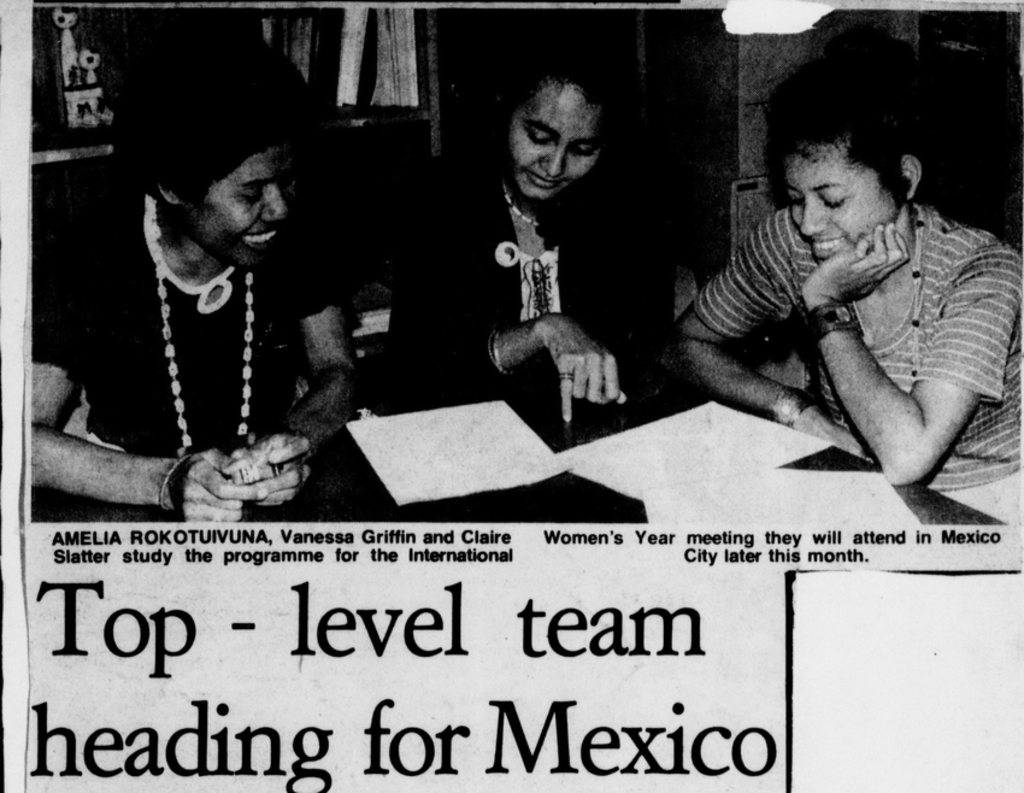
A newspaper cutting of Fiji’s NGO delegation examining the UN International Women’s Year Conference Program before travelling to Mexico City. Picture courtesy: YWCA/PAMBU, ANU
Compiled by
SAMANTHA RINA