
National airline Fiji Airways has acknowledged the Government’s recent announcement of the interim fuel surcharge; and has also indicated its appreciation of the broader economic considerations behind the decision.
As the country’s national carrier, it remains steadfast in its commitment to delivering reliable, high-quality services amid a challenging and evolving cost landscape.
The airline now looks forward to continuing close collaboration with the Government and all relevant stakeholders to safeguard the vital connectivity they provided for the movement of people, tourism, trade, and the economic lifelines that kept Fiji and the Pacific connected.
Together, the airline and the Government are committed to ensuring that any route adjustments were kept to an absolute minimum.
Since the announcement by the Fijian Competition and Consumer Commission (FCCC) and Minister of Finance Esrom Immanuel of the geopolitically-influenced interim fuel surcharge of 5.91 cents per kilowatt hour (kWh), the airline continues to engage with customers and tourism partners, and the Government and industry stakeholders.
While it is still early days since the announcement, the airline is expecting questions and concerns, particularly from the tourism sector.
Tourism accounts for around 40 per cent of Fiji’s GDP and supports more than 150,000 jobs, which is nearly one in every three jobs nationwide.
And as the national carrier, Fiji Airways carries around 70 per cent of all visitors in Fiji by air.
As Fiji Airways managing director and chief executive officer Paul Scurrah puts it, the health of the national airline and the health of Fiji’s tourism industry are inseparable.
Mr Scurrah said they recognised that the Government faced difficult decisions in managing energy costs for the country, but as an airline, any increase in operating costs added pressure to an already challenging environment.
He said they were now carefully assessing the full impact and working closely with the Government and all relevant stakeholders to manage this responsibly for businesses, the people and the country.
Asked about the immediate changes being discussed since the announcement, Mr Scurrah said they were working through a thorough assessment of the financial impact across its operations.
He said while it would be premature to outline specific measures at this stage, their focus, however, was on protecting the quality and reliability of services their customers and partners depended on.
Impact of unpredictable cost environment on operations and planning
Fiji Airways has navigated significant challenges before through global fuel crises, the pandemic and other economic shocks, and it is confident in its ability to adapt and respond.
But the airline boss unpredictability has real consequences.
“A monthly review cycle makes forward planning harder, affects long-term investment decisions and creates pricing uncertainty for customers who book weeks and months in advance,” Mr Scurrah told this newspaper.
“What we are calling for is a stable, transparent and longer-term energy pricing framework that gives businesses like ours the visibility needed to plan, invest and grow with confidence.
“Fiji’s economic recovery and growth ambitions depend on a business environment that is stable and predictable.
“We are committed to working with the Government to get there because what is good for Fiji is good for Fiji Airways.”
Mr Scurrah said they also supported the Government’s intention to protect vulnerable households and small businesses, reasoning that being the right thing to do.
However, he said at the same time, aviation played a unique role in Fiji’s economy, and the airline was grateful that the Government recognised the importance of keeping the national carrier strong, connected and competitive.
“Our conversations with Government are ongoing and productive, and we are navigating this period together.”
Route suspensions and airfares
Mr Scurrah said the airline had been transparent about recent network changes made in response to rising fuel costs.
One of eight weekly Brisbane flights was temporarily suspended earlier this year.
The Nadi–Dallas route will be suspended from September 7 later this year, and it is upgrading Vancouver services and increasing Hong Kong frequencies from September 22.
He said those decisions reflect a challenging environment where jet fuel prices had more than doubled since the start of the year.
“They are not taken lightly. However, we are committed to working closely with the Government and all relevant stakeholders to keep any further route adjustments to a bare minimum.
“Forward bookings remain encouraging, particularly from Australia and New Zealand, and the launch of our new Gold Coast service on June 11 is a strong signal of our confidence in Fiji’s future.”
Mr Scurrah said fare adjustments were a normal part of how airlines responded to changing costs, and it would be reasonable to expect some adjustments as cost pressures continued.
“However, we want to be clear, we have no plans to introduce a fuel surcharge at this time.
“Fiji’s tourism industry depends on affordable air access, and that responsibility is not lost on us.
“We will do everything we can to remain as competitive and accessible as possible.”
Next course of action
Mr Scurrah told this newspaper that their immediate focus was completing a thorough assessment of the financial impact across the business.
He said they would continue engaging closely with the Government, tourism partners and industry stakeholders throughout that process.
“Fiji Airways is committed to playing its part in protecting the connectivity, jobs and economic opportunities that matter most to Fiji and the Pacific.
“We are in this together and we will navigate it together.”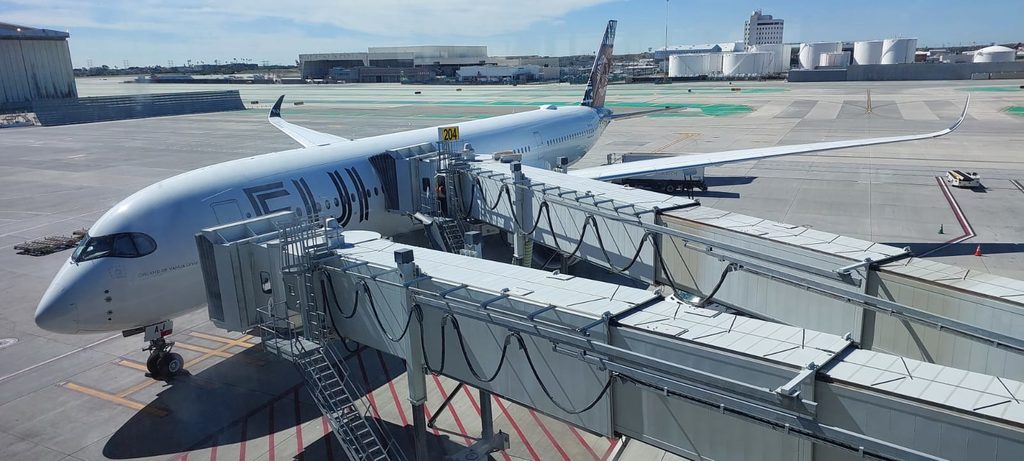
The Fiji Airways A350-900 Island of Vanua Levu that served a direct service from Nadi seen here attached to the airbridge at the Los Angeles International Airport in the US in February early this year. Picture: TIMOCI VULA