
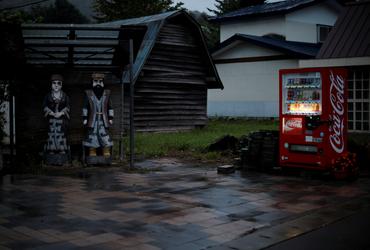
TOKYO (Reuters) – On a wooded lake shore in northern Japan, the government is building a modernist shrine that has divided the indigenous Ainu community whose vanishing culture it was designed to celebrate.
At a cost so far of $220 million, Japan’s “Symbolic Space for Ethnic Harmony” is on track to open in time for the 2020 Olympics, part of a drive by Prime Minister Shinzo Abe to draw millions of foreign visitors to Japan and to the northern city of Sapporo, where the Olympic marathon will be run.
(Click reut.rs/2NejDTG to see a picture package.)
Also known as “Upopoy” or “singing together” in the Ainu language, the complex will include a museum, a replica of an Ainu village, many of which Japan destroyed in its 19th Century colonization of Hokkaido, and a memorial housing the bones of hundreds of Ainu whose remains were sent to universities in the 20th Century.
For some surviving Ainu, whose exact numbers are unknown, the project underscores how Japan has failed to come to terms with its history – despite more than a decade of deliberation on how Tokyo could meet its commitments to an indigenous group it officially recognized in 2008.
Some Ainu worry the new museum complex is mostly meant to burnish Japan’s international standing ahead of the Olympics.
“I think it’s possible it could end up becoming a theme park,” said Ainu tattoo artist Mai Hachiya. “People would come to see the dancing and other performances. It would be like a zoo.”
‘SILENT AINU’
Scholars say the Ainu settled in Japan’s northernmost island and across Sakhalin, Russia, by the 1300s. They hunted, fished, practiced an animist religion and spoke a language unrelated to any other.
Japan took control of Hokkaido by force in the 19th Century and made it a colony. After opening it to Japanese settlers, it forced the Ainu, which it labeled “former aborigines,” to assimilate.
A 2017 survey counted just over 13,000 Ainu in Hokkaido. The actual number is estimated to be much higher, because many Ainu fear identifying as other than Japanese and have moved to different parts of the country.
Ainu children are half as likely to go to college as other Japanese and average household earnings are significantly lower, official data show.

