
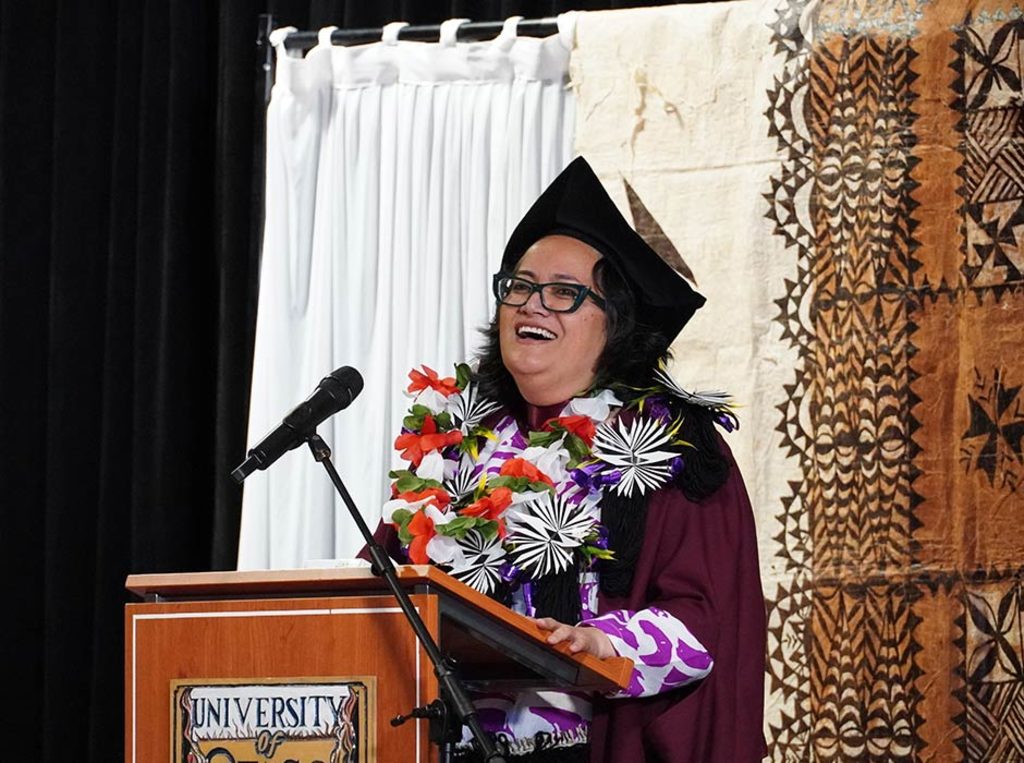
When Mere Taito walked across the stage to receive her doctorate in English, she did so as the first Indigenous Pacific scholar to graduate with a PhD in English from the University of Otago.
For the Rotuman poet, writer and researcher, the milestone is both deeply personal and profoundly communal.
Her thesis titled Kavei se täe! A genealogy of Rotuman texts: Reading early 20th century Rotuman publications; Writing multilingual archival digital visual poetry, is believed to be the world’s first doctoral work devoted to Rotuman literature.
Recognised by the university as an “exceptional thesis,” it blends rigorous scholarship with creative experimentation, bringing long-overlooked texts into contemporary conversations.
“I am extremely humbled, overwhelmed, very grateful, and at the same time, mind blown. I did not set out to be the first of anything,” she said.
“I was drawn to the work of examining early Rotuman literature because there was so much joy and rich intellectual engagement to be had here.”
From chance
inspiration to
PhD research
The seeds of Taito’s research were sown in 2016, when a nephew dismissed poetry as having “no pictures”.
The remark lingered with her, especially at a time when media reports on Rotuma’s language, Fäeag Rotuam ta, were dominated by talk of “critical endangerment” and “language death”.
“These conversations bothered me because they sidelined the regenerative work of our communities,” she recalled.
Determined to tell a different story, she began experimenting with visual and digital poetry, using platforms like Canva to bring text and image together.
Her path took a sharper focus when she encountered Professor Alice Te Punga Somerville’s project Writing the New World, which traced Pacific literary genealogies before the rise of writers such as Vilsoni Hereniko and Elisapeti Inia.
Inspired, Taito turned to Rotuman publications produced between 1913 and 1949, including the Rogorogo newsletter, Tales of a Lonely Island, and two autobiographical works written by her grandfather Fuata Taito.
These texts, she says, are rich with the “linguistic agility and storytelling skills” of their authors.
They capture life in early to mid-20th century Rotuma, the challenges of Christianity, pre-Christian spirituality, and the islanders’ movements during the First and Second World Wars.
Creativity meets scholarship
Taito’s doctoral journey was not straightforward.
She began her studies at another university but left after a lack of support forced her and six other Indigenous candidates to withdraw.
Eventually, she found her footing at Otago, supervised by Professor Jacob Edmond and Professor Te Punga Somerville whom she described as her “dream team.”
The poet in her shaped much of her methodology.
Alongside her academic writing, she produced Kaveia Tan Kal Ta: Mark the Round Water, a collection of 54 digitally born poems created through six different authoring tools.
This creative strand was made possible in part by a 2024 Digital Fellowship from Creative Australia and Creative New Zealand, which gave her access to a digital mentor.
“Play is joyous, and yet play is also vigorous,” she says of her process.
“Any substantial work like a doctoral thesis rests on vigorous revisions, re-thinking and re-editing, which is a process I quite enjoy.”
Reclaiming Rotuman voices
What matters most to Taito is how her work re-centres earlier Rotuman writers such as Emosi Rima, Mesulame Titifanua and her grandfather, Fuata Taito.
She is convinced that archival mission texts, even those written in pre-standard orthography, remain vital to language regeneration.
“Non-standardised texts are still valuable in contemporary language regenerative work. Engage with them!” she urges.
Her PhD, she insists, is a scholarly and creative gift to her people.
“To be able to offer my people a scholarly and creative gift that is of an exceptional standard makes me teary just thinking of this.”
Looking ahead
Now, Dr Taito is already preparing for her next chapter.
She has secured a postdoctoral fellowship at Northwestern University’s Center for Native American and Indigenous Research in Chicago, where she will continue exploring archival texts.
Reflecting on her journey from Rotuma to Fiji and now the international stage, she offered encouragement to the next generation of Pacific scholars.
“Set high standards. Do not settle for mediocrity. Bring your A game to your research. Find joy in your work because joy will sustain you throughout your journey and most importantly, find your intellectual tribe.”
The PhD is more than an academic triumph for Taito but rather a living testament of the gifts of heritage, family and community and most important of all, the power of Rotuman voices that continue to speak across generations.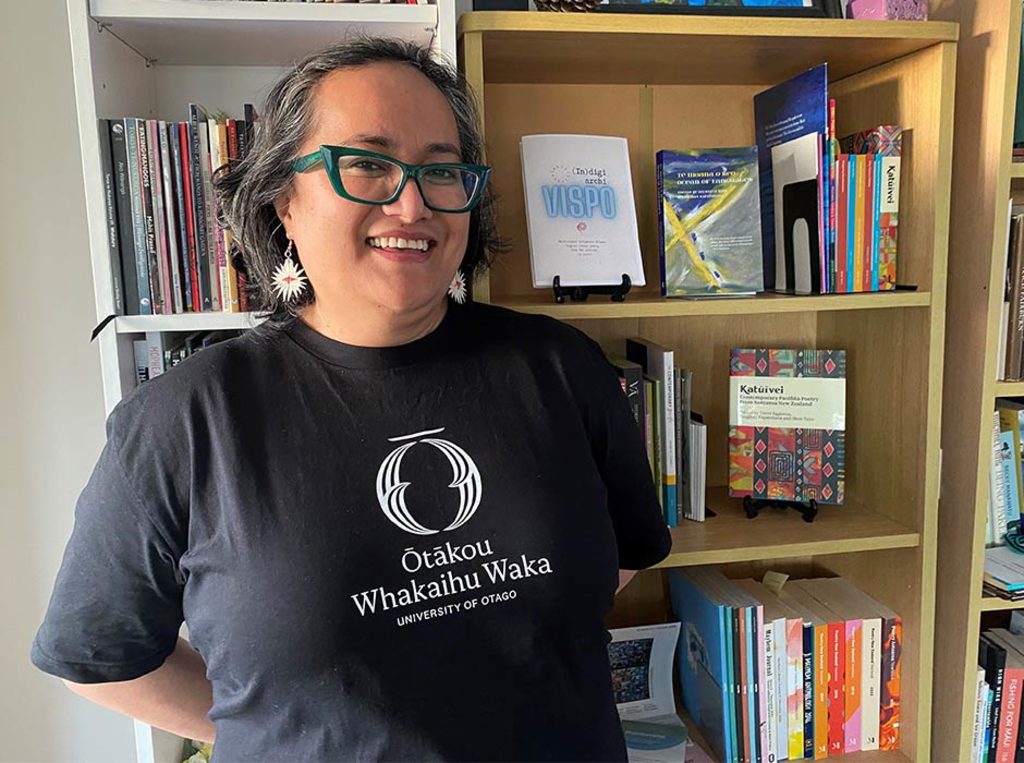
Mere Taito’s thesis is believed to be the world’s first doctoral work devoted to Rotuman literature. Picture: UNIVERSITY
OF OTAGO
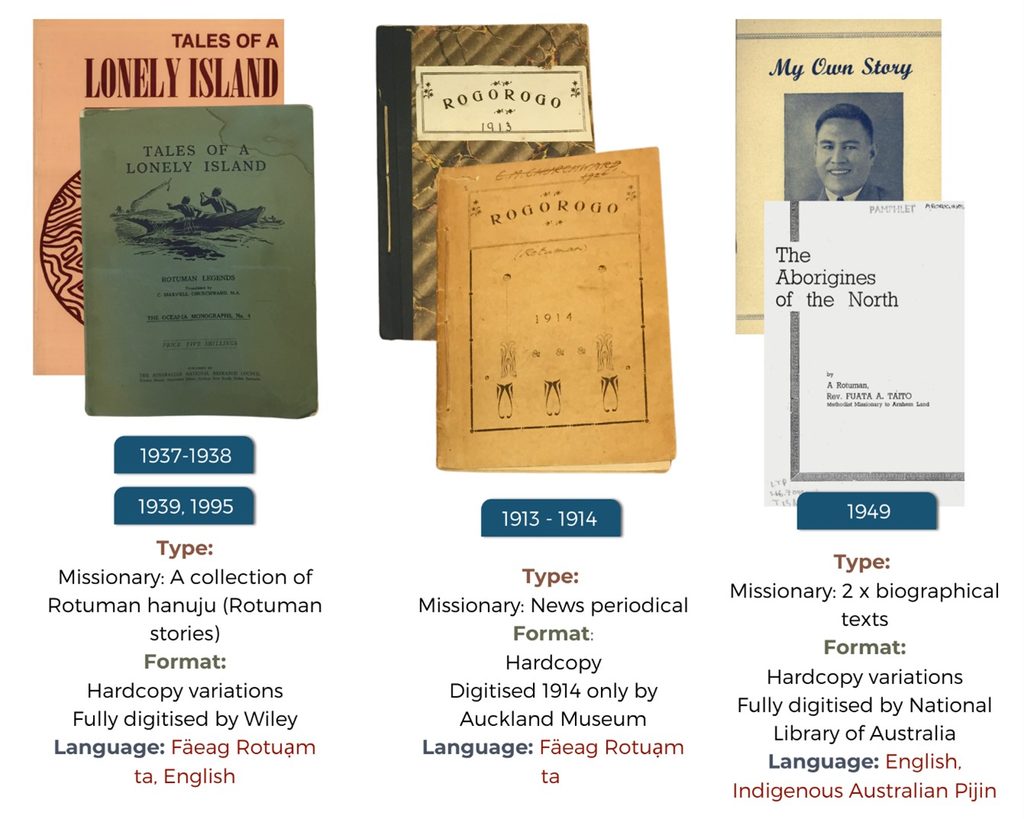
Early to mid-20th century multilingual Rotuman texts from which Dr Taito drew inspiration. Picture: UNIVERSITY OF OTAGO
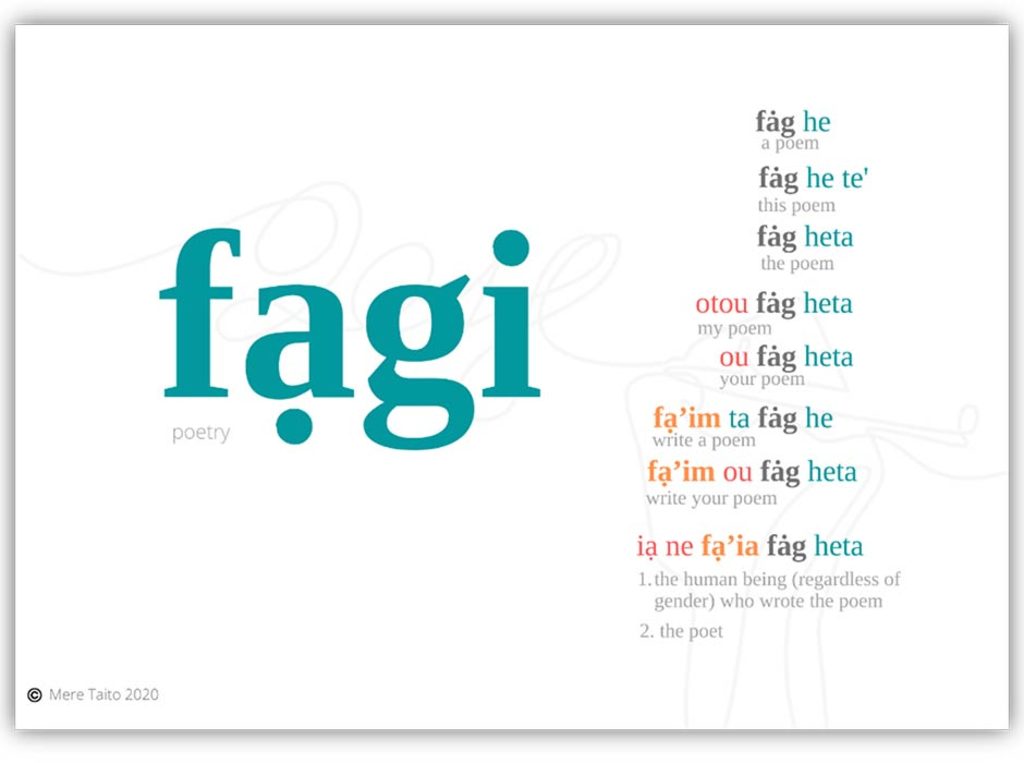
An example of Mere’s work “Fạgi”, which featured in the ‘International Journal of Comparative Education’ in 2020. Picture: UNIVERSITY OF OTAGO

