
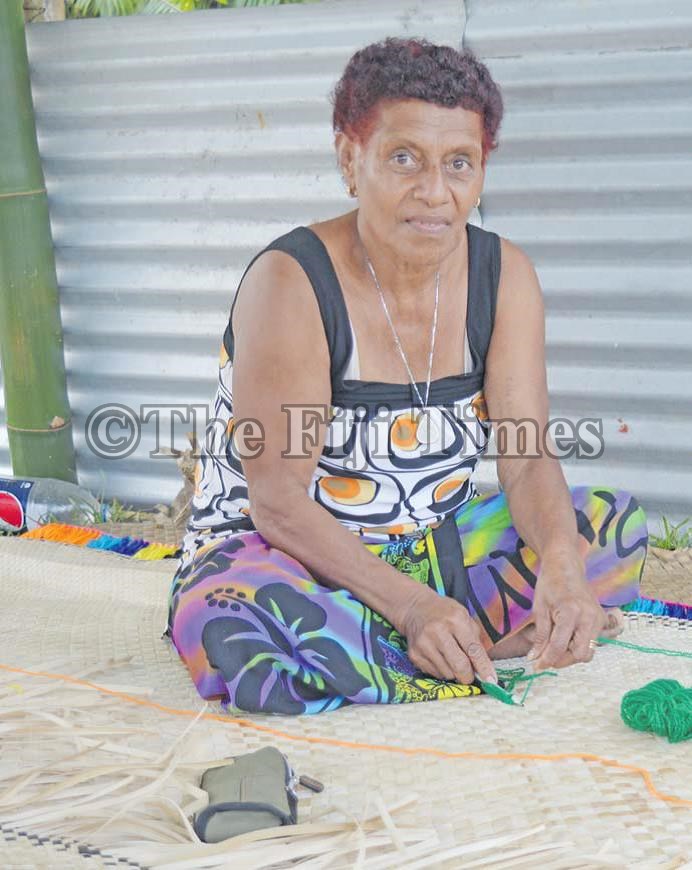
THE knowledge of weaving among women in villages is fast disappearing.
That makes Asinate Drauyawa a worried woman.
The grandmother is proud of her heritage and values indigenous women’s traditional role of mat weaver in the family.
She first learned how to weave from older women in the village while growing up in Navatu, Cakaudrove and believes there is a disconnection between today’s older women and girls.
“It seems many older women don’t take weaving seriously anymore and young girls are just not interested at all,” she said.
“This disconnection affects how we pass down what we know to the younger generation, the appreciation of our traditional roles and the survival of our culture.”
While Fijians were merrymaking, Drauyawa was kept busy during the 2019 Christmas holiday weaving mats for her family and traditional obligations.
“I am trying to finish this mat so that it can be presented tonight at a funeral gathering,” she said.
“The wool (kula) on this delana (small mat) will have crocheted ends to prevent it from fraying. This is a modern technique I use to ensure my mats last longer.”
Drauyawa said many women who lived in villages did not know how to weave. This she said affected the availability of mats for traditional gatherings such as wedding and funerals.
“Now even women in villages are buying mats. Some have pandanus planted in their back yard but they are not weaving any more while there are some who have never woven once in their lifetime.”
“In my days, every young girl was expected to learn how to weave by the time she reached puberty. Today, in their spare time, young girls are only interested in grooming themselves and playing with mobile phones.”
Drauyawa said weaving could also be a supplementary source of income for rural families and a way women could become financially independent.
“I am always weaving because I sell them to buy what I want and to cater for traditional family obligations which keep popping up. I never know when a close relative would pass on so I am always ready for the unexpected.”

