
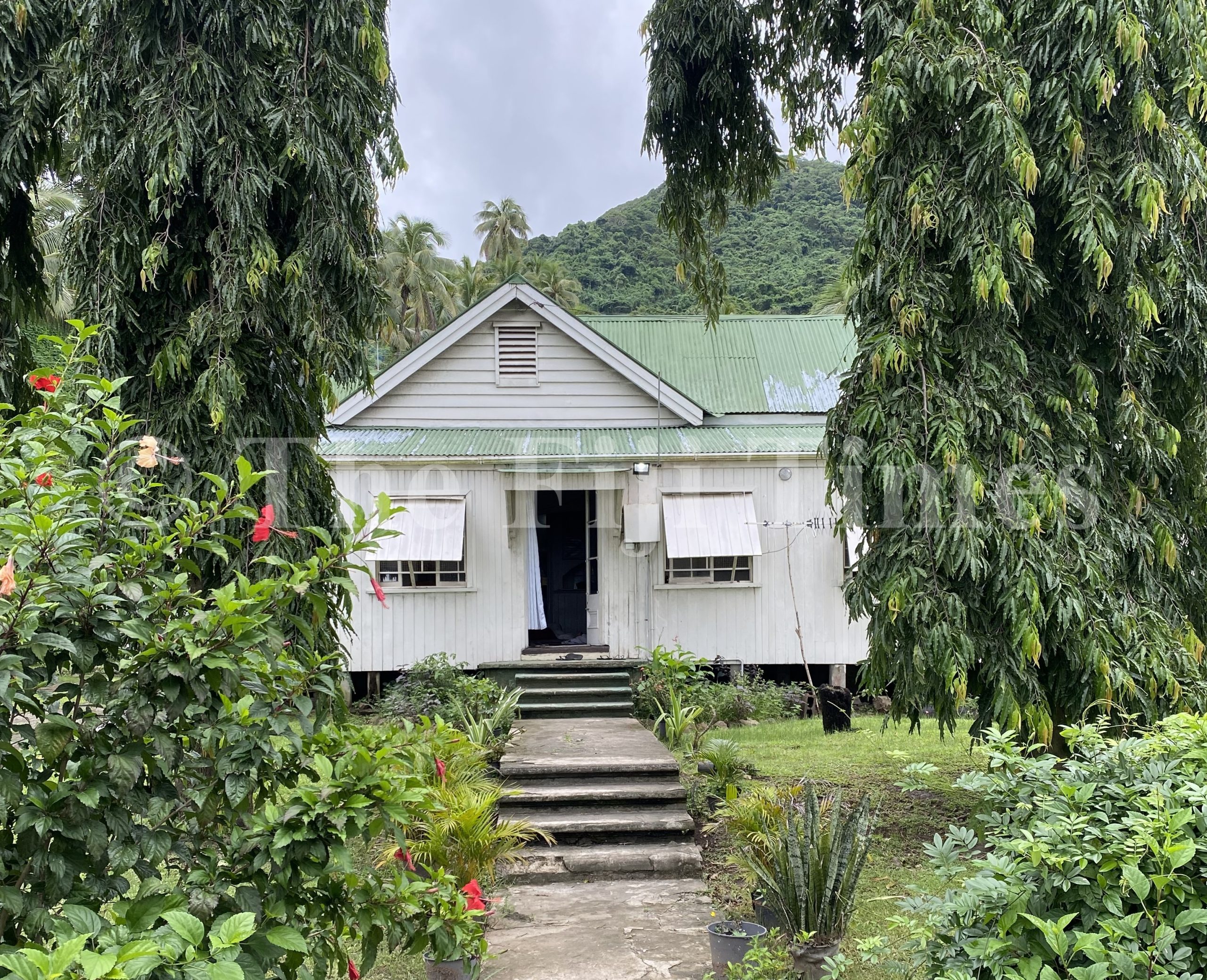
It’s not every day when one gets the chance to sleep over at Government House. These days, it is the residence of Fiji’s President and Head of State.
But previously, the iconic white building housed Fiji’s Governor-Generals and Colonial Governors.
In the old port capital of Levuka, remnants of Fiji colonial past are manifested in many old and monumental buildings, from churches and schools to hotels and public halls.
One of them is the country’s first Government House also called Nasova House, the base of the short-lived Cakobau government and the residence of Fiji’s first governor, Sir Arthur Gordon.
Gordon altered and expanded the building to fit its purpose as the Government House when he arrived in June 1875.
Robbin Chatan in his journal article published in the International Journal of Historical Archaeology in 2003 — titled ‘The Governor’s vale levu, Architecture and Hybridity at Nasova House, Levuka Islands,’ he said the design and specifications of the property were done by a local architect and surveyor John Holmes.
Its design was a hybrid piece of architecture, showcasing elements Fiji’s traditional architecture and British colonial pride.
The tender to erect the external and internal framework to a local building firm, Messers Wilson and Murchie at an estimated cost of $FJ2100.
“An article in the Fiji Gazette describes the general plan for this building as a quadrangle with two wings measuring 84ft by 24ft and the central building 102ft by 24 ft,” Chatan wrote.
“All three sections of this structure were surrounded by a verandah measuring 8ft in breadth.
Gordon, who was known for shaping of Fiji’s history said he appreciated the Fijian elements of the building and in a letter to Lady Gordon (before she moved to Levuka) described it as ‘physically and mentally enjoyable’.
“The rooms are large, numerous and may be made very comfortable and pretty in fact so far as we gentlemen are concerned, they are very comfortable already but will need a little alteration for you and the chicks,” Sir Gordon wrote.
Gordon made changes to the north and south wings including the central building where the former parliament house in the north wing transformed into a dining room well suited for ceremonial reception purposes.
“He converted the old offices of the King and his Privy Council in the central building into the main domestic quarters, with a suite of rooms that included seven bedrooms,” said Chatan.
“The Governor and his staff took over the rooms in the south wing as offices and those at the west end of the wing as domestic quarters for the household’s Indian stewards.
“The addition of a suite of interconnected buildings of various sizes and functions including one known as the drawing room expanded the domestic space at Nasova House necessary for civilised residence.”
It was the seat of government and a domestic residence. Official business often intersected with domestic affairs.
Lady Gordon arrived in Levuka on September 19, 1875, with her two children, Nevil and Jack, and her personal travelling companion and artist Constance Gordon Cumming.
Von Hügel was already in residence at Government House with a large collection of material obtained during his travels throughout Viti Levu.
The other members of Government House were actively acquiring Fijian objects and Lady Gordon expressed delight in obtaining unusual things. This exhibition installation evoked the dining room at Government House.
Lady Gordon, assisted by Maudslay and von Hügel, used the assembled collections to decorate the room.
Today, Nasova House still stands in the same compound where it stood in the late 1800s. a superb testament to the quality of materials and the workmanship skills used.
I got the rare chance to lodge at the famous property and enjoy its splendour, may be not in the same way Gordon and his family did but at least it gave me a glimpse of British upper class living.
From the property, one can enjoy unobstructed sunrises on the horizon in Nasova Bay, where in the 1800s, women from Draiba Village were often seen fishing for the day’s dinner.
The main road splices the property into two halves, one with the official residence and offices, including front and backyard gardens and one with a park that lies adjacent to the sea, where the ruins of Gordon’s jetty can still be seen.
The wooden interior is still intact, thanks to Canadian Oregon timber used in its construction.
If you stand inside the house and look up at the ceiling, you’d spot artistically carved designs in the centre, marking the main parts of the building where people gathered.
The windows are partially casement and awning, the latter allowing the outer window to be pushed out to allow in sea breezes.
The curtain rods are wooden and lines the verandah seem to run around the front half of Nasova House.
You will still find colonial drawers, and wardrobes with mirrors, food pantry and light switches, in good condition.
They might need a fresh coat of paint and a bit of dusting to make it more presentable and maintain its sense of elegance.
Nasova House looks far smaller than what some old photographs portray because some of its materials were brought over to Suva to build the Governor’s new residence when Suva became the new capital.
It has a maid’s quarters and a laundry room in its backyard and at the northern end of the compound still stands the flagpole that fluttered in Levuka skies some 150 years ago.
According to The Suva Times on October 14, 1882, the part of Government House that was removed and taken to Suva included part of the drawing room which included the governor’s private apartments.
The annexe specially built by Des Voeux for the 1881 visit of the then Prince of Wales and Duke of Clarence was also moved.
William Des Voeux was the last governor to reside at Nasova House.
When he moved to Suva, he reflected on his time in Nasova and noted that he missed the fishing parties of women “who often caused great amusement in waters off Nasova”.
“While the water at our pier being somewhat shallow, we had but little opportunity to observe the movements of fish, which at our former residence had been a constant source of interest.” Des Voeux said.
The first Government House in Suva was burnt in 1921 by a lightning strike while the construction of the next residence in 1926 is the exact building that stands today

