
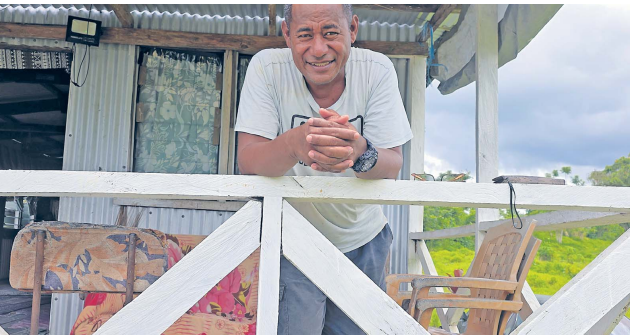
F OR 18 long years, Ledua Qalobula lived away from his own family. This was not out of choice, but necessity.
As a child, he was placed with an Indo-Fijian family in Baulevu, Naitasiri under Jain Shankar, so that his parents and siblings could live safely on a piece of land the farmer had given them.
“It was not easy being away from my family for almost two decades,” Ledua reflects.
“But it was all for survival.”
He began working for just four dollars a day, a wage that stayed the same for nearly ten years.
Eventually, it rose to ten dollars, and later fifteen, the highest he would earn during that time.
“It wasn’t much,” he says, “but it was enough to go by.”
What felt like sacrifice at the time would later reveal itself as a blessing in disguise.
Roots that traveled early Ledua’s story begins in Komo, Kabara in the Lau Group, but his life truly took shape on the mainland of Viti Levu. When he was just two months old, his family moved first to Batiki Settlement, in Naitasiri and later to Wainasasa.
He attended Naitasiri Bharatiya School, but his formal education ended prematirely at Class 4.
“I was not really well educated,” he says without hesitation.
“But life became my classroom.”
Today, after more than 35 years, Muaniweni is the place he proudly calls home.
Lessons forged in hardship Those 18 years away from home left a deep imprint on Ledua’s life.
Living and working closely with the Shankar family taught him discipline, resilience, and purpose.
“I learned to use time wisely, to make the right decisions, and to work very hard,” he says.
“Those are lessons I still practice every day.”
It was also during this time that his love for farming was born.
“Mr Shankar taught me the fundamentals of farming,”
“That’s where my dream of becoming a farmer really started.”
These same values – hard work, patience, and responsibility, are now the ones he has passed on to his own children.
Building a family, chasing a dream After marrying into the village of Delaidamanu, Naitasiri, Ledua began a new chapter.
Together, he and his wife raised six children, two boys and four girls.
“That’s when I realised daily wages would never be enough,” he says.
“I needed land. I needed something permanent.”
That search eventually led him to a 10-acre Crown Lease land, where he now farms ginger, dalo and cassava.
“It’s been a long journey,” he says, “but farming is what I love.
It’s manageable, and I know it can provide.”
Faith lost—and faith restored Ledua speaks candidly about a season in his life when his original faith faded.
“For many years, I did not know Jesus,” he says.
“I lived like the family I stayed with. I ate their food, spoke their language, went to the Hindu temple, served their gods and took part in firewalking ceremonies.”
“I was practically a Hindu believer.”
Each morning, he picked flowers for ritual offerings. Christianity became a distant memory.
That changed after marriage.
“It was my wife who helped me return to Christ,” he shares.
“She prayed with me and shared the Gospel.”
Unfortunately, her companionship ceased when she succumbed to cancer a few weeks ago, leaving her children behind in Ledua’s capable hands.
“I thank God for giving me a good wife and friend. And I’d like to tell every husband to dearly love their wives because when they die, you’d be lost if unprepared.”
In 2012, Ledua committed his life to Christ and joined the Assemblies of God Church. He later worshipped with the Church of the Nazarene in Navua before returning home to Muaniweni.
For the past 12 years, he has served with the Original Pentecostal Church. Today, he ministers to Indo-Fijian
families in his community – preaching and praying in Hindi.
“When I look back, I see God’s hand in everything,” he says.
“Like Moses, I was taken away from my family and was brought up in a strange setting so God could prepare me for a purpose.”
“What once felt like suffering was actually preparation.”
The land as a way forward Ledua is passionate when he speaks to his fellow iTaukei brothers and sisters about land and farming.
“There is money in the land if you are willing to work hard and sweat,” he says.
“Too much land is just lying idle.”
The 47-year-old believes farming can lift families and entire communities out of poverty.
“People chase jobs in towns and cities.”
“But the land will always be there. If you use it wisely, it can take you out of poverty.”
After years as a laborer, Ledua now stands as a farmer on his own land.
“I’ve lived it,” he says.
“This is not theory. This is my life. Anyone can do it.”
Gratitude, legacy, and hope Above all, Ledua’s story is one of gratitude.
“I thank God for His calling and His timing,” he says.
“Even my struggles were shaping me into who I am today.”
His hope is simple but profound—for his children, and for his people.
“I tell my sons never to abandon the land.”
“Even if they work elsewhere, one day they will come back to it.”
“The land rewards hard work,” he says with conviction, and faith gives meaning to it all.”

