
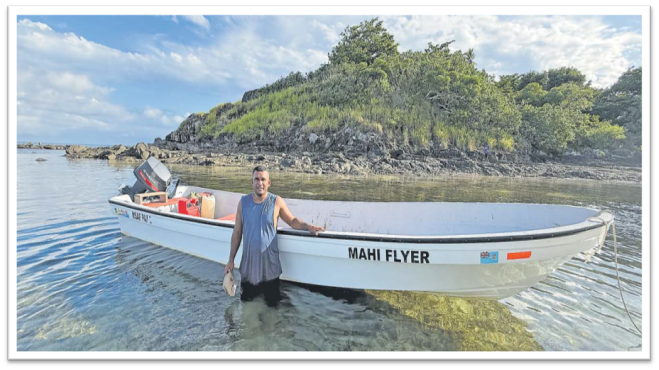
FILIPE Qionikorolevu is a pure Vatulele islander whose entrepreneurial spirit is key to his success in continuing two businesses that have sustained his family for generations.
Deeply rooted in his community, Mr Qionikorolevu balances the demands of running a ferry service with overseeing the production and export of traditional tapa or masi cloth, both of which have become vital to the island’s economy and culture.
The ferry business has been around way before he was born and is a direct continuation of a vision his grandfather initiated many years ago.
Starting with just one fibreglass boat, his grandfather laid the foundation for what would later become a thriving transport service between Vatulele Island and mainland Viti Levu.
When Mr Qionikorolevu’s father took over, he expanded the fleet, adding a second boat to meet the growing demand.
Today, Mr Qionikorolevu, who took the reins of the family business 10 years ago, runs a fleet of three boats, each serving as a lifeline for island residents who need to travel to the mainland for various purposes.
The ferry service plays a crucial role in the daily lives of people on the island, given Vatulele’s isolated location, residents rely heavily on speedboats to get to the mainland, whether for school, work, shopping or social events.
“In a normal day, I wake up, do some chores at home and then head out to check on the boats,” Mr Qionikorolevu said.
“I make sure they are ready for the day’s work.”
This routine is a necessity, as passengers from the island often need to travel to the mainland for schooling, market vending or for special occasions such as weddings or funerals.
The pricing for ferry services is standardised across the island, with a flat rate of $40 one way and $80 for a return trip.
The pricing structure doesn’t vary by the number of passengers or cargo, but instead, it is based on the number of trips made each day.
Although business can be unpredictable, with some weeks yielding very little income, peak seasons such as the “back to school” rush or during major holidays like Christmas and New Year, offer a much-needed boost.
Despite these fluctuations, maintaining the fleet is a priority for Mr Qionikorolevu.
His boats require regular maintenance to ensure they remain reliable.
He spends around $100 a boat every two months for servicing, including checks on the engine and repairs when needed.
For all three boats, the total maintenance cost amounts to approximately $300 every two months, a necessary investment to keep the boats in working order.
In addition to his ferry business, Mr Qionikorolevu’s family has a rich history in making tapa cloth, a traditional art form that has sustained the people of Vatulele for generations.
Vatulele is well-known for producing some of Fiji’s finest tapa, which is crafted from the bark of the mulberry tree, a process that can take up to three days to complete for the simplest piece of tapa.
Each piece is meticulously handcrafted, with distinct patterns and designs that reflect the unique heritage of the island.
The process involves soaking the bark overnight before beating it with a wooden club to make it wider and longer.
The sheets are then glued together, depending on the desired length and width.
The result is a piece of cloth that is both functional and culturally significant.
Masi, the iTaukei name for tapa, is often used in ceremonies and is highly prized for its cultural value, making it a popular export product as well.
Mr Qionikorolevu has also maintained a steady income from the tapa business, both through local sales and exports.
His family markets their tapa through social media, particularly on Facebook, under the handle @Vatulele Tapa Flee.
This digital presence has helped them reach international markets, with exports going as far as Tahiti and Hawaii.
According to Mr Qionikorolevu, the prices of tapa varies widely, with basic white tapa starting at around $500 to $1000, while printed ones can fetch higher prices depending on the intricacy of the design.
Interestingly, it was the money earned from the tapa business that helped Mr Qionikorolevu purchase the third boat in his ferry fleet.
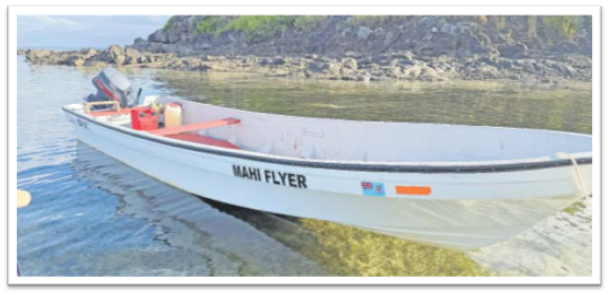
In a beautiful fusion of tradition and innovation, the new boat was named the “Mahi Flyer” (Masi Flyer), acknowledging the fact that the boat was bought with earnings from his family’s long-standing involvement in the tapa trade.
Overcoming challenges and looking to the future
Despite the steady demand for both ferry services and tapa, Mr Qionikorolevu faces challenges that come with any business.
Sometimes, customer demand can be unpredictable, and there are days when the income generated is barely enough to cover operational costs.
Some weeks, he makes as little as $40, which can make it difficult to meet the day-to-day expenses of running the business.
Yet, Mr Qionikorolevu remains undeterred, always looking for ways to keep the operations afloat.
“There are tough days, but we push through,” he said.
For the future, Mr Qionikorolevu plans to expand both the ferry and tapa businesses.
He aims to increase tapa production and improve the ferry service by introducing more boats as demand grows.
His vision is not only to ensure the continued success of his family’s businesses but also to create a secure environment for his children to thrive in.
A father of seven, Mr Qionikorolevu sees his work as a means of providing a solid foundation for his children’s education and future.
“There’s wealth in our resources,” he said.
“But it’s all about your mindset. If you’re lazy, you won’t earn any money. If you work hard, you’ll make it.” Mr Qionikorolevu said.
In the years to come, Mr Qionikorolevu hopes to continue growing his businesses, ensuring that they not only contribute to his family’s success but also play a significant role in preserving and promoting the rich cultural heritage of Vatulele.
SIGAVOLAVOLA
NOTE: This article was first published in the print edition of the Fiji Times dated January 25, 2025.

