
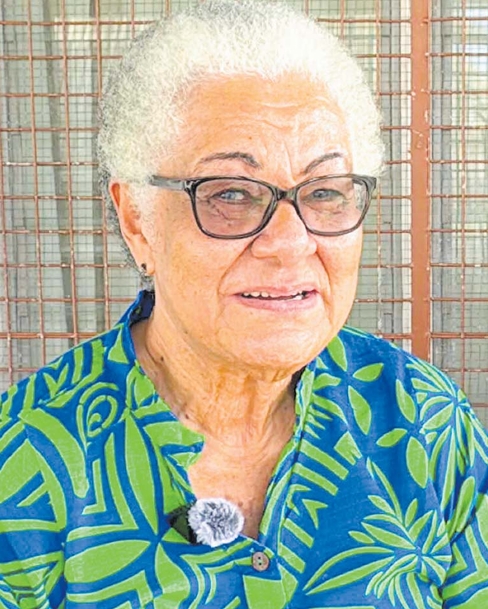
ADI Salaseini Kavu Fong had just retired. But when she thought she was done, a new calling beckoned. A request from the Tui Cakau set her on a new path – one that she has committed to for more than 20 years.
When she walked into the Soqosoqo Vakamarama iTaukei Cakaudrove (SVTC) in 2005 as its new president, there was barely anything to go by. Everything the organisation had ever known lived only in the memory of its women, passed down by mouth through generations.
“I didn’t know what I was getting into,” she said.
She called the women of the province together and proposed the simplest of asks: that each woman donate a dollar to support the operations and upkeep of the SVTC. The women were willing, and soon they collected $6000 – enough to open a bank account. Today, the SVTC has three accounts.
“Everything was passed on through our ancestors by mouth. Whenever there’s a changeover, it means starting all over again. At the time, we had nowhere to start from.”
Working village to village across all 15 districts of Cakaudrove, she and her SVTC team built a provincial board of 19 representatives, a constitution, and policies the organisation had never had.
“Listening to the demands about women at the rural level – I had to first understand what do they really want? And it was clear they wanted to be heard so that’s what we did.”
SVTC operates across 139 villages in the province today. Its small team of volunteers, with donor support, runs community awareness and training programmes that reach into districts across the province. Every three months, district representatives travel by bus or boat to Savusavu to meet, report and plan the next round of outreach.
When COVID-19 hit, meetings were split across two days. When that was not enough, they went online. A virtual entrepreneurship workshop reached 61 women across the province.
“Being old school, I relied upon the young people to tell me what to do. It was really satisfying. They’re still operating, and they maintain it.
“It’s no use introducing new stuff if we cannot sustain it,” she said.
Violence against women, long unspoken in the province, became a core focus. Village conversations pulled in drugs, digital platforms and financial literacy.
“These are all intertwined. When you don’t have money in the household, it affects the running of the home and impacts a lot of other things, contributing to other social ills.”
Faith cannot be separated from any of it. In Cakaudrove, it sits at the centre of community life, and Adi Salaseini said reaching people means using their beliefs as a point of entry for conversation.
“We have to approach them through their faith, both men and women and also the children. It’s a big challenge. But we mustn’t give up.”
She is also firm about who carries the responsibility.
“SVTC is not only a women’s organisation – it must be everybody’s organisation. The whole community is responsible, not only us.”
In 2020 she received a commemorative medal for Fiji’s 50th Anniversary of Independence for her contribution to the vanua and yasana of Cakaudrove.
She wants rehabilitation centres for young people caught up in drugs, not prison. She wants skills training kept inside the provinces so women do not have to leave their families to access it.
“I don’t believe in taking them out of where they are. Because that will also cause social problems. Women need to look after their families while being free to pursue other avenues of supporting their families.”
When it comes to the youth, she said they cannot be overlooked and must be engaged from the start.
“We sit with them, listen to them. We’ll put in a bit of advice – try this out and see whether you like it or not but the choice is theirs to make.”
Adi Salaseini’s dream is a centre where women across the province have their own space.
“In five years’ time, we hope to build a center where women can come and learn and create and be able to bring in their children – so they feel that they belong and it is their own.”
For someone who describes herself as old school, Adi Salaseini has not shied away from the changes that come with the times and recognises the importance of bringing the young and old together.
“Our vision, our mission is to preserve what is ours – our traditional knowledge. Then we carry it forward and pass it along to the younger and newer generations so they merge – that’s a sustainable approach to keeping our traditions, culture, and ways of being alive.”

