
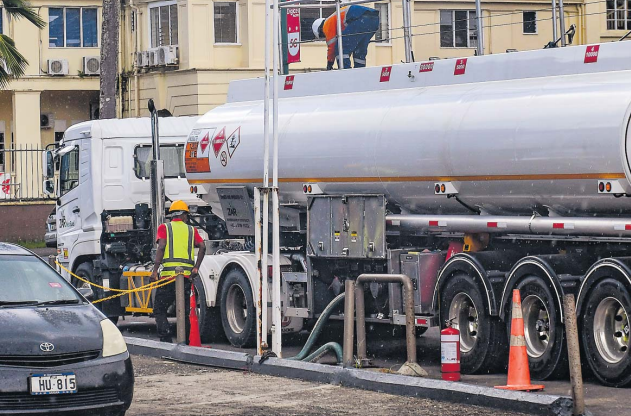
FIJI’S fuel crisis is no longer a question of if, but how hard the impact will be felt and how well the country can respond.
The escalating conflict in the Middle East has exposed a structural reality that Fiji has long lived with but rarely confronted so starkly. That as a small island economy heavily dependent on imported fuel, we have very little control over the forces shaping its cost of living.
What is unfolding now is not simply just a spike in fuel prices, but a wider economic squeeze that touches transport, food, electricity and ultimately household survival.
Government leaders were quick to reassure the public in early March that there would be no immediate fuel hikes.
Yet within weeks, prices rose, announced just hours before taking effect.
For April, the price of unleaded fuel increased from approximately $2.76 per litre to around $2.84 per litre, while diesel rose from about $2.36 to $2.44 per litre
This disconnect has understandably fuelled public frustration, however, what the wider public does not understand is that fuel pricing in Fiji is not politically controlled in the way many assume.
Under the Fijian Competition and Consumer Commission Act 2010, the Fijian Competition and Consumer Commission (FCCC) operate independently, setting fuel prices based on international benchmarks, shipping costs and exchange rates.
Its pricing mechanism includes a built-in lag, meaning today’s prices reflect global conditions from weeks, sometimes months, earlier.
In practice, this creates a delayed shock effect, even if global oil prices stabilise tomorrow, Fiji may still experience rising costs in the months ahead.
The economics of our prolonged shock
Former Deputy Prime Minister Biman Prasad has been candid about this inevitability.
According to Prof Prasad supply disruptions caused by war do not resolve quickly.
“Even in the event of a ceasefire, rebuilding production, stabilising supply chains and rebalancing global demand could take six months to a year or longer,” Prof Prasad said.
“In economics we say bad times last long.”
This is reinforced by the Asian Development Bank, which paints a sobering picture of Fiji’s vulnerability. As a net energy importer, Fiji absorbs global oil price increases more directly than larger economies.
When oil prices surged from around US$70 to near US$120 per barrel during the conflict, the effect translated into higher fuel bills, rising transport costs and mounting pressure across supply chains.
The numbers tell the story and under a prolonged conflict scenario, economic growth in the Pacific could fall by as much as 2.2 percentage points, while inflation may rise by up to 1.8 percentage points.
For Fiji, this is compounded by its reliance on tourism and imported goods. Any disruption to aviation routes, shipping logistics or global trade flows adds another layer of strain to an already exposed system.
And yet, the government maintains that Fiji is better positioned than before.
Fiji’s partial fiscal “buffer”
According to Prof Prasad, debt levels have been reduced from around 90 per cent of GDP to the high 70s, creating some fiscal breathing room.
In theory, this provides capacity to cushion the blow, through subsidies, targeted support or economic stimulus.
However, while the ratio has improved, Fiji’s total debt remains high in absolute terms, and the country continues to operate within tight fiscal constraints.
The International Monetary Fund has stressed the need for Fiji to rebuild fiscal buffers and rely on targeted support rather than broad relief, warning that risks remain elevated.
External pressures, including a persistent current account deficit and potential strain on foreign reserves, further limit the country’s ability to absorb prolonged shocks.
A fact, further supported by ADBs recent quantifying of the Pacific and Fiji’s vulnerability.
This means that while Fiji is better positioned than before, its fiscal space is still finite and how far that buffer can stretch will ultimately depend on the duration and severity of the global crisis.
But fiscal space, while improved, is not infinite. The scale and duration of the global crisis will ultimately determine how far that buffer can stretch.
Resilience at the household level
At the same time, the crisis is forcing a broader national conversation about resilience.
Minister for Agriculture Tomasi Tunabuna’s call for households to grow their own food may sound simplistic, but it speaks to a deeper truth that Fiji’s vulnerability is not just about fuel, but about dependence.
The more the country relies on imported energy and goods, the more exposed it becomes to external shocks beyond its control.
“Fijians are saying ‘we are struggling to put food on the table,” Mr Tunabuna said.
“We are not struggling to put food on the table, we are just not very actively growing our food.”
The current fuel crisis is both an immediate challenge and a long-term warning.
And as Mr Tunabuna said, Fiji needs to diversify its energy sources, invest in renewables, strengthening local production and reducing import dependence.
Grace Road is already preparing for the inevitable, by buffing up their production with local produce to offset the importing and freight costs.
These are not quick fixes but they are necessary if Fiji is to avoid repeating this cycle every time global instability strikes.
For now, however, Fiji is entering a period of sustained economic pressure, driven largely by forces far beyond our shores.
The question is no longer whether the country can avoid the impact but whether it can manage it in a way that protects its most vulnerable and builds a more resilient future in the process.

