
A life-long journey full of lessons!
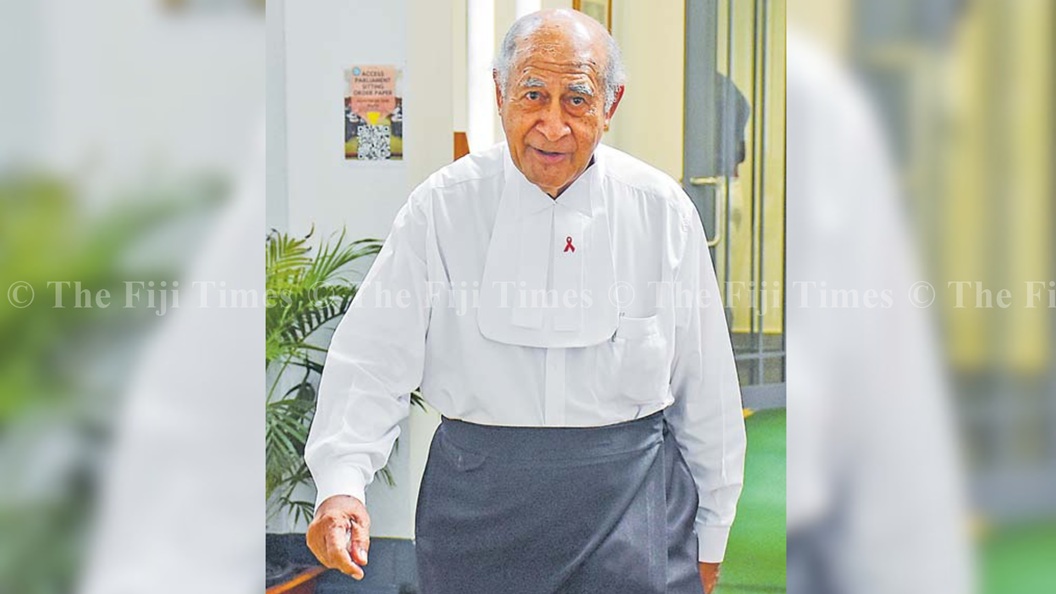
The nation united to mourn the passing of Ratu Epeli Nailatikau. Tributes have flown from across the country and overseas for an industrious statesman, a distinguished chief, the people’s leader and a respected servant of the people. I was saddened to hear about the loss of Ratu Epeli who possessed the ability to connect with ordinary citizens on a down-to-earth platform. Ratu Epeli lived a life that was defined by a commitment to serving others before self. The former Commander of the Republic of Fiji Military Forces, President of Fiji from 2009 to 2015 and Speaker of the Parliament from 2019 to 2022 has left lessons to embrace. Many saw him as their role model as he was seen as an experienced diplomat and a national leader. He was widely respected by ordinary citizens for his leadership and dedication. The 85-year-old leader was deeply revered by many because of his humility. He was approachable, and he posed for a smile whenever he was approached for a selfie or photo. He walked the streets without escort and never hesitated to stop and speak with ordinary citizens. Ratu Epeli was also a strong advocate for HIV/AIDS awareness. It is hard to find a leader like him whose life was defined by service. Beyond his chiefly lineage, his commitment, perseverance and dedication shaped his legacy. He served his roles with dignity and strength. I express my deepest sympathy and condolences to Adi Koila Nailatikau and the family and the people of Bau. Rest in peace, the people’s leader, courageous soldier, hero and warrior! Until that glorious morning, ni moce mada! Rajnesh Ishwar Lingam Nadawa, Nasinu
Economic shock
The recent decision by the Government of Victoria to provide free public transport for a month is a timely and practical intervention. However, it may not solve the problem entirely, but it sure does offer a short-term solution for householders to navigate through the rising cost-of-living. For a small country like ours, the pressure on ordinary households continues to intensify. The first being the proposal for EFL tariff increase (the decision is expected to be out by mid-April) and now the rising fuel crisis. The Fijian consumers are silently watching these ordeals unfold before them, without any tangible solutions from the regulatory bodies. At a time like this, I genuinely feel that it would be both reasonable and necessary for our government to step in with immediate relief measures that could absorb some of the economic shocks laid onto the consumers. It could be a short-term measure notwithstanding all other fiscal policy implications. It’s not needed but warranted. Kartik Krishneel Makoi, Nasinu
Who is responsible?
I’m not sure if the individuals selling green coconuts along the roadside between McDonald’s and the Wailoloa Rd Junction in Nadi have the necessary licensing or permits from the Fiji Roads Authority and the Nadi Town Council. Regardless, it seems they’re there due to demand and because it’s their livelihood. As long as these vendors don’t engage in theft or harassment, I don’t see a major issue — other than the problem with littering. Every day, heaps of rubbish left behind by the sellers are visible to passersby, including both locals and international tourists. This litter not only pollutes the scenic area but also damages our public image. I’d like to know how the council plans to address this ongoing problem. If these vendors are allowed to continue operating, they should be educated on proper rubbish management practices. The site has been a hub for roadside selling for years now, whether permitted or not, but I believe it’s time for authorities to take decisive action. Vendors should either meet the necessary requirements or cease selling in this area. It’s a straightforward solution. Suresh Chand Nadi
Dangerous gamble
I write as a resident of Saweni, Lautoka, in firm opposition to the proposed waste-to-energy incinerator at Vuda Point. While promoted as a modern solution, global evidence shows these facilities carry serious and lasting risks.
Incinerators emit toxic pollutants including dioxins, heavy metals, and fine particulate matter (PM2.5), all linked to cancer, respiratory illness, and cardiovascular disease. These risks are not theoretical. Communities living near such plants consistently report higher health burdens. For Saweni residents, this represents an unacceptable threat to public health. The environmental risks are equally concerning. Vuda Point is a sensitive coastal area connected to marine ecosystems that support fisheries and livelihoods. Incinerators produce hazardous ash that requires secure disposal. In a small island setting like Fiji, any failure in containment could lead to soil and ocean contamination. Labeling this as “green energy” is misleading. Economically, such projects often fail. The Harrisburg Incinerator pushed its city toward bankruptcy due to massive debt. The Detroit Renewable Power Facility faced long-standing pollution issues and eventual closure. Across Europe, similar plants have locked governments into costly contracts that discourage recycling. In Australia, multiple proposed incinerators have faced strong resistance due to concerns over emissions, environmental justice, and incompatibility with circular economy goals. These examples highlight a clear pattern of financial and operational failure. Socially, property values in Saweni and surrounding areas will likely decline, while residents face the stress of living near a known pollution source. This is not development. It is a burden placed on communities without their consent. Fiji has committed to environmental stewardship and climate resilience. Approving an incinerator contradicts these goals. Sustainable alternatives such as waste reduction, recycling, and composting are safer and more forward-looking. As a resident of Saweni, I reject the notion that our community should become a testing ground for a risky technology. The burden of pollution, health risks, and economic uncertainty must not be placed on the shoulders of ordinary citizens for the sake of a project that has repeatedly failed elsewhere. Depika Prasad (Dr) PhD (Plant Biotechnology) Saweni, Lautoka
Fuel crisis
Let’s go for cheaper options between fuel and food. Home grown food is cheaper, healthier and readily available. Wise choice! Tahir Ali Hamilton, New Zealand
Soccer news
Ba FC donates gate-takings (FT27/3/26) to wife of former Ba and national football rep “who is currently battling cancer”. I applaud Ba FC for its progressive initiative for the welfare of the former player and Fiji FA for facilitating it. Is this a first in Fiji soccer? I recall when Suva rep Umesh Murthi was paralysed through an on-field incident his family struggled to obtain support. I hope this Ba FC initiative becomes an integral part of the player welfare culture in Fiji soccer. Rajend Naidu Sydney, Australia
Ellington wharf
Strengthen regulations with heavy fines so shipping companies can respect the law and not create unnecessary situations. It’s not the first time the travelling public have suffered. Dan Urai Lautoka
Jolted into action
Let us hope that our Coalition Government is jolted into action during this fuel crisis. The prices of goods and services will increase. The announcement by Grace Road to set up a juice factory should be welcomed. Companies should think of ideas where many things used everyday can be recycled. Countries that seriously begin to prepare themselves for the coming disaster will be in a better position to deal with it. Australia has already made public transport free to accommodate people who park their cars at home. Rakesh Chand Sharma Adelaide, Australia
Public transport
With the growing crisis in the Middle East, and its impact on global oil prices, this is the ideal time for Government to roll out its plan to tackle, not just the fuel problem, but the daily traffic congestion, particularly in the Suva Nausori corridor. Have you seriously thought about free public transportation? Do it and you kill more than two proverbial birds with one stone. Samu Railoa Vanuabalavu
FNPF we’re still waiting
I thought we had seen the last of that Fiji National Provident Fund (FNPF) mouthpiece Geoff Rashbrooke. But alas he re-emerged to share more of his thinking on the FNPF pension scandal that won’t go away. His latest ramblings were in The Fiji Times of March 21. My first inclination was to disregard them. His writing was, as usual, mostly impenetrable, relating to the specialised work of risk assessment and management handled by actuaries like him. I also decided I would ignore his strange denial of the existence of a Pension Buffer Fund. However, I was drawn to one item in particular that finally compelled me to write a limited response. He asserted that the FNPF became insolvent – meaning it couldn’t pay its debts. Insolvency signified a state of severe financial distress for this crucial national financial institution. Mr Rashbrook mentioned options for dealing with this potentially ruinous problem but did not disclose how it was finally resolved. I have followed the affairs of the FNPF for many years, and I cannot recall any specific news about it falling into insolvency. That’s why I became so focused on Rashbrooke’s clear assertion this had happened. So, Mr Rashbrooke since you’ve decided to comment again on the FNPF’s shocking treatment of several thousand elderly people, could you please tell us about this FNPF insolvency that somehow escaped public scrutiny? Perhaps you were referring to “technical insolvency”? My sense of the FNPF is that it is still very well placed financially as indicated in its regular public pronouncements. Yet it refuses to meet its commitment to some 1400 pensioners remaining from the original 2012 victims. They were all targeted for severe unlawful cuts to their contracted payments. The casualties also involved those who opted reluctantly to take lump sums. This was at a time when then FNPF chief executive, Aisake Taito, announced the Fund “was acting from a position of strength”. The Prime Minister of the time, Voreqe Bainimarama, also stressed the FNPF was in a “strong financial position”. He indicated it was sustainable for 40 years – approximately half a lifetime. To add to the projection of financial well-being the Fund subsequently increased the sustainability figure to 45 years. My message to the FNPF directors and management is that we’ve been waiting for far too long. I’m 81, living on a shoestring budget with responsibility for a daughter with health challenges. How do you keep justifying your callous treatment of me and my fellow sufferers? Dewan Chand Namadi Heights, Suva
HIV crisis
Fiji is already being battered with a barrage of serious national challenges, and the rising number of HIV/AIDS cases has now become another grave concern for the country. As Navneet (TD) had mentioned (FT 30/03), there are multiple reasons behind low condom use, including lack of awareness, social stigma, accessibility issues, and, in some cases, disregard for the risks involved. This highlights the need for stronger, more effective community-driven responses that go beyond simply issuing warnings. Concerned citizens could take a more active role by coming together to organise awareness marches in major towns and cities. Such efforts could focus on advocating and educating people about the risks of HIV and the importance of practising safe sex. A campaign with a striking and firm slogan, such as “no rubber, no kaba” could help reinforce the importance of protection while encouraging more responsible choices. Be wise, condomise! Nishant Singh Lautoka

