
THE people of Fiji should be given the power to elect their President.
Former attorney-general Graham Leung argued that the current system, where Parliament appointed the President, may not best reflect the role’s symbolic importance.
Mr Leung said under the present constitutional arrangement, the President was chosen by elected members of Parliament. However, he questioned whether this process aligned with the expectation that the office remained above politics.
“I personally believe that the President, being the symbol of national unity, should be expected to be above parties and politics,” he said.
“He or she, a president of our country, is expected to be politically neutral, especially in a country such as ours, embodies national unity and institutionalises consensus.”
Mr Leung suggested that a more appropriate system could involve direct public participation.
“I think a better way of choosing the President is by popular vote of the people.”
He acknowledged, however, that Fiji’s demographic makeup would likely influence outcomes under such a system.
With the iTaukei population forming the majority, he noted that an iTaukei President would be the probable result.
“But if that is the will of the people, I’m comfortable with that.”
Under the 2013 Constitution, the process for appointing the President is outlined in Section 84.
When a vacancy arises, the Prime Minister and the Leader of the Opposition each nominate one candidate.
Parliament then votes, and the nominee who secures a majority of votes from members present is appointed President.
Lawyer says significant limitations on rights in 2013 Constitution
ALTHOUGH the 2013 Constitution appears to guarantee strong rights, those freedoms are in reality tightly
restricted and limited in practice.
This was highlighted by former attorney-general Graham Leung, who said Fiji’s current Constitution reflected a concentration of power in the hands of “two individuals”.
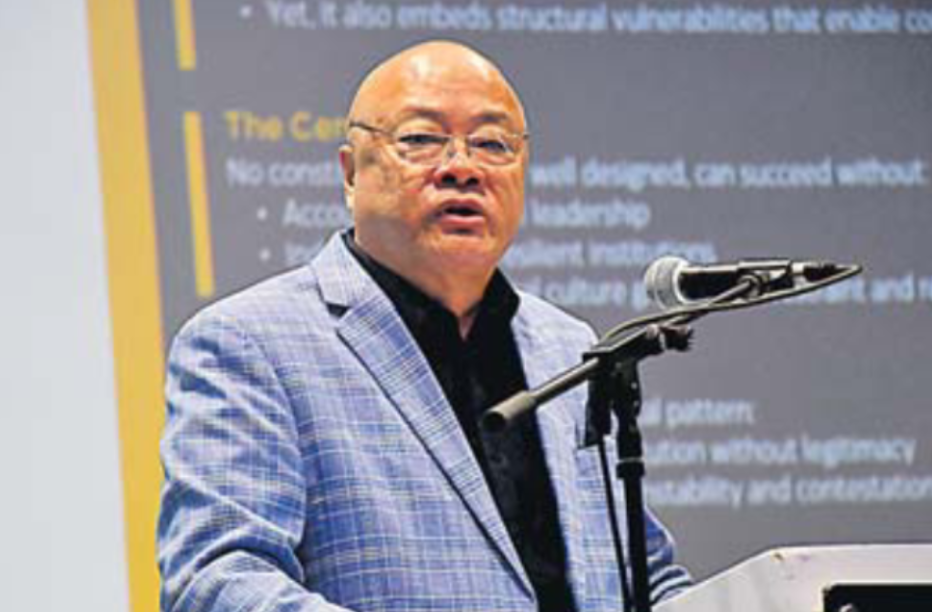
Speaking at the ‘Amending Fiji’s Constitution’ dialogue at the Fiji National University’s Nasinu Campus, Mr Leung said the 2013 Constitution was initially presented as progressive, particularly through its Bill of Rights.
He noted that it included provisions such as freedom of speech, freedom of association, the right to privacy and access to information.
However, Mr Leung said a closer examination revealed significant limitations placed on many of these rights.
“If you drill down a little further, you will see that the Constitution has serious limitations on many of the
rights that have been prescribed,” Mr Leung said.
He said under the 1997 Constitution, the rights could be limited on the ground that they were necessary or
justifiable in a free and democratic society.
“That language is missing from the 2013 Constitution,” he said.
Mr Leung said the document reflected a period when power was concentrated among a small number of
individuals, which he described as “unhealthy and skewing” the Constitution towards authoritarianism.
He said this concentration of power undermined democratic principles.
Mr Leung also referred to the period of military-backed rule, noting that 103 promulgations were enacted
between April 2009 and the abrogation of the 1997 Constitution, followed by 328 decrees before the 2014
General Election.
He said many of these laws contained what were known as ouster clauses, which prevented judicial review and limited the ability to challenge decisions in court.
Mr Leung said the Constitutional Review Commission should carefully examine these provisions moving
forward.

