
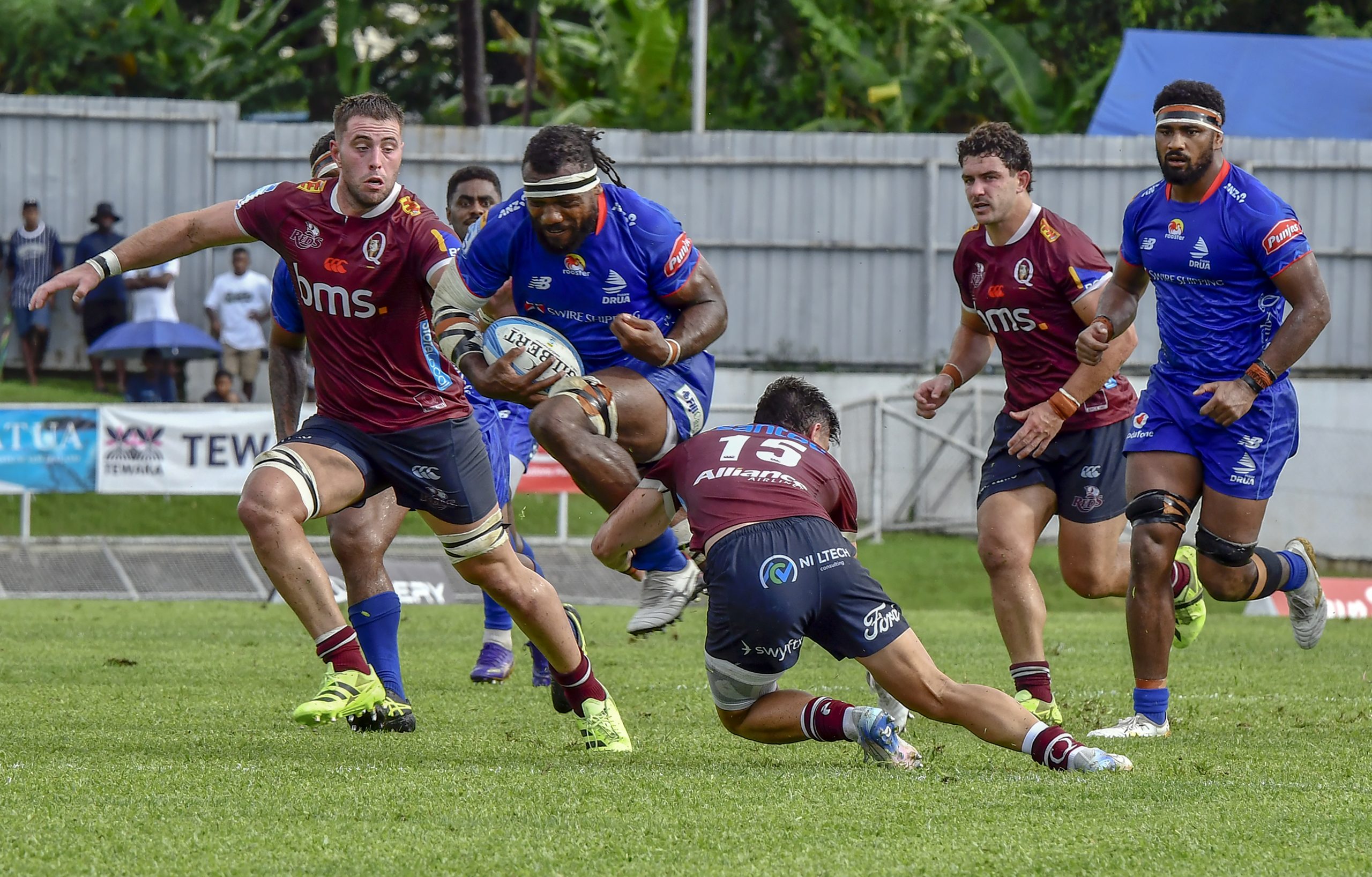
Drua needs consistency
The Fijian Drua needs to somehow maintain extremely important consistency, more than anything else.On 4R Electrical Ground in Ba, the Drua performed exceptionally well against the Brumbies. A truly historical first match in Ba. Super sweet home victory on the turf in Ba. Wow! What a win. Our play fell apart against the Reds in the second 40 minutes. We held a 6-7 scoreline at the break. Pity, two certain tries went begging. The Drua had almost 40 missed passes and poor handling. We spilled the ball over the try line. Some seven certain tries were lost. The rest is all missed opportunities. It was a hard match to watch. Eden Park, Auckland will feature wet and cold weather for the Drua — around 18°C this weekend. The Blues will hold their own. Victory for the visiting team will be a tough ask. Upsets can happen. The Drua must lift their match at least 200 percent for the entire 80 minutes against favourites, Auckland Blues. Impossible is nothing. Toso tale Drua. Toso. Ronnie Chang Martintar, Nadi
Value of the tabua
You’re right, Pita — the value of a tabua (FT 25/03), was never about its size or how it compares to a packet of Rewa Life. In our tradition, it’s worth lies in the isavu (the history and effort) and the rarity of obtaining something from a monster of the abyss. Our fathers knew that every true treasure requires great effort and sacrifice to gain. Just as we must crush the rock to find gold, dive into the deep for pearls, or drill into the inner Earth for oil, the tabua represents the ultimate struggle to bring a gift from the darkest depths of the ocean, thus the value. Buying a ‘whole whale’ might be cheaper in your eyes, but it carries none of the mana or the weight of the traditional protocols that a single tooth represents. It’s not just a tooth; it’s a sacred connection to the abyss and our heritage that cannot be measured by a price tag. Peceli Alistir Waitolu, Naitasiri
What a garbage joke
No way we are going to import almost a million tonnes of garbage to burn for energy generation each year. Sometimes I wonder what part of the body some people think from. If I read and heard it correctly, the EIA report of 1529 pages says it’s not a bad thing. If this stupidity disguised as investment is allowed to go ahead, very soon Aussie garbage bins will have Fiji written on them to indicate to the Aussies what to chuck where. Donald Singh Nausori
Rubbish pollution
I read the recent and well researched Facebook post of Charlie Charters on the proposed Waste to Energy plant at Vuda and was surprised by the allowance of Government for the project to proceed to this point. Mr Charters lays out the argument that this plant will be severely detrimental to the pristine environment of our coastline around tourism properties along with the fine dust from the plant. Put together with the perception of major pollution, it will be a danger to the growth of our tourism industry. To the Government, please listen to public concerns and ban this project forever. This will be your legacy, decades after you have gone. Conan Hatch Nadi Airport
Probe on human remains
Authorities are still looking into five separate cases of human remains discovered between December last year and February this year. Among these cases, I believe two have been confirmed as murders, but no one has been charged yet. In response to media inquiries, police stated that they are treating the death of a woman found near the Lautoka Special School on December 5 last year as a murder. Police mentioned that a suspect was questioned but was later released while they await forensic analysis results. The woman has been positively identified. Another case involves a decomposed body found in a cane field in Tunalia, Nadi, on December 28 last year. This case is also classified as murder. The victim has been identified, and a suspect was questioned and released as authorities wait for forensic test results. A third incident occurred on December 30 at the Tamavua-i-Wai Settlement in Wairua, where the body of a 15-year-old boy was discovered. Although he has been identified, the cause of death remains unknown due to advanced decomposition. A potential suspect was interviewed and released, with investigations still ongoing. In another case, a partially decomposed body was found on February 28 this year at Naidiridiri Settlement in Nakasi. The identity and cause of death of this individual are still unknown due to severe decomposition. Authorities are continuing their investigation. Lastly, regarding a body found in mangroves near Vatuwaqa Bridge on January 7 this year, police report that they are still working to identify the victim. A post-mortem examination has not yet been performed. Investigations into all five cases are ongoing as authorities seek to uncover more details. This situation indicates that we are indeed witnessing something unprecedented. Suresh Chand Nadi
A grand initiative!
The captains of all participating clubs looked smart and elegant in their outfits as they posed for the captain’s photoshoot at the Damodar Arts Village in Pacific Harbour. What touched hearts was the fact that these captains took time to plant indigenous plants and trees. I believe this is a great team bonding session and the need to appreciate our environment and the surroundings around us. I salute Lawrence Tikaram and the host committee and Div Damodar for this grand initiative that brought rugby and nature and promoted unity. This will enable the young generation to appreciate sports, culture and the need to protect our environment. The 50th Fiji Bitter Marist 7s competition is set to attract a good crowd to the HFC Bank Stadium. The focus must be clean rugby (away from drugs) and keeping our national stadium litter-free, while igniting friendship, unity, camaraderie and oneness. The Marist 7s has for ages nurtured grassroots rugby and unveiled a host of Fijian 7s players, and for that, I’m truly indebted to the past and present organisers. I’m also looking forward to the battle between our former 7s stars. These 7s legends will bring back a lot of beautiful memories. Rajnesh Ishwar Lingam Nadawa, Nasinu
Code of conduct
WITH the substandard leadership, lack of professionalism, attitude problems already characterised by some members of three-wheeler Coalition Government MPs and some of those holding higher offices, just imagine a government without a code of conduct bill. AREKI DAWAI Suva
Traditional ways
Many may be preparing to go back to traditional ways to save fuel. Let’s increase God’s blessed natural power like solar, animal, manpower, and two-wheeled transportation. Less fuel for healthy living. Tahir Ali Hamilton, New Zealand
Lift breakdown
With the constant breakdown of lifts at the Colonial War Memorial Hospital, a place now looking more haunted than healed, perhaps it’s time to call in the “professionals” for an exorcism, starting with the infamous East Wing. Something definitely supernatural going on there. Meanwhile, national debates rage on about whether vernacular languages should be mandatory in schools, but one can’t help but notice the grim irony. Patients in urgent need of surgery at CWM are being hauled up flights of stairs in bedsheets like we have time-travelled back a century. Nothing given to efficiency, dignity and patient safety. It’s a sobering snapshot of priorities gone astray. Shameful indeed! Nishant Singh Lautoka
My response
By now Rajend Naidu should have realised that Pulitzer or Nobel Peace Prize are no longer prestigious. Brother Rajend, I believe your most admired Nobel laureate, Mohammed Yunus silently scooted out two days after the Bangladesh elections. Rakesh Chand Sharma Adelaide, Australia
Effective communication
I have yet to see a copy of the new national Communications Guidebook (FT 24-5/26) but I am sure that if its intention is to enable Government to “reach every Fijian” it will have detailed plans to set up a department of communication in the languages that Fijians actually speak: Fijian, Fiji Hindi, Rotuman etc, and that it will be staffed by people trained to communicate in these languages. Otherwise, it seems to be a waste of time. Pretending that everyone in Fiji speaks English continues a latter-day colonial delusion and is not only an insult to speakers of vernacular languages, it also disenfranchises the vast majority of our population. In the next election, it will be the party that communicates most effectively in our vernacular languages that will carry the day. Paul Geraghty USP, Suva
Simple English
I am appalled at the number of foreigners living and working in the country that can’t speak basic English. Makes one wonder how did they get their visa issued. Sobo! Wise Muavono Balawa, Lautoka
Imported waste and border security risks
We, the concerned community of Vuda–Saweni, wish to raise a critical national issue regarding the proposed waste-to-energy facility at Naikorokoro Point — specifically, the reported importation of up to 700,000 tonnes of foreign waste and the serious implications this presents for Fiji’s already stretched border control systems. Fiji is currently confronting a rapidly escalating drug crisis. Recent high-profile interceptions, including the seizure of over 2.6 tonnes of cocaine in waters near Tavua earlier this year, have exposed the increasing sophistication and scale of transnational criminal operations using our maritime borders. These are not isolated incidents — they are clear indicators that Fiji is now firmly within the operating corridors of international trafficking networks. At the same time, the domestic impact is undeniable. The rise in methamphetamine use and associated social harm is placing growing pressure on law enforcement, health systems, and communities nationwide. It is within this already strained environment that the proposal to import massive volumes of foreign waste must be carefully scrutinised. Border control, customs, biosecurity, and policing agencies are already operating under significant pressure —tasked with monitoring vast maritime zones, increasing cargo flows, and evolving criminal tactics. The introduction of hundreds of thousands of tonnes of imported waste annually would represent a substantial escalation in inspection demand, compliance verification, and enforcement oversight. This raises unavoidable and serious questions:
How will authorities realistically and effectively inspect and verify such volumes without diluting existing controls?
What additional resources, infrastructure, and personnel will be deployed to manage this increased burden?
Can we confidently guarantee that such a system will not be exploited as a pathway for illicit substances, hazardous materials, or other contraband?
Experience globally shows that large-volume, low-visibility imports — such as waste — can present attractive concealment opportunities for organised crime, particularly where systems are already under strain. One additional point that warrants careful consideration is the downstream risk associated with the repatriation of containers to Australia. Specifically, the potential for these containers to become a conduit for illicit substances entering the Australian border system. Given current regional drug trafficking dynamics, any increase in container movement — particularly from waste streams — inevitably heightens the overall risk profile and places further pressure not only on Fiji’s border control systems, but also on those of our regional partners. This raises not only a domestic enforcement concern, but also a serious bilateral and regional security implication. The integrity of containerised trade flows is fundamental to maintaining trust between jurisdictions, and any perceived vulnerability — particularly involving waste imports and exports —could expose both Fiji and Australia to unintended consequences within established customs and biosecurity frameworks. It is, therefore, an issue that warrants careful consideration from both a national security and international responsibility perspective. This is not a criticism of our enforcement agencies. On the contrary, their efforts and recent successes demonstrate both capability and commitment under challenging conditions. However, it is precisely because these systems are already stretched that the introduction of a high-risk, high-volume import stream must be approached with extreme caution. National security, public health, and border integrity must not be compromised by decisions that may unintentionally create new vulnerabilities. We, therefore, respectfully but firmly urge that a full and transparent risk assessment be undertaken — one that specifically addresses border security capacity, enforcement resourcing, international implications, and the cumulative strain on national systems — before any approval of this proposal is considered. The stakes are too high for anything less. Lee-Ann Forrest On behalf of concerned community of Vuda–Saweni

