
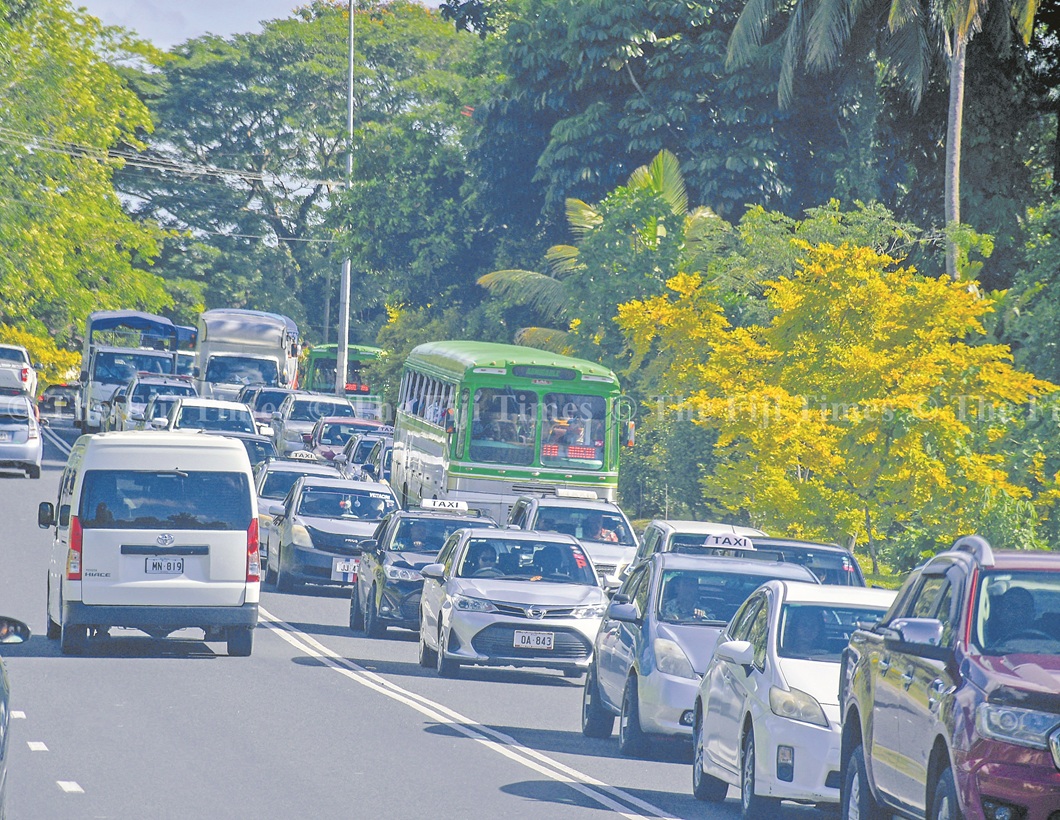
As Fiji grapples with emerging fuel shortages — with stocks reportedly between 20 and 45 days depending on the product amid tensions in the Middle East — and rising cost-of-living pressures, we must stop treating these events as isolated disruptions.
They are not. They are stress tests of the kind of economy we have built.
WHEN fuel becomes scarce or more expensive in Fiji, the consequences do not stop at the pump. They move quickly through transport, electricity, goods distribution, farming inputs, retail prices, and household budgets. In a country that imports a large share of its food, a fuel shock can quickly become a food-affordability shock. For families already living close to the edge, that becomes a household crisis.
The real national question, therefore, is not simply whether there is a temporary fuel shortage. The deeper question is whether Fiji has prepared itself economically to survive a crisis without borrowing more, taxing more, or selling national assets to get through it.
Because people do not live on GDP headlines. They live on daily survival requirements:
- energy independence;
- food security;
- water security;
- health and wellbeing;
- financial stability;
- quality education;
- public safety;
- good governance; and,
- reliable infrastructure and logistics.
These are not abstract policy ideals. They are the foundations of ordinary life. And if those foundations are weak, then any external shock — fuel, food, freight, currency, debt, or disaster — quickly becomes a national welfare crisis.
The numbers behind Fiji’s vulnerability
The structural weakness becomes clear when we look at the numbers. Fiji spent about $F1.6 billion importing refined petroleum in 2024, making it the country’s single largest import category. In the same year, Fiji spent around $F1.1 billion importing food and agricultural products, particularly crop and livestock commodities.
Together these outflows exceed $F2.7 billion every year — money that briefly circulates domestically before leaving the country permanently.
The scale of the problem becomes clear when we reduce it to one simple national equation.
Every year Fiji must earn this foreign exchange simply to keep the country powered and fed.
It is important to distinguish this from the standard economic lens of exports versus imports. Fiji’s vulnerability is not defined by whether foreign exchange inflows exceed outflows. It is defined by how much of the essentials of life — food and energy — must be sourced from outside the country. Fiji does earn foreign exchange not only from tourism and remittances, but also from goods exports such as sugar, gold, fish, timber, and bottled water. Yet even with these inflows, the country still depends on roughly $F2.7 billion in essential imports each year. That means exposure to global price shocks and supply disruptions remains high regardless of the overall trade balance. In other words, an economy can appear externally stable on paper, yet remain structurally fragile in practice.
To put this in perspective, that figure represents a massive structural leakage of national income tied directly to basic survival needs: Fuel and food.
True, Fiji is not without buffers. Foreign reserves remain comfortable at roughly $F3.7 billion, covering around 5–6 months of imports, and the country benefits from strong tourism earnings and remittances that bring in valuable foreign exchange.
But repeated external shocks still drain these buffers. When fuel prices spike or supply chains tighten, the pressure quickly reaches household budgets. And that is where the real vulnerability lies. This dependence also creates a predictable economic chain reaction that many households now recognise.
The Forex drain behind the growth numbers
Part of the confusion lies in how we measure economic success.
Import-driven consumption can coincide with higher household spending, but every dollar spent on imported fuel, wheat, rice, or processed food also worsens the trade balance and drains foreign exchange reserves.
In simple terms:
Rising imports » higher consumption spending » GDP appears stronger
BUT » worsening trade deficit + permanent loss of foreign exchange » reduced resilience
This creates an illusion of progress. Economic activity appears healthy while households and the nation become more exposed to global price shocks.
A system built heavily on consumption and imports can look stable in calm seas.
Until the storm hits.
How the structure was created
To understand how Fiji arrived here, we must look back several decades.
Beginning in the late 1980s and 1990s, Fiji liberalised large parts of its economy as part of broader structural reforms that reduced tariffs, opened markets to international competition, and deregulated key sectors.
Liberalisation itself is not inherently harmful. But in Fiji’s case it often occurred before strong domestic productive capacity had been built — a process compounded by the political instability of the 1987 and 2000 coups, which deterred long-term investment in agriculture, manufacturing, and local industry.
Imports expanded rapidly while domestic capacity struggled to keep pace. Over time, the economy became increasingly dependent on foreign supply chains rather than on its own productive base.
Growth appeared in the form of imports, consumption, tourism inflows, and remittances. But resilience — the ability to produce essential goods locally — did not expand at the same pace. And that imbalance is what makes external shocks so dangerous today.
A country with real strengths, but also real vulnerabilities
Fiji is not starting from zero. Tourism generates roughly $F3.5 to 4 billion annually, while remittances contribute around $F1.1 billion each year, providing vital foreign exchange inflows.
The country has set a target of achieving close to 100 per cent renewable electricity generation by 2036, and recent government programs have installed hundreds to over a thousand solar home systems in rural communities, while continuing to extend grid access to additional households. These are real national assets.
The question is whether they are being scaled fast enough to offset the structural vulnerabilities that remain.
What lowering the cost of living really requires
If Fiji is serious about lowering the cost of living, the solution cannot rely solely on subsidies, speeches, or temporary relief.
The real solution is simple: Reduce structural dependence.
That means strengthening four foundational pillars of economic resilience.
The solution is not a collection of disconnected policies. It is a production system — one that starts where resources, land, and people already exist.
Landowner-led village enterprise — rebuilding productive rural economies
The most powerful engine for change lies in Fiji’s 1193 villages. Today the contradictions are stark: Fertile land lies idle while food is imported, rural labour migrates overseas under PALM and RSE schemes, and villages import food they could produce themselves, even as the national food bill exceeds $F1.1 billion annually.
At the same time, Fiji already has the labour force it needs. Thousands of workers have gained hands-on experience through the PALM and RSE schemes — learning commercial farming, harvesting systems, and production discipline in some of the world’s most efficient agricultural environments.
The question is not whether Fiji has the labour, but whether it has created a pathway for that capability to be used at home.
Redirected into village-based enterprise systems, this experienced workforce could help activate idle land, scale production rapidly, and transform food imports into domestic industries.
Yet despite having land, labour, and growing domestic demand, these elements are not being brought together into a coordinated production system. This is not a cultural failure. It is a design failure.
Fiji’s land laws were designed primarily to protect communal ownership, which they have successfully done. But they were never designed to mobilise that land for organised production at scale.
The system enables leasing — not landowner-led enterprise.
What is missing is the institutional middle: The architecture that links communal landholding units to productive village economies — pooling land by consent, organising labour, accessing production-linked finance, and supplying guaranteed markets aligned to national demand.
A practical pathway is to establish inter-generational development plans for each of Fiji’s villages, tailored to their soil, climate, resources, and human capacity. When aggregated nationally, these plans can feed directly into a co-
ordinated import-substitution program.
Food security — producing more of what we eat
Fiji imports around $F 1.1 billion worth of food and agricultural products every year, much of it food the country is capable of producing locally.
Yet, large areas of fertile land lie idle while villages import rice, milk, meat, and cooking oil.
Closing this gap requires more than encouraging farmers. It requires system design: Irrigation infrastructure, cold-chain logistics, coordinated supply chains, and land reforms that enable productive use of idle land.
Production must be linked directly to demand — supermarkets, tourism, schools, hospitals, and processors — so farmers produce into guaranteed markets rather than uncertainty.
Local manufacturing — reducing import leakage
Many everyday goods consumed in Fiji can be produced domestically if the right incentives exist.
Targeted tax incentives, duty concessions, and industrial support can help build import-competing industries — particularly in food processing, agro-manufacturing, packaging, and light industry linked to agriculture and fisheries.
The goal is not isolation from global trade, but retaining more value locally before imports fill the gap.
Energy independence — expanding solar and local energy systems
Energy sovereignty must move beyond large power stations and into households and communities.
Encouragingly, the technology pathway already exists — and Fiji has begun moving in this direction. Recent installations of solar home systems in rural communities demonstrate that distributed energy models work.
In Fiji’s sunlight conditions, a 10–15 kW rooftop solar system can generate enough electricity to power a household, run modern appliances, and charge an electric vehicle. Combined with battery storage and induction cooking, such systems enable families to produce a substantial share of their own energy needs.
When households generate their own electricity, two things happen simultaneously.
First, the national fuel import bill begins to fall.
Second, families gain direct protection from global energy price shocks.
An electric vehicle charged from rooftop solar is not simply a car. It becomes part of a household exit from fuel dependence.
If adopted widely, household solar and electrified transport could begin to chip away at Fiji’s $F1.6 billion annual fuel import bill, turning abundant sunlight into one of the country’s most valuable economic resources while creating thousands of local jobs.
In other words, energy sovereignty can begin at the household level.
What even modest import substitution could mean
If Fiji is currently leaking about $F 2.7 billion a year, even modest substitution would have significant effects. At 10 per cent substitution, Fiji retains about $F270 million annually. At 50 per cent, that rises to about $F1.35 billion retained locally.
This is not just foreign-exchange savings — it is domestic production, jobs, and income circulating within the country. In other words, even partial substitution is not marginal. At national scale, it becomes a major engine of resilience.
Beyond economics — the hidden gains of redesign
The implications of this shift extend well beyond economics.
When a country produces more of its own food, the impact is not only economic — it is physical. Greater access to fresh, locally grown food reduces dependence on highly processed imports that are driving Fiji’s non-communicable disease crisis. Health outcomes improve, and long-term pressure on the healthcare system begins to ease.
When production expands within villages and regional centres, rural economies begin to revive. Employment opportunities grow closer to home, reducing the need for outward migration and allowing families to remain connected to land and community.
That shift carries powerful secondary effects.
Less rural-to-urban migration reduces pressure on informal settlements, easing the housing shortage in urban areas. It reduces congestion on already strained road networks, lowers transport demand, and improves overall quality of life in towns and cities.
It also strengthens social stability — keeping families together, preserving community structures, and reducing the social dislocation that often accompanies economic migration.
At the same time, local production and distributed energy systems reduce exposure to global supply shocks, making both households and the national economy more stable. This is not just an economic adjustment. It is a redesign of how a nation lives — how it eats, works, moves, and sustains itself.
The deeper question for Fiji
The emerging fuel shortage therefore raises a deeper national question.
Is Fiji economically prepared to withstand a crisis that cascades from fuel into transport costs, electricity prices, and food affordability?
Or has the system been designed in a way that forces the country to rely on borrowing, subsidies, and external supply chains whenever shocks occur?
Because what we are seeing is not a temporary disruption.
It is the exposure of a structural reality: An economy that leaks roughly $F2.7 billion every year simply to stay powered and fed.
That leakage feeds a predictable cycle — fuel imports driving transport costs, transport costs driving food prices, food prices pressuring households, and pressure pushing the system back toward borrowing and continued dependence.
Economic resilience is not measured by how much a government can borrow during a crisis.
It is measured by how well households can continue to eat, move, power their homes, and sustain their livelihoods when external shocks occur — without that cycle repeating.
A national lesson
Fuel shortages do not create Fiji’s weaknesses. They expose them.
For too long, economic motion has been mistaken for economic strength — imports rising, spending increasing, GDP appearing stable — while the underlying system quietly became more dependent and more exposed. But the difference becomes clear when a shock arrives. A country that imports its food and fuel ultimately imports its vulnerability — not just in prices, but in its ability to function when global systems are disrupted.
The lesson is not about reacting to the next crisis. It is about redesigning the system itself.
Because the same structure that creates the $F2.7 billion leakage also defines the pathway out of it — through village-based production, domestic food systems, local manufacturing, and household-level energy independence.
The only lasting protection is to build an economy that produces the essentials of life at home — starting with the solar rooftops over our heads and the soil beneath our feet.
For too long, we have asked: “Are we earning enough?”
The question that will define Fiji’s future is this: “Can we produce what we need to survive — and live comfortably on our own terms, without dependence on imported essentials?”
- SUNIL CHAND is an engineer and reform strategist with three decades of senior-level experience across manufacturing, regulation, and higher education. The views expressed herein are his and not of this newspaper.

