
I request Prime Minister Sitiveni Rabuka to note that the FNPF, for the first time, has admitted that a Pension Buffer Fund (PBF) had been established in 1975 and also that it had also been invested for income like all other funds in its possession (FNPF Statement, The Fiji Times, March 7, 2026).
In many of my previous articles I had pointed out (as had the late Jackson Mar independently) that with the proper crediting of interest income, the Pension Buffer Fund had accumulated to more than enough in 2011 to pay the 2012 Pensioners without drawing on the funds allocated to the General Members or drawing on government subsidies.
This last FNPF statement, in response to the article by Daniel Fatiaki and me, falsely denied this latter basic fact while still alleging, falsely, that for FNPF to make full restitution to the 2012 Pensioners, they would need to draw on funds belonging to the General Members or Government.
The FNPF statement of March 7, 2026 went on to speculate on a whole range of solvency issues, nothing to do with the claims by the 2012 Pensioners for fulfilment of their lawful contracts with FNPF, unilaterally broken by FNPF in 2012. There is no need to discuss these other issues which are mere red herrings thrown up by the FNPF management and board.
Here I draw on FNPF’s own statement of March 7, 2026, admitting the existence of the Pension Buffer Fund, and my estimates of its likely size in 1999, 2011 and 2025.
I also regret that the FNPF board and management are now acting like accessories justifying the illegal theft of the 2012 Pensioners’ lawful property.
The Pension Buffer Fund (PBF) set up by Parliament
FNPF has now acknowledged that the PBF was set up by the Ratu Mara Government in 1975 through parliamentary approval for a 2 cents injection from all FNPF members.
Of course, it could be seen as “unfair” to those FNPF members contributing, but who would eventually not take the pension option when they reached 55.
But the primary objective of the Ratu Mara Government was to encourage those retiring at age 55 to take the pension option which would support them until the end of their lives, rather than take the lump sum which in Fiji tended to be frittered away all too soon.
Most importantly, the decision to set up the PBF was a parliamentary decision and therefore the “law” which has to be obeyed, not the views of actuaries seeking generous income from FNPF or World Bank experts who are never accountable to local people anywhere in the world.
The late Jackson Mar and myself have independently estimated that by 1999, the PBF with interest would have accumulated to $535 millions, when pension annuities that year were less than $25m annually.
Clearly, the PBF even then was more than capable of paying another 20 years of pensions without resorting to General Members’ Funds or Government subsidies.
So quite sensibly, the 2 cents injection into the PBF was stopped by Parliament in 1999 and that was also the law and had to be obeyed.
What was also passed by Parliament in 1999 was the higher pension annuity rates steadily coming down from 25 per cent to 15 per cent (by 1 percentage point per year), which I had argued against when I was in the Fiji Parliament in 1999.
I had stated then (and it is in the Hansards records) that the Pension Annuity Rate should have been reduced immediately to 15 per cent, but Parliament decided otherwise. Those higher relatively generous Pension Annuity Rates also were approved by Parliament and became the law.
But the PBF kept growing
Despite the high annuity rates and pensions paid, the PBF kept growing, especially if it had been credited properly with interest.
How utterly outrageous that the FNPF statement (FT March 7, 2026) claims “the assertion that interest should have been credited to the PBF has no basis in law. The PBF was not a separate ring-fenced account owed exclusively by pensioners.”
Hullo, we have never said the PBF was “owned” by pensioners. We have said the PBF was set up by the Fiji Parliament precisely for the purpose of paying pensions and receiving the lump sums of those reaching 55 and choosing the pension option.
The FNPF statement (March 7, 2026) itself acknowledges that the PBF “formed part of the over-all pooled investment fund. All assets were invested collectively and investment income was managed as part of the broader fund reserves”.
Clearly, those funds allocated to the PBF by the Fiji Parliament decision through the 2 cents injection were also earning income. So why should there be any law to stipulate that the PBF should have received interest? Why should the PBF be denied the same interest that was credited to other funds invested by the FNPF?
We point out that by 2011, the PBF ought to have had around $903m, when the total pensions being paid out was a mere $49m, i.e. the FNPF even then was in a position to pay another 18 years of pensions at that level – more than enough given that average life expectancy was only around 65 for males and 67 for females.
It was therefore outrageous for FNPF to claim in 2012 that the PBF would run out in just a few years (as they did in a graph) in order to justify their reduction of the Pension Annuity Rate from 15 per cent to 8.7 per cent.
We do not dispute FNPF reducing the PAR to 8.75% after 2012
Let us be clear that the 2012 Pensioners do not dispute the right of FNPF to reduce the Pension Annuity Rate after 2012 to 8.7 per cent, but that should have been applied only to new retirees at age 55.
What the 2012 Pensioners disputed and took to court was FNPF’s decision to apply that reduction of Pension Annuity Rate to existing pensioners who had lawful contracts signed with FNPF on the 9NOP forms, which declared that they could not change their minds after they signed that Form 9NOP.
FNPF strangely went against the advice from one of their ethical actuaries (Shona Tomkins from firm Promontory) who had stated that reduction of existing pensions would be against “the law of contracts”.
But FNPF callously ignored that sensible advice. Although in a Key Features Statement clearly admitted their guilt when they tried to assure future new retirees “The rates in Table 1 will be regularly reviewed by the FNPF board subject to actuarial advice. Any change in rates in the future will only affect new purchasers, not those who have already purchased the product.”
Ha ha ha. too late for the 2012 Pensioners?
While the FNPF called the reduction of pensions a “reform” it resulted in a total disaster which the FNPF (board and management) to this day have still not acknowledged despite what they can see with their eyes: the total collapse of the Pension Take Up Rate to below 4 per cent by those reaching age 55.
Today, 98 per cent of all retirees at age 55 (yes, 98 out of every 100 new retirees) refuse to take the pension option, but take their lump sums. They do not trust the FNPF after the 2012 robbery.
No amount of costly “rebranding” by the FNPF management and board is going to take away that disastrous reality of totally collapsed Pension Take Up rates. No amount of lipstick on a pig will change the fact that it is a pig.
Note that the FNPF board and all its members blatantly ignore the collapse of the Pension Take Up Rate: It is not even mentioned in their annual reports.
Instead, both FNPF board members and senior management in 2011 went on a propaganda rampage alleging that the FNPF would be made insolvent unless they reduced not just the pension rate for future retirees, but also existing pensioners.
The FNPF article of March 7, 2026, is still making those fallacious arguments against the 2012 Pensioners’ claims when it was abundantly clear that the PBF had more than enough in 2012 to pay the existing pensions without drawing on General Members funds.
We have also shown that the PBF in 2025 with interest credited would have around $1382m.
This massive sum is far more than needed to pay for full restitution of the 2012 Pensioners (backpay plus ongoing pensions at the pre-2012 rate), and still leave some $800m for General Members and the FNPF solvency reserves.
So why do the FNPF board and management keep repeating the falsehood that the General Members or Government will have to “cross-subsidise” the 2012 Pensioners?
Other irrelevant FNPF arguments
Throughout the FNPF statement, over and over, there are claims of FNPF after 2012 needing to satisfy “solvency requirements” set by international “authorities” like World Bank or actuaries.
There is ample data to show that FNPF has never lacked for adequate liquidity.
I see no need to address these arguments as they are totally irrelevant to the claims of the 2012 Pensioners which are based entirely on the illegal trashing of their lawful signed contracts with FNPF (clearly pointed out by former Chief Justice Daniel Fatiaki) and the adequacy of the Pension Buffer Reserve (pointed out by the late Jackson Mar and myself).
FNPF Employees and Board now” accessories” to a robbery
More than a year ago, the FNPF chairman (Daksesh Patel) had lamented to me that while he fully sympathised with the 2012 Pensioners, his “hands were tied” by the 2011 Decrees.
But with this FNPF statement of March 7, 2026, it is clear now that the FNPF management and board members are willing to be accessories to the FNPF’s criminal seizure of the property of the 2012 Pensioners by using all kinds of false arguments to justify it.
Far from being FNPF employees and board members accountable to all FNPF members including the 2012 Pensioners, they have become accessories justifying the 2012 restructuring which the previous Minister of Finance called “illegal”.
Why address PM and not the Minister of Finance?
Why am I addressing Prime Minister Rabuka in this article and not the new Minister of Finance?
Sadly, even though the previous Minister of Finance (Professor of Economics Biman Prasad) had labelled the FNPF action against the 2012 Pensioners as “illegal”, the recent statement by the new Minister of Finance suggests that he does not have the financial acumen to understand the intricacies of FNPF lies about the 2012 Pensioners’ claims.
The new Minister of Finance still calls the 2012 restructure “reforms” the way the FNPF board and management have done consistently.
The new Minister of Finance does not seem to understand that he should not even have issued that statement he did a few weeks ago given that the 2012 Pensioners’ claims are not against Government, but against the FNPF.
Indeed, what role did the FNPF board and senior management have in that statement by the new Minister of Finance?
It is tragic that while the board and FNPF management are supposed to be accountable to all FNPF members and pensioners (including the 2012 Pensioners) they have steadfastly refused to be accountable.
When the previous Minister of Finance (Professor Prasad) had informed me a few months ago that he would consider some compromise solution, I had requested anonymous data on an Excel spreadsheet from the FNPF board on the approximate numbers of 2012 Pensioners, their monthly pensions and their ages, in 2012 and 2025.
I have been contemplating some compromise equitable solution which would fully restore all the low income pensions (including their backpay by three instalments) and put some moderate monthly cap on well-off pensioners so as to reduce the total financial liability for FNPF (I had suggested a cap of around $5000 per month). I am confident most high income pensioners would accept some compromise in order to benefit the low income pensioners.
Sadly, despite all their grand claims in their Vision and Mission Statements about accountability, both the FNPF board and the Minister of Finance have declined to provide me with this information which has absolutely nothing confidential.
How extraordinary and arrogant that FNPF declares in its March 7, 2026, statement “The FNPF does not intend to make further public comments in this matter.”
May I request the Prime Minister Sitiveni Rabuka to consider the facts that are in this article and discuss a constructive way forward with his new Minister of Finance, the FNPF board chairman and the 2012 Pensioners’ Core Group (chaired by Ross MacDonald) perhaps with the previous Minister of Finance in attendance given that he would understand all the financial issues discussed here.
- WADAN NARTSEY is a professor and is one of the region’s senior economists and a regular commentator on political and economic issues in Fiji. The views expressed in this article are not necessarily the views of The Fiji Times.
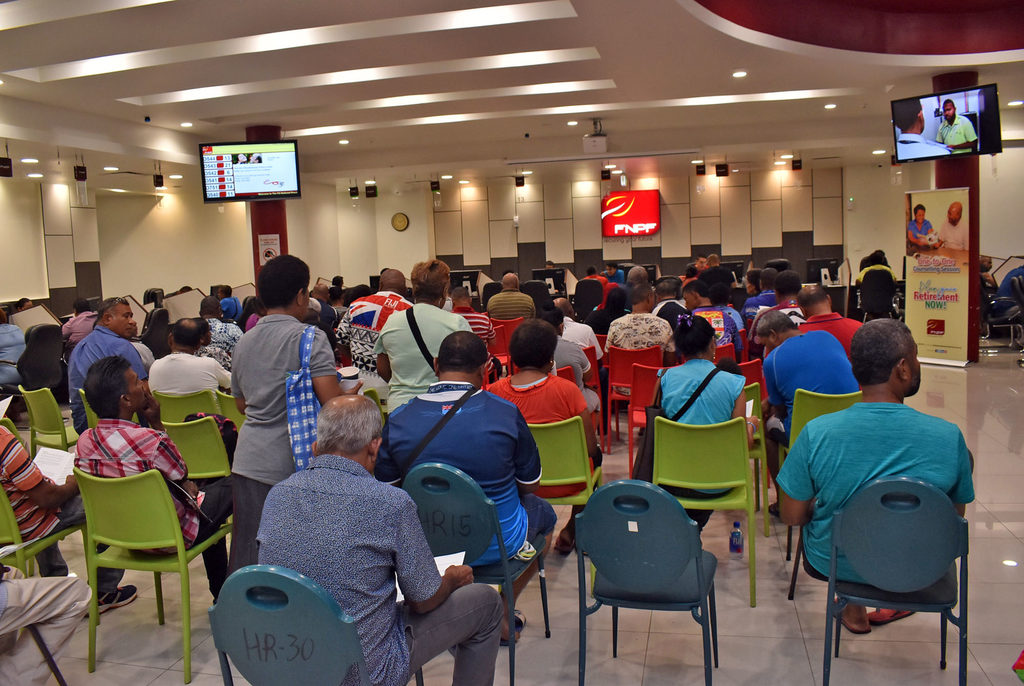
Customers await their turns to be served at the FNPF building in Suva on Saturday, February 29, 2020.
Picture: JONACANI LALAKOBAU
FNPF. Picture: FILE

