
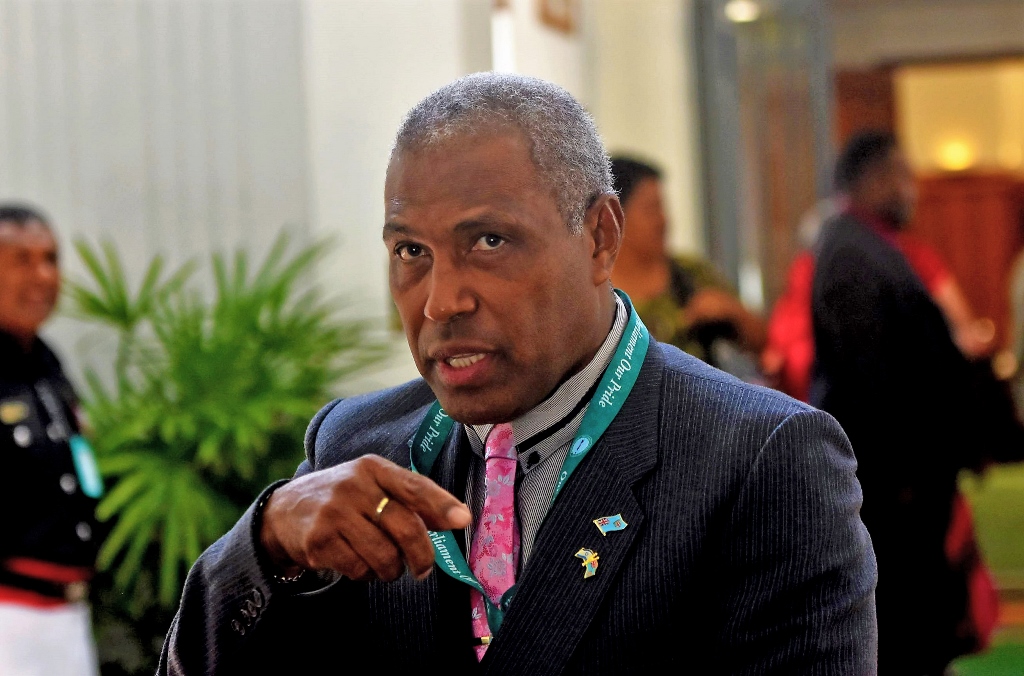
Minister for Justice and Acting Attorney-General Siromi Turaga has once again raised the issue of a constitutional review.
The review of our Constitution, he told Parliament yesterday, will be carried out lawfully, transparently and with meaningful public participation.
A constitution, he reminded the House, is no ordinary statute. It is the supreme law of the land and sets out the framework of the State. It distributes power, safeguards rights and defines the relationship between citizens and the government.
Highlighting the significance of the review process, he noted that Fiji has experienced four constitutions, each reflecting the aspirations, tensions and compromises of its time.
The intention to review the Constitution, he said, did not arise suddenly.
His remarks come in the wake of Opposition Leader Inia Seruiratu arguing that Fiji’s history of political instability cannot be attributed solely to the Constitution.
Speaking in Parliament this week in response to the President Ratu Naiqama Lalabalavu’s address, Mr Seruiratu urged leaders to consider the underlying causes of past national crises. Fiji’s experience, he suggested, demonstrated that constitutional documents alone could not prevent instability.
Mr Turaga maintains that discussions around constitutional reform have been evolving over time.
He believes the conversation has developed through national dialogue, engagement with institutions and the pursuit of lawful processes over the years.
The issue has also been raised in academic and policy circles.
In August 2024, constitutional expert Professor Anthony Regan of the Australian National University shared his views during the Fiji National University Vice-Chancellor’s Leadership Seminar in Nasinu.
Professor Regan suggested that maintaining the Constitution in its current form should not be seen as the only option. While he acknowledged that not everything within the 2013 Constitution was problematic, he questioned what he described as the unusually high concentration of authority within the executive branch.
He pointed out that in the Westminster-style framework adopted by Fiji, the roles of the Prime Minister and the Attorney-General appear prominently throughout the document. He noted that the PM is referenced more than a hundred times and the A-G dozens of times, an uncommon feature when compared with other constitutions.
Professor Regan also highlighted the difficulty of amending the Constitution. The requirements for change, he suggested, place it among the hardest constitutions in the world to alter.
Now that the subject has once again entered public debate, we reflect on the fact that a constitution ultimately belongs to the people. It should be accessible, understandable and relevant to us all.
Attention will inevitably turn to the question of constitutional reform and how, or when, such changes might happen. For his part, Mr Seruiratu has already indicated support for reviewing the Constitution if it is genuinely undertaken in the national interest.
Again, we say that a constitution is a vital national document. It highlights the rule of law, protects human rights and provides stability within our political system. It sets out how power is distributed, encourages civic participation through democratic processes such as elections and provides the foundation for good governance.
Our strength lies in our diversity, our ethnic, cultural and religious differencesand any constitutional framework should recognise and respect that diversity while promoting inclusivity.
We have said this before. Any constitutional process must reflect the will of the people and must not be driven solely by those who hold political power.
Former Attorney-General Graham Leung echoed a similar concern following Professor Regan’s comments. He pointed to a Supreme Court observation that criticised the existing document as the work of only a small group of individuals involved in drafting it.
Whether the present call for reform gains momentum or not, there appears to be growing support for a more inclusive and representative approach to reviewing this important legal framework.
Should we take that path, then the process must engage all segments of society.
A constitution should capture the hopes, concerns and perspectives of the nation.

