
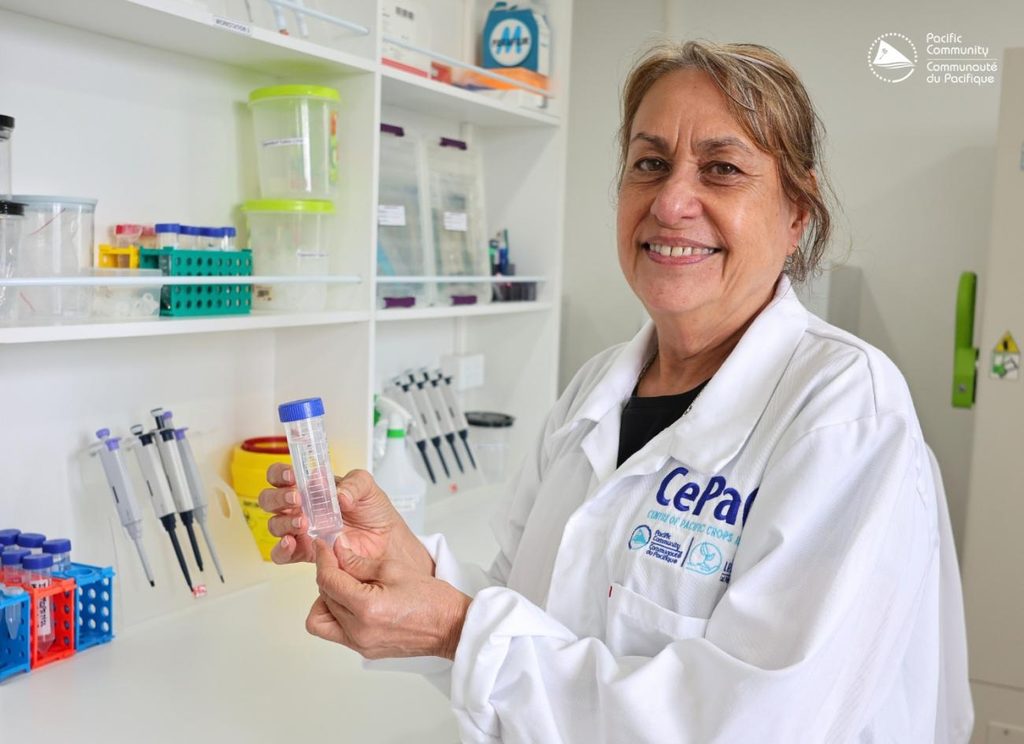
The graun and the solwara, the land and the sea, have always been part of her story.
Growing up in Papua New Guinea, Carmel Pilotti experienced the best of both worlds.
Some days were spent by the ocean, walking the reef when the tide was out, guided by salty air and warm water.
Other days were spent on the land, surrounded by gardens and fruit trees, watching crops grow and learning the rhythms of the seasons.
Long before she became a scientist, Carmel was already learning how the natural world worked.
In the Pacific, science does not begin in a laboratory; it begins at home. It begins in the garden, on the reef, and in the way we observe and respect our environment, our graun, our fanua. For Carmel, nature was her first “living laboratory”.
As a young girl, she learned through everyday life. She saw how soil stayed healthy when it was not left bare but covered with leaves and dead grass to help with water retention, and how crops were rotated to keep the soil healthy.
She learned about planting and harvesting by watching the seasons and seeing what was planted at different times of the year. She observed different crops in the family garden, noting which grew well and which did not.
These were lessons demonstrated, mostly by women, and they shaped how she understood science long before she ever knew the meaning of that word.
The notion of tertiary study was a dream. Like many Pacific women, Carmel grew up with cultural expectations that shaped what was seen as possible for women to achieve.
Career opportunities for women, especially in science, were limited and not always visible. But she was supported by family, who recognised the value of education and encouraged her to pursue her ambitions to quiet her need for learning. Her role models were close to home.
Women (extended family members) in senior leadership roles, female teachers of maths and science, and family members who showed her that women could lead, teach and influence change.
Those early influences stayed with her. Pursuing her interests in chemistry and biology, Carmel went on to complete a PhD in Botany (Plant Pathology-Genetics) at the University of Queensland.
Today, Carmel is the Curator of the Pacific region’s only genebank at the Pacific Community’s (SPC) Centre for Pacific Crops and Trees (CePaCT) in Fiji.
CePaCT works to ensure the efficient long-term conservation of the genetic diversity of key crops and tree species of the Pacific region, as well as to promote underutilised crops, including the largest taro collection in the world.
For Carmel, this work is deeply personal. Coming from a culture that is deeply ingrained in agriculture and where crops like taro feature prominently in cultural customs, she understands that taro and other traditional crops are part of the Pacific identity. Traditional crops, like taro, are present in our ceremonies, our livelihoods and everyday lives.
Protecting taro diversity means protecting Pacific families from pests, diseases and the growing impacts of climate change. It means making sure future generations can continue to plant, harvest and share the crops that have sustained our islands for centuries. This is science that speaks directly to Pacific realities.
Carmel is also an advocate for women in science and agriculture. She recognises that Pacific women hold deep knowledge of land, food systems and the environment, yet are often left out of decision-making spaces.
“For more women to join the agriculture sector, it is important for them to have role models in higher-level positions,” Carmel said .
“It is also important for organisations to ensure women are represented in technical, scientific and extension roles, so that the needs of communities are properly understood, and real impact can be realised.”
She believes women bring unique strengths to science, shaped by generations of knowledge and an innate sense of stewardship and care for our environment, passed down through mothers and grandmothers.
Carmel’s journey, from the reefs and gardens of Papua New Guinea to regional scientific leadership, reminds us that Pacific science is strongest when it reflects its people and Pacific ways of knowing.
As we celebrate women and girls in science, her story is a reminder to look forward, and to look home, to the land and the sea.
This story was first published by the Pacific Community in its website WWW.SPC.INT and has been included as part of this newspaper’s International Women’s Day 2026 media campaign with key partners.

