
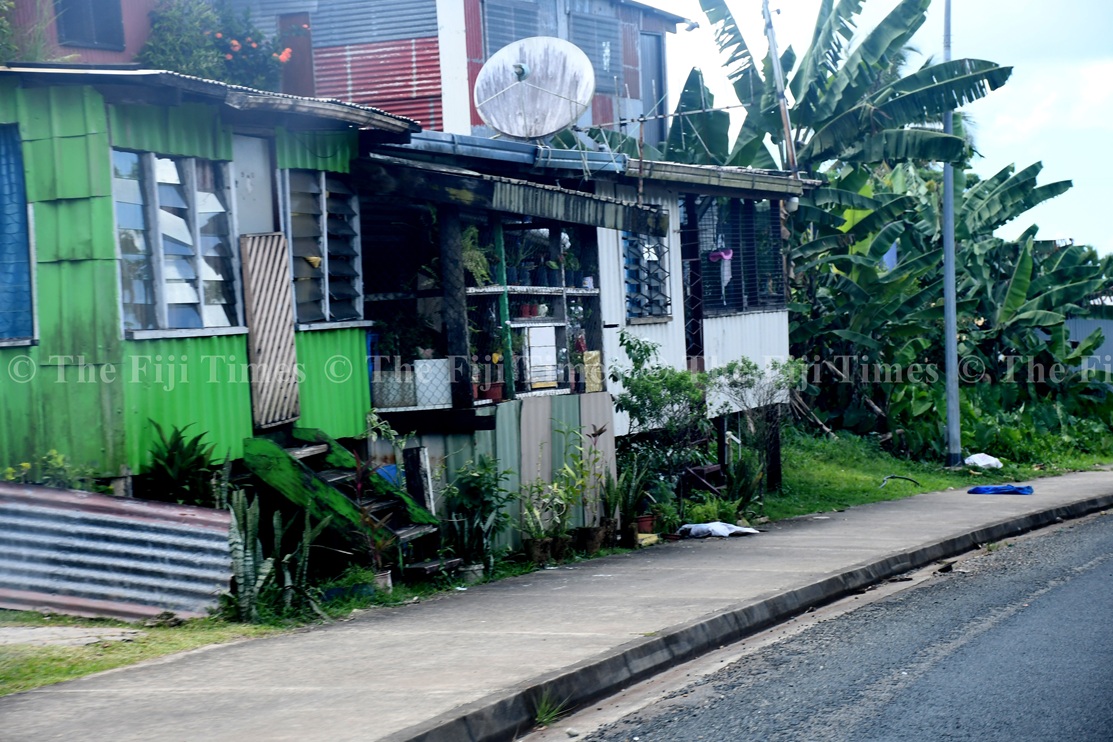
Houses built close to the road reserve in the Tacirua settlement have brought renewed attention to questions of compliance, enforcement, and public safety along one of Suva’s busy transport corridors.
Tacirua drew attention after major delays on Princes Highway during Water Authority of Fiji works and reports of pedestrians stepping onto the road in nearby Khalsa, raising concerns about safety risks linked to homes built close to the road reserve.
Several homes – and in some cases recent extensions – sit near, or appear to encroach into, designated road reserve areas.
The situation has triggered discussion about where responsibility truly lies and how oversight should be exercised.
Is it with government authorities, municipal officials, or landowners?
Building on road reserves is illegal
Minister for Housing and Local Government Maciu Nalumisa said the legal position was clear: road reserves are protected land, and construction within them is not permitted.
“Well, I think the issue here is people have built on road reserves, that’s a breach in itself,” Mr Nalumisa said.
He said municipalities, in coordination with the Fiji Roads Authority (FRA), were responsible for ensuring residents were informed of the breach.
“It’s the responsibility of the municipalities as well as the FRA to look for a way to notify those that are living in this area that they are breaching by building on the road reserves.”
Mr Nalumisa said some property extensions were now pushing further into road reserve land, placing even greater responsibility on councils to act.
“So, it’s the responsibility of the respective council to let those people know that they’re constructing illegally.”
Possible enforcement measures, he said, include warning notices, halting further work, relocation, or demolition of structures built on road reserves.
Jurisdictional conflict
The issue, however, is complicated by land ownership and municipal boundaries.
Suva City Council chief executive officer Tevita Boseiwaqa said Tacirua settlement sits on native land outside Suva City’s municipal jurisdiction.
“First, let’s look at the land ownership,” he said.
“I understand that in Tacirua, it’s native land it’s outside Suva City.
“Suva City doesn’t have any authority of the ownership… we don’t have any jurisdiction over that.”
He noted that informal settlements commonly develop without going through municipal building or planning approval processes, leaving councils unable to enforce the rules that apply within declared town boundaries.
Landowners and roadside plots
On the ground, landowners say they are simply responding to the needs of families who approach them.
Landowner spokesman Setareki Qaliduadua said residents often specifically requested plots beside the road.
“Every people came to us, only one thing they asked from us – please put our house beside the road.” Mr Qaliduadua said.
He confirmed that ownership of the area is split between two mataqali groups – his own and his cousin’s – and that decisions regarding relocation remain dependent on individual households.
“One guy, his house is close to the main road now. He approached us and asked us if we can provide him another piece of land to relocate.”
Mr Qaliduadua noted that future road–widening works could require some homes to shift, depending on the plans.
Transport Ministry and safety measures
Minister for Transport Ro Filipe Tuisawau said road safety concerns in areas where houses sit close to the roadside are valid, and options such as road humps are being considered.
“Yes, that is one of the effects and we will really need to properly assess where to put the road humps and the impact it has,” Mr Tuisawau said.
He warned that excessive traffic – calming infrastructure along major routes could disrupt traffic flow.
Questions sent to the Fiji Roads Authority (FRA) regarding enforcement, the status of the road reserve boundaries in Tacirua, and any planned action had not received a response by the time of publication.
A broader governance challenge
The Tacirua situation highlights the wider complexity of development control where native land ownership, municipal boundaries, and national road regulations intersect. As informal settlements continue to grow along major transport routes, the absence of clearly aligned enforcement between landowners, FRA, municipalities, and central government leaves many residents – and the public using these roads – in a potentially vulnerable position.
Under Fiji’s road laws, road reserves form part of the public road corridor and include not only the paved surface but also verges, drains, footpaths and adjoining infrastructure essential for safe passage.
Any activity within this corridor requires formal approval from the Fiji Roads Authority (FRA), which regulates all work that could affect the road network or traffic flow. FRA guidelines also make clear that road reserves cannot be used for private or commercial structures, and applications must meet strict safety, surveying, and traffic-management requirements that informal settlements cannot satisfy.

