
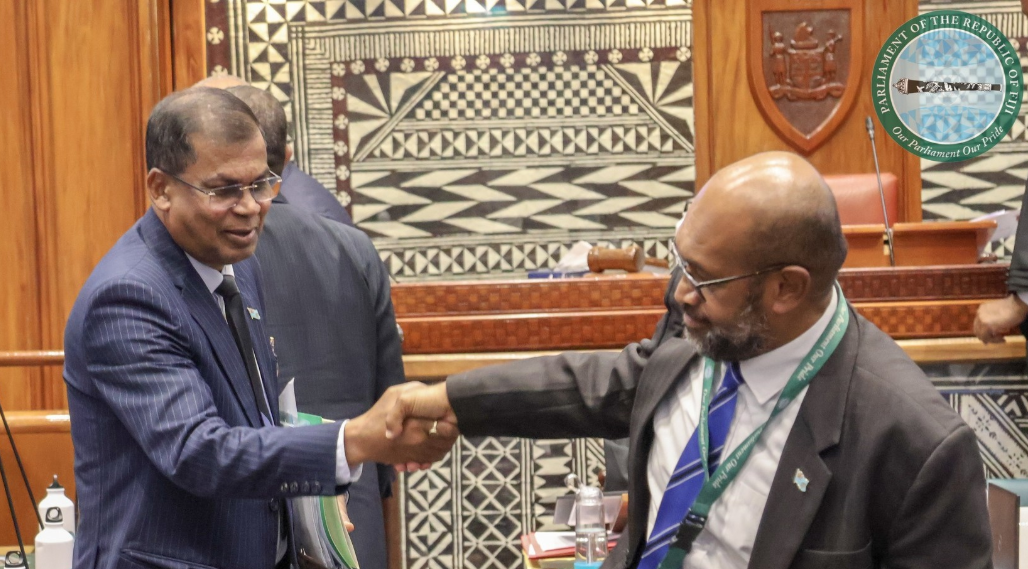
Opposition MP Jone Usamate has sharply criticised former Deputy Prime Minister and National Federation Party leader, Professor Biman Prasad, accusing him of misleading the public over tax changes and the cost of living.
In a statement, Mr Usamate said the Prof Prasad was trying to defend Government policy using “spreadsheet arguments” while ordinary Fijians continued to struggle with rising household costs.
Mr Usamate rejected claims by Prof Prasad that taxes previously reached levels of around 25 per cent, arguing that the figure combined different levies such as Value Added Tax (VAT), Environment and Climate Adaptation Levy (ECAL) and Service Turnover Tax (STT) which largely applied to the tourism and hospitality sector.
He said comparing those taxes with the current 15 per cent VAT imposed on everyday goods and services affecting ordinary households was misleading.
The Opposition MP also disputed the Government’s claim that there were no zero-rated essential food items under the previous tax system.
According to Mr Usamate, 21 basic food items were zero-rated for VAT before the 2022 election, including flour, rice, sugar, canned fish, cooking oil, potatoes, onions, garlic, dhal, tea and salt.
He added that certain essential medicines were already accessible through the Government’s Free Medicine Scheme for eligible low-income families.
Mr Usamate said the Government later increased VAT from 9 per cent to 15 per cent in the 2023 budget, which he claims significantly raised the cost of living.
While acknowledging the recent announcement to reduce VAT to 12.5 per cent, he argued that it still represents a net increase compared with the pre-2023 rate.
He claimed the reduction would not fully ease the pressure faced by households already grappling with higher food and living costs.
Mr Usamate said the public was more concerned with the impact of government policies on daily expenses rather than debates over tax calculations.

