
On February 28, the Millennium Challenge Corporation (MCCC) – an independent United States government agency focused on unlocking growth through results-driven foreign assistance – signed a Compact Development Funding Agreement with Fiji.
The signing by US Deputy Secretary of State Christopher Landau and Minister for Finance, Commerce and Business Development Esrom Immanuel in Suva is a step toward designing an MCC compact to unlock private sector-led growth and strengthen economies ties, and enables joint technical work to design projects that will strengthen Fiji’s economy and create opportunities for US trade and investment.
In August last year, the MCC board of directors selected Fiji as eligible to develop an MCC compact program, which recognises Fiji’s reform momentum and its vital role as a regional economic hub for transportation, business, healthcare, and workforce development.
The compacts are five-year agreements between MCC and an eligible country to fund programs that target key constraints to economic growth; and the agreement with Fiji launches a data-driven design process to identify priority sectors and design projects that advance the country’s growth and shared interests in the Pacific.
The MCC’s grants support large-scale infrastructure, strategic reforms, and economic modernisation; and also advances America’s economic and strategic interests by delivering measurable returns to both grant recipients and US taxpayers – expanding commercial opportunities for US businesses. Mr Landau said the compact with Fiji was a catalyst for prosperity with the compact designed to drive investment in Fiji, open new markets for US companies and strengthen the foundation for a free and open Indo-Pacific.
Minister for Finance Esrom Immanuel said the agreement reflected Fiji’s commitment to good governance, economic freedom, and investments that foster growth.
“Together, we will tackle key development challenges and create lasting benefits for Fijians,” Mr Immanuel said.
MCC
MCC was founded in 2004 with a single question in mind – in a time-limited and transparent way, how does it partner with well-governed countries to unlock growth that is good for its partners and the US.
It saw potential in the Pacific with Vanuatu being one of its first partners with a $US66million (approx. $F145m) compact, and more than 15 years later had become transformative for that economy.
That compact funded the rehabilitation of a combined 150km of roads on Vanuatu’s two primary islands of Efate and Santo, which in turn led to a 50 and 75 per cent, respectively, in reduction in travel time; and helped lead to 20 new resorts, 50 holiday retreats, 3000 real estate offerings and increased GDP.
Since then, MCC has had a growing portfolio around the world, having invested more than $US17 billion in nearly 50 countries, which it estimated had benefitted about 400 million people in those partner countries.
In the words of MCC acting chief of staff Dan Petrie, “MCC is a small but mighty agency within the US government”.
Principles
MCC operates on a few foundational principles
n Transparency: MCC said it has been consistently recognised for being the most transparent agency, which is important to US Congress and taxpayers who help fund this work; and it’s committed to delivering a high impact on projects that ultimately can be scrutinised.
n Accountability: MCC believes strongly in country ownership, that these are shared interests and a path toward the countries embracing, owning and sustaining projects long after MCC leaves. A 100 per cent of its projects are independently evaluated and published online.
n Selectivity: A board of directors chaired by the Secretary of State consider countries on an annual basis on where they can work, and is both need and merit based. The need-based criteria in its statute is there’s a cap basically on the GNI per capita and the countries that they can work in; and the merit-based – they look across factors like economic freedom, ruling justly, and whether a country is making investments in their people. It creates a scorecard with 22 indicators and can track how partner countries perform, which can be accessed publicly.
n Timebound: A critical piece of MCC’s model and approach by statute, the compacts are five years. Once the program “enters into force, that five-year clock starts ticking”. Mr Petrie said that helped focus them in terms of what it could accomplish in that time and helped ensured strategies were in place from the beginning to maintain sustainability, and that there was a handoff.
MCC and Fiji
Fiji secured a $US12m (approx. $F26m) compact funding agreement, which will help MCC assess, conduct feasibility studies and due diligence as a way to further refine its thinking about its approach in Fiji.
The $US12m jumpstarts MCC’s work on a “constraints to growth analysis”, with their economists working in conjunction with counterparts from partner countries to determine the root causes of those constraints, and design projects that would target those causes.
“So while we don’t know exactly the contours of what the compact will be, that’s essentially what this $US12 million will be helpful in advancing that conversation, and so it can support things like further due diligence or feasibility, certain staffing time, staffing, that sort of thing,” Mr Petrie said.
“It’s an important step in terms of ultimately narrowing the focus so that when we’re ready to sign a compact, we feel like all the hard work has been done and we’re ready to roll. We think there’s tremendous opportunities in transport and logistics, obviously in the port business enabling environment, kind of simplifying and streamlining that, making sure people that do want to come in and invest, that there’s pathways to do so,” he said at a press conference in Honolulu, Hawaii last week.
He said there was a variety of potential opportunities in Fiji, among which also were projects on water and sanitation, NCDs and health as well.
“We’re in good conversations with the government of Fiji now and this next stage will be kind of focusing on what the compact will actually ultimately entail.”
While MCC does not necessarily come in with an exact budget number, he said it would depend on the areas of focus in Fiji.
“That’s going to depend on whether we’re looking at transport and logistics in the port or whether it’s in health or, so there’s different opportunities there, so it’s not a set amount. And of course, it’s scaled for the nature of the opportunity in the country themselves. In general, compacts can be, you know, the Vanuatu compact was $US66m; but compacts in some countries have been in the hundreds of millions of dollars threshold programs, which are a bit smaller.”
Timebound grants
Once a project was defined and a compact signed, the ‘five year clock’ will start ticking”.
“So it sharpens the mind quite quickly and we want to make sure before we enter into force that we have all of our ducks in a row so to speak,” Mr Petrie said when asked about the consequences of countries lapsing on deadlines. “Ultimately though, funds that are not expended within those five years come back to MCC or are not fully dispersed so to speak. So in other places, for very understandable reasons, they’ve made the full amount that is part of the signature at the beginning, it’s not always fully dispersed.”
Resilient projects
Though the Donald Trump’s US administration has de-emphasised climate change, Mr Petrie said resilience would always be part of their work in the Pacific.
Speaking to the quality of MCC’s infrastructure, he said they wanted those projects to last.
“You all know better than I do about the ability to withstand natural shocks and have infrastructure where you’re investing in it and you’re not rebuilding it every few years. So MCC is building things to international high standards. We’re going to want to be thinking about, regardless of the sector that it’s in or the type of project, that it’s built to last, and that it meets ultimately what the needs are in the country that we’re working in.
“In the Pacific, that’s going to be the ability to withstand natural disasters and shocks, which is just a fact of life.”
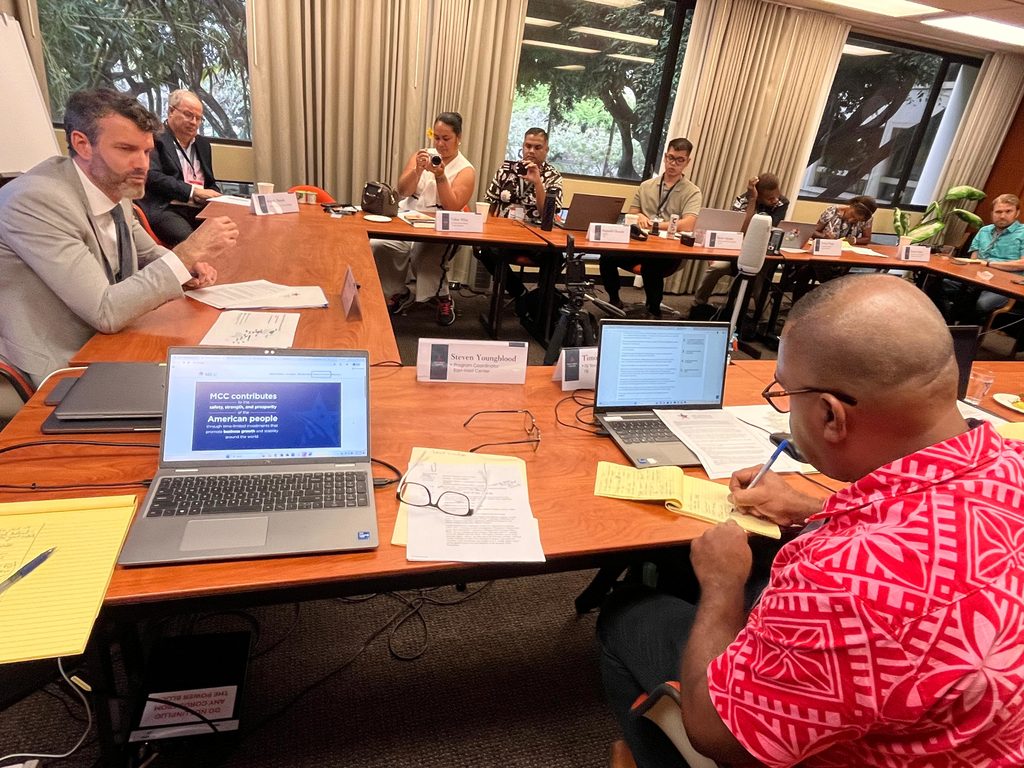
MCC acting chief of staff Dan Petrie responds to a question from The Fiji Times in an interview with Pacific journalists on the sidelines of the US Pacific Agenda investment summit in Honolulu, Hawaii last week. Picture: STEVEN YOUNGBLOOD

