
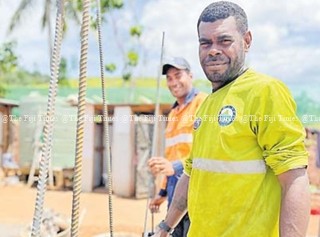
Early civil works at the Nabavatu relocation site had to be redone after underground seepage was discovered, forcing contractors to prioritise drainage before housing construction could proceed.
Project engineer Versoni Tavana said the decision to redo the works carried out by the Ministry of Works was unavoidable.
“From day one, we prioritised improving drainage before preparing the terraces for construction,” he said.
While some parts of the site still experienced soft ground, Mr Tavana said the issue was manageable.
“There’s some soggy ground here and there, but it’s manageable.”
He said soil conditions had been assessed early, but although the land had been identified for relocation, it was not ideal when phase two construction began.
“Due to this, drainage became critical to make the site suitable for housing.”
Despite the early challenges, Mr Tavana said progress had since improved.
“Land distribution for the 37 relocating families will be equal, with each household receiving a standard two-bedroom home.
“All homes have the same internal and external square metre measurements,” the engineer said.
“There is no variation. Equity was a key consideration.”
He said productivity depended more on how workers were deployed than on worker numbers alone.
“We move teams around based on trade strengths, whether local or foreign workers.
“Sometimes you can have a hundred workers on site, but the output is the same as ten if supervision is not right.
“Supervision ratios are key.”
Mr Tavana said worker numbers fluctuated depending on construction stages, with more labourers required for floor pouring and fewer during steel installation.
“All steelwork is prefabricated in Suva and shipped here for assembly.
“That’s why site numbers may appear low at times, but efficiency remains high.”
He said with early groundwork issues resolved; construction was now moving steadily toward delivering new homes for the 37 families.

