
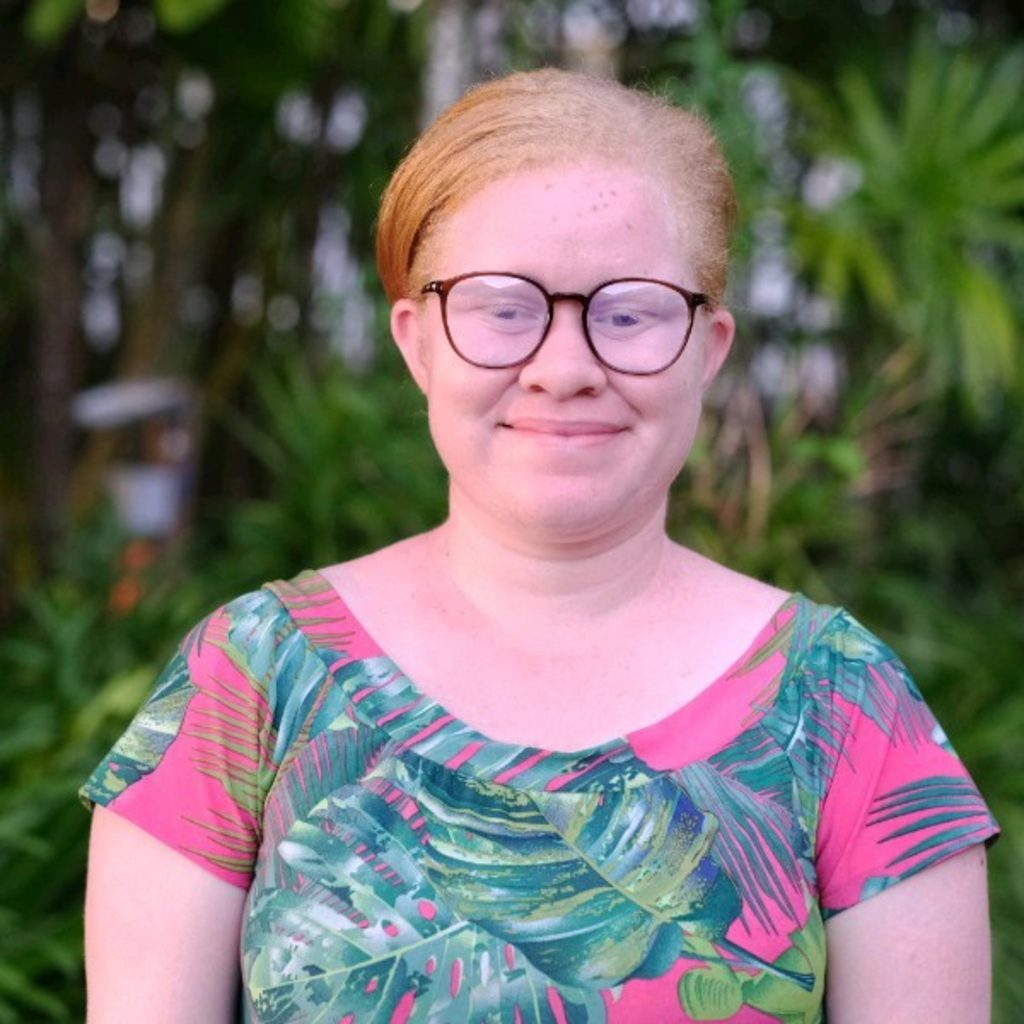
AT just 24, Sabina Moce has come a long way. Living with albinism meant she struggled a bit more than most of her classmates when it came to learning.
Today, she sits in policy rooms where disability is discussed and has represented the Pacific at key regional events.
“Some of the effects of albinism are that I’m short-sighted. I cannot see very far. I cannot go into the sun for a long period of time. If I do, I need to put on sunscreen, wear a hat, long-sleeved clothing, and use an umbrella,” she explained.
Her advocacy, she shared, came from trying to be understood and accommodated in her high school years.
“I started by educating my teachers on the need for bigger font sizes in high school. They would print out two pages of notes on one A4 paper. That was quite a struggle for me.
“I would ask my desk mate to dictate the notes on the board to me, or I would even take her book in the afternoon just to stay updated with my notes.”
She realised she needed to “come out of her shell” if she was to be heard.
“The teachers would tell me, you could always come up to the board and take notes off it. But being a young person and being different, I felt embarrassed to disturb everyone else.”
Eventually, she reached out to her form teacher.
“She kind of came around and understood the need I had in terms of how notes should come.”
After high school, her advocacy expanded. She started with the Fiji Albinism Project and went on to volunteer with the Fiji Disabled People’s Federation and United Blind Persons of Fiji.
She worked with the Pacific Disability Program and Pacific Girl under Pacific Women Lead, the Fiji National Youth Council, the Pacific Youth Council and the Commonwealth Children and Youth with Disabilities. She also served on the US Embassy Youth Council in Suva.
“I thought my advocacy was just here – locally. It started with a speech and then it moved on to attending different conferences, and then being privileged and honoured to be invited to speak and be part of the team that represented the Pacific at the Small Island Developing States meeting.”
She later joined the working group that organised the Commonwealth Youth Forum at the Commonwealth Heads of Government Meeting (CHOGM) in Samoa.
“Too often we’re invited to spaces where we’re just given a space to sit, not a space to speak. Something that I’ve always seen is too often we’re tokenized.
“I’ve been invited to spaces where sometimes I am the only person with disability. I mean, one is better than nothing but I would love to see more participation of persons with disabilities within the various spaces of policy or even conferences and meetings.
“To be inclusive, we should have everyone at the table. I cannot share their story because I do not understand their challenges.”
Growing up, Sabina recalls that attitudes were not always kind.
“Walking along the street, I’ve always been called ‘rea’ or ‘mata boko’, ‘mata ca’. And it hurts to hear people say that because they don’t understand.
“Having a supportive family has made me strong enough to take that and change it into a strength.”
With elections due soon, Sabina highlights a few concerns.
“One of the biggest changes would be the practice during elections, how our elections officers are trained to accommodate the needs of persons with disabilities.”
She also highlights access audits carried out by organisations of persons with disabilities.
“Sometimes you go into an office, your front desk is as high as my shoulders, and if you have a person in a wheelchair come in, what is that?”
Her message to others living with disabilities is clear: “Never be shy because of your disability, because your disability may also be your greatest ability.”

