
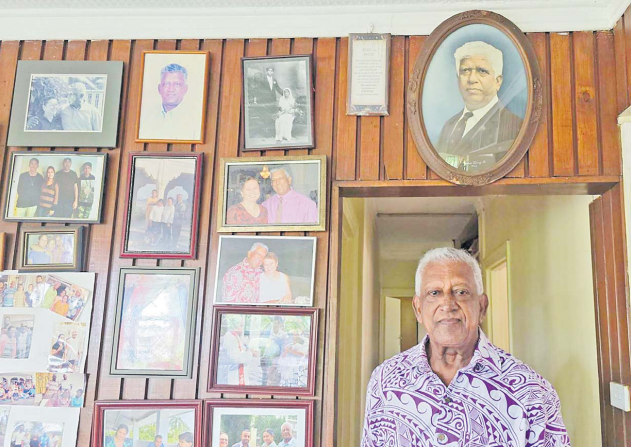
For Vijay Madhavan, the story of his life begins in a home brimming with love, laughter, and lessons. Growing up in Labasa, his childhood was simple yet rich with memories that continue to shape him today.
“Our house was a wooden and brick house with three bedrooms, a kitchen, sitting room, and one small porch,” Mr Madhavan recalled.
“Younger siblings slept together, while older brothers, Satya and Umesh, shared a room. Life was a mix of discipline, adventure, and education.
“Discipline and love were inseparable; love was not expressed in words but in actions. Whether it was holding onto Amma’s sari after some mischief, sharing a cup of tea with Pitaji, or walking to school under the morning sun, love was in everything he did for us.”
Mr Madhavan remembers childhood as a time of exploration and playful mischief. Christmas gatherings under the mango tree with cousins, kakas, and fuas remain some of his fondest memories.
“If that mango tree could speak, it would tell tales of stolen fruits, laughter, and lessons learned the hard way.”
Even with all the fun, there was a clear sense of structure. The children were encouraged to maintain Hindi at home, uphold their Christian faith, and commit themselves to education.
James Madhavan — teacher, politician, leader
At the centre of the family stood James Madhavan, affectionately known as Pitaji or Masterji. Born on September 8, 1914, in Veisari near Suva, he was the son of Dorasami and Kalu, indentured labourers brought from India to work in Fiji’s sugar plantations. Their resilience and values shaped his early worldview.
Mr Madhavan trained at the Davuilevu Training Institute in Nausori, one of the few educational opportunities available to Indo–Fijians at the time. There he met Eunice Anamma Pillay, who would become his lifelong partner in faith, education, and service. The couple married on May 8, 1936, forming a partnership that strengthened both their family and their community.
“Pitaji’s principles were simple: serve people, value education, and lead with integrity, whether at home or in the community, he believed in doing what is right, even if it is difficult.”
His career in education began soon after training. By 1939, he was the principal of a high school, and in 1942 he became the first local person appointed principal of All Saints Secondary School in Labasa. His leadership extended beyond academics — he introduced initiatives promoting critical thinking, discipline, and civic responsibility.
“He would read Shakespeare aloud, explain world events, and show black–and–white films of India’s struggle for independence, it was our first exposure to global ideas and justice.”
Mr Madhavan’s dedication to education naturally led him into politics. As one of the founding members of the National Federation Party, he advocated for cane farmers and workers. In 1947, he won his first election, representing the Eastern Constituency of Vanua Levu. His activism was not without challenges: in 1960, during a dispute with CSR over cane contracts, he was arrested after refusing to hand over his Land Rover, which authorities wanted to restrict his movements.
“He didn’t stay in the cell long because an unknown supporter paid his fine. That Land Rover became a symbol of his independence and courage.”
He played a significant role in Fiji’s political development, representing the nation in the 1965 and 1970 negotiations in London that paved the way to self–government and independence. Despite his public prominence, he remained humble.
“Even as a legislator, Pitaji never missed an opportunity to help a child, a farmer, or a neighbour.”
The mother: Eunice Madhavan — teacher, mentor, pillar
Eunice Madhavan, lovingly known as Amma or teacher. Born on July 4, 1914, in Togaleka, Navua, she lost her mother at age three and was raised at the girls’ home in Dilkusha.
“Dilkusha shaped Amma’s entire life. Its values of discipline, education, and service stayed with her. She would often return to mentor young girls, encouraging them to complete school and take active roles in their communities.”
Mrs Madhavan trained as a teacher at Davuilevu, graduating in 1933, and went on to teach in Nausori, Ba, and Labasa. She balanced motherhood with supporting James in his educational and political duties. Later, her focus shifted to church and community work. Her contributions were recognised in 1980 when she was awarded the MBE for services to education and the community, receiving the medal from Queen Elizabeth II at Buckingham Palace in London.
“She taught women to sign their names to be on the electoral roll.
She taught mothers the importance of breast milk over diluted formula, and she encouraged all of us to value education. Her lessons were practical, yet deeply moral.”
Amma’s influence permeated the household. Through stories, chores, and everyday routines, she instilled the values of courage, ethics, and responsibility.
A family defined by service
The Madhavan children grew up in an environment shaped by strong principles. Pitaji read the newspaper aloud every evening, encouraging thoughtful discussion and respectful dialogue.
“Every lesson at home prepared us to be citizens, to serve, and to lead with integrity.”
“Home was a gathering place for relatives, friends, and community members seeking guidance or comfort. Life was rich with stories, values, and occasional mischief.”
The family also experienced profound loss, including the passing of siblings Sharda (1966), Shiro (1994), Umesh (2019), and Pushpa shortly after.
“We miss them all very much, yet their memories, along with the teachings of Pitaji and Amma, continue to guide us every day.”
A living legacy
Mr Madhavan’s reflections paint a picture of a family grounded in faith, education, resilience, and service. From childhood adventures under mango trees to witnessing his father’s courage during political struggles, the Madhavans grew up surrounded by lessons in integrity and compassion.
“Pitaji’s last words were ‘My wife, Labasa. It tells you everything — about his love for Amma, his devotion to family, and his dedication to the people of Labasa and Fiji.”
James and Eunice Madhavan’s legacy lives on through the lives of their children and the countless individuals they served.
Their story is not only one of leadership and community upliftment, but also of ordinary acts — nurturing, teaching, guiding, advocating — that became extraordinary over time.
The Madhavan legacy is one defined by love, learning, courage, and unwavering service to family and community.

