
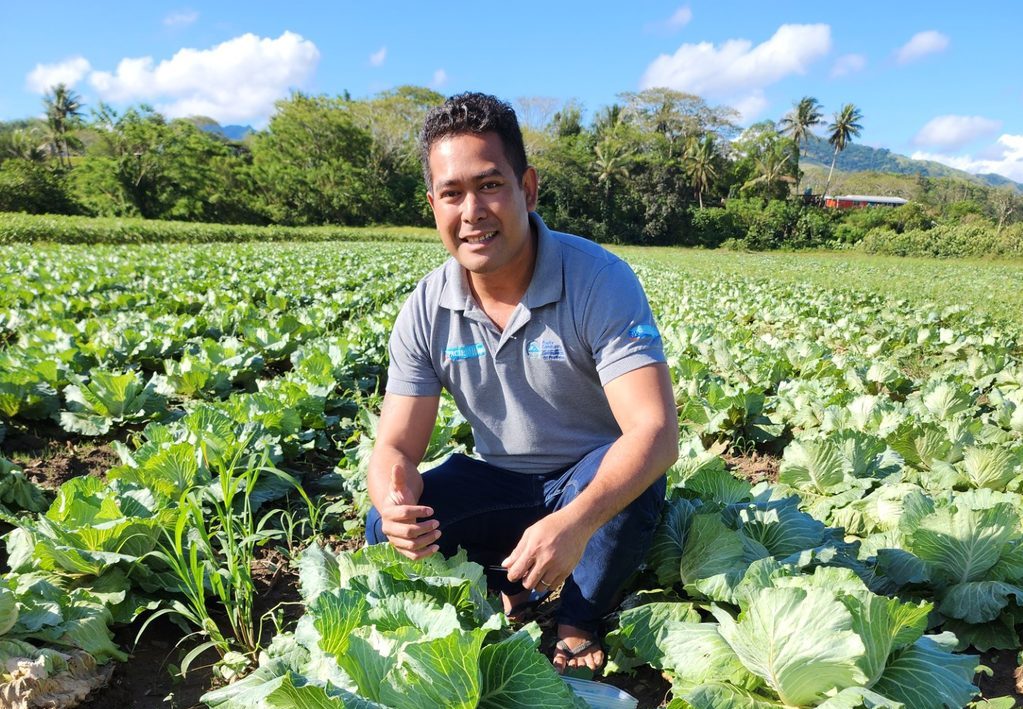
When Mani Mua, left his home island of Rotuma as an 18-year-old to pursue maritime studies in Suva, he did not know his life trajectory would take an interesting turn.
Life back in Rotuma revolved around farming and fishing and it was all Mani knew growing up.
So, when he left home, it was in the hopes that he would pursue a field of study that would provide him a job and support his family.
Imagine his father’s surprise when Mani decided on agricultural studies instead.
“His first words over the phone were – ‘aren’t you tired of farming?!” Mani chuckled.
More than two decades later, that decision has shaped Mani into one of the Pacific’s most important voices on plant health and sustainable farming systems.
Today, Mani is completing his PhD at the University of Queensland under the John Allwright Fellowship, an Australian Government scholarship administered by the Australian Centre for International Agricultural Research (ACIAR).
The fellowship supports scientists and economists from partner countries to undertake postgraduate study in Australia.
Mani’s research focuses on plant health and, more specifically, on how farmers adopt sustainable pest management practices such as Integrated Pest Management (IPM).
“Plant health is integral to crop production, food nutrition and security,” he said.
“Studies reveal that pests are estimated to reduce total global food production by up to 40 per cent, and while pesticides remain integral to achieving the production levels required to sustain a global population of over eight billion people, their inappropriate use is a threat to planetary health and sustainable alternatives are required.”
This prompted Mani’s research to promote IPM as a safer and more sustainable alternative to heavy pesticide use. However, adoption by farmers is far from straightforward.
“Adoption isn’t a one-off decision,” he explained. “It’s a continuous learning process influenced by awareness, attitudes, validation and the environment farmers operate in.”
Through his research, Mani has developed a conceptual model to help understand how farmers respond to pest management options and recommendations — findings that could significantly improve how extension services and plant health clinics operate across the Pacific.
Before beginning his PhD, Mani worked at the Pacific Community Land Resources Division (SPC LRD) as a plant health coordinator supporting an ACIAR-funded project – ‘Responding to emerging pest and disease threats to horticulture in the Pacific Islands’.
The seven-year project was led by the University of Queensland in partnership with agriculture ministries in Fiji, Samoa, Tonga, and Solomon Island, including Papua New Guinea and Vanuatu with partnerships from Fiji National University (FNU), Solomon Islands National University (SINU), the University of Goroka (UoG), and the University of the South Pacific (USP), and PestNet.
One of the most significant outcomes of that work was the establishment of plant health clinic programs across several Pacific countries.
In Fiji, this led to the creation of the Fiji Plant Doctor Network, a digital platform that allows extension officers to share photos and information about plant health problems directly with specialists.
What began as a simple WhatsApp group has evolved into a national network now operating on Viber.
“With limited resources, you have to work smarter,” Mani said.
“Instead of travelling long distances for simple problems, agriculture officers across Fiji can get quick and credible diagnoses and focus on cases that really need field visits to farmers.”
The network is backed by more than 350 information factsheets available through PestNet’s Pacific Pests, Pathogens and Weeds app, creating a shared knowledge base that continues to grow.
Yet the challenges facing plant health in the Pacific remain significant. Climate change, soil degradation, declining crop diversity, weak policies and the constant threat of new pests and diseases all place pressure on food systems.
Mani is also frank about the role people play in spreading risks and managing it.
“Wherever people go, pests and diseases follow,” he said.
“We move planting material without fully understanding what we might be carrying with us.”
Looking ahead, Mani hopes to return his skills and knowledge to the region, not just through research, but by supporting education systems and policies that strengthen plant health from the ground up.
“I want to serve Pacific people however I can,” he said. “That means helping build systems that work for us, not just importing models from elsewhere.”
As Mani nears the completion of his PhD, he says the decision to pursue agricultural studies was influenced by his drive to help alleviate hunger and poverty in the region.
Moreover, he finds joy in the fact that he changed his father’s mindset about agriculture as a career pathway.
“If you look closely,” he reflected, “the health of our plants mirrors the health of our people.”
“To build strong and healthy nations, we must first protect and care for our plant health so they can return us that favour. Humans are remarkably similar to plants, perhaps more so than we care to realise.”
“I often ask myself, if I am a plant, what type of plant would I want to be or what type of plant reflects me best. Am I a raintree where the birds and animals could find refuge or am I a parasitic plant that thrive off others. Afterall, a healthy nation begins with a healthy plant.”
Application for the John Allwright Fellowship 2027 intake is now open and interested applicants can check out the ACIAR website for further information.
MATILDA SIMMONS is the communications officer Pacific at the Australian Centre for International Agricultural Research (ACIAR). She can be contacted on this email: matilda.simmons@aciar.gov.au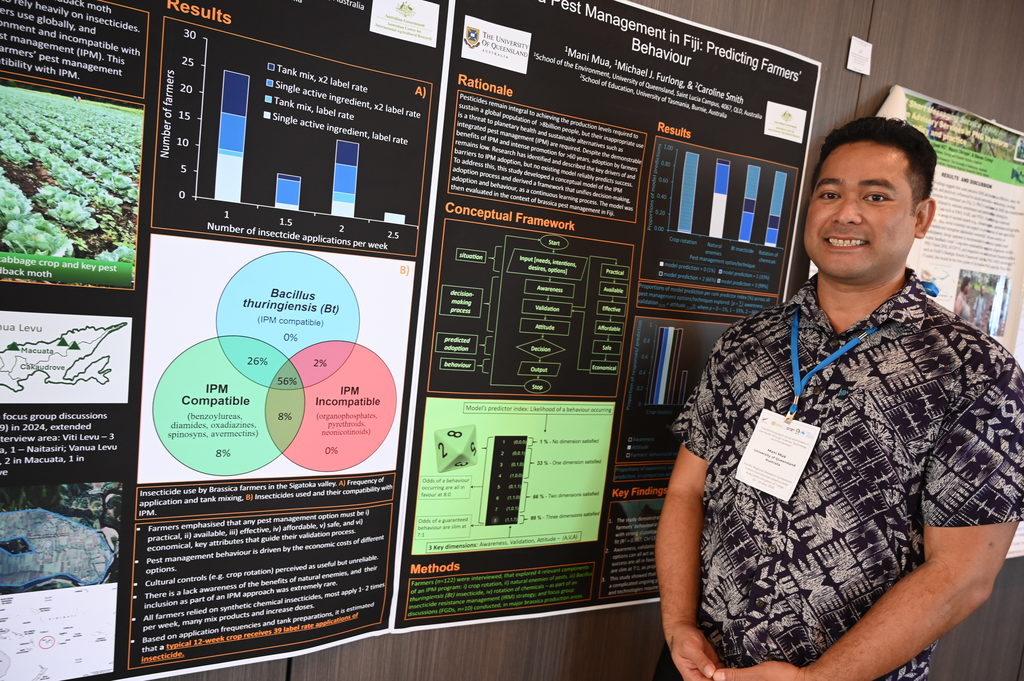
Mani Mua hopes to return his skills and knowledge to the region, not just through research, but by supporting education systems and policies that strengthen plant health. Picture: SUPPLIED

Matilda headshot

