
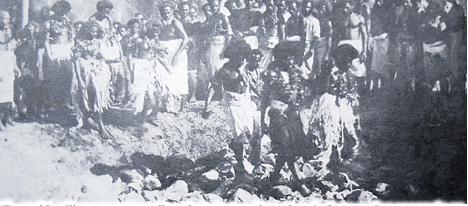
This week we re-look at a story on firewalking which was previously published in The Sunday Times in December 2019.
I began my investigation on Fijian firewalking history in Rukua Village inside the home of Mika Tubanavau, a self-made historian on anything Beqa -history, geography, vilavilairevo (local term for firewalking) and legend.
To attempt a story in a village outside the Sawau district, where the gift has remained for centuries, was highly unorthodox but literature advised me nobody knew the history of firewalking better than Tubanavau.
With a few firewalking research and text book credits to his name, he considered himself the gatekeeper of oral traditions.
His bedroom was a treasure trove of folders, newspaper cuttings, historical books, research papers and even typed interviews documenting people’s interaction with ancestral gods and goddesses, some as spooky as the feared shark god himself, Dakuwaqa and his shark friend, Masilaca, of neighbouring Yanuca Island.
“Have you ever heard stories of the little people?” Mika questioned me after my sevusevu was presented.
To talk about beings belonging to the realm of the supernatural, as a basis of understanding the gift, was something I found rather queer. But I told myself I had to trust my storyteller.
Through my three-day interaction with Tubanavau and the numerous printed articles I perused, I found out that the little people or veli, as they are commonly referred to, were believed to be short, dark-skinned, long-haired, were largely naked, lived in groups and had strange looks.
Peculiar in demeanour and personality, they were not the kind of things I wanted to see.
“You must know this… the little people see things opposite from the way we do. They are a very unusual bunch,” he remarked as he flipped through his collection of documents.
“To them hot is cold, heavy is light and long is short.”
Tubanavau told me he had never seen a veli although he spent a lifetime working with experts and university researchers on the origins of firewalking and its connection to the little people.
Some believe the gods of firewalking are not ghosts but rather “spirits of humans”. Others think they are “small and hairy forest dwellers” who possess unnatural powers.
According to old stories, it was this very class of beings, known to Beqans as kalou rere, who gave the gift of firewalking to the Sawau people a very long time ago.
It might probably be impossible to pinpoint when the gift of vilavilairevo was first given and performed on Beqa.
However, from experts’ reconstruction of the Sawau tribe’s oral accounts, it appears vilavilairevo was already practised before Christianity and the missionaries.
“There is research-based consensus that it may have started in the 1700s or earlier, while the Sawau people were living in the hilltop village of Navakaisese,” Tubanavau said.
This concurs with the 2007 Ph.D dissertation, “Custodians of the Gift”, written by Guido Carlo Pigliasco of the University of Hawaii, which said “by the time the Sawau occupied the hilltop fortification of Navakaisese…at the end of the eighteenth century, the ‘gift’ of the vilavilairevo was already their exclusive possession”.
Since then vilavilairevo has remained unique to Sawau, made up of the villages of Dakuibeqa (the chiefly village of Sawau), Dakuni, Soliyaga, Naceva and Naseuseu, and the village Rukua in the district of Raviravi.
The Sawau people settled at Navakaisese (in the hills) after fleeing the disturbances of inter-tribal wars along Beqa’s coastline. It was in this ancient village that the story of firewalking was first set, focussing on three main characters.
A long time ago Navakaisese had a famous story teller named Dredre. The rule was everyone who came to listen to his stories had to promise to bring him a nabu or token of appreciation.
One day, when young men gathered in the large bure Nakauyama, Dredre asked each man his nabu. Tuiqalita from the mataqali Naivilaqata promised to bring an eel he had seen in a stream up the Namoliwai River.
Everyone revealed their nabu (storytelling gift) before Dredre entertained people with stories till about midnight. So early next morning, Tuiqalita hiked up Namoliwai River where he noticed fresh movements in the water. He dipped his hands into the cold water and pulled out a bark cloth.
Reaching further, he touched a human limb and pulled his catch out of the water.
In his hands was a veli called Tui Namoliwai who pleaded for his life in return for a gift.
He first asked Tuiqalita to be his God of war but Tuiqalita declined he was already fierce in the battle field.
Tui Namoliwai offered to be Tuiqalita’s god of veitiqa (spear throwing) but he declined saying he was already a good thrower.
The little man offered to be Tuiqalita’s God of wealth and love too but he refused still.
Finally, Tui Namoliwai offered Tuiqalita the power over fire where he could be buried in a lovo for days and still come out alive. He accepted and became the first person on Beqa to walk on hot stones.
Tubanavau had been to the stream where Tuiqalita caught Tui Namoliwai. He had also been to a number of old mountain villages during his days as a research field consultant, including Navakaisese.
“They are up there within the forest and they are amazing and beautiful,” he said, pointing to hills south east of Rukua, somewhere behind Raviravi.
Tubanavau showed me illustrations of these ancient settlements that crowned mountain tops in the form of hill and ring-ditched forts.
“I’m perhaps the only person on Beqa who knows everything there is to know on firewalking. But nobody seems to be interested in it, especially the young generation,” he said, a hint of concern in his voice.
“What I’m going to give you now is an account of how firewalking was performed in olden days by the people of Rukua. This is the first time I will give a full account of all the rituals involved from preparations right up to thanksgiving,” Tubanavau said.
While a burden of responsibility overwhelmed me, I felt flattered by the rare opportunity of retelling a story that had been passed down many generations.
At least four nights before any fire-walking ceremony, villagers are normally alerted about the event and firewalkers known as dauvila, are called by the bete (priest) to lodge in a special house, away from their wives, partners and family.
During this 96-hour period, they abstain from eating coconuts or any food with coconut as an ingredient. They are also not allowed to have sex and must maintain a peaceful decorum.
“These are firewalking taboos because the little people dislike both coconuts and women,” continued Tubanavau.
“Also if a fire-walker’s wife is pregnant, he cannot take part. He needs to rest until his baby is born. Disobeying these rules will result in severe burns.”
The lovo pit in those days was massive and deep. Firewalkers had to literally jump into (vila) the pit (revo). It was heated up for many hours with logs placed under the stones.
Firewalkers collect drau ni balabala (dry leaves of the Cyathea lunulata plant) to make anklets (vesa ni yava) and drau ni ba (mangrove leaves) commonly to cover the pit end of the performance.
“The balabala figuratively represent the little people and their presence in the pit and costumes reminds us of their promise and protection,” Tubanavau said.
Before the ceremony, which amazingly does not involve any yaqona or kava at all, the priest divides his firewalkers into two groups – those who will drag burning logs from the lovo pit and even out the hot ashen stones, and those who will jump into the scotching pit.
While the chief is virtually the master of the ceremony, giving directions and guiding his team, it is optional for him to jump into the pit. However, he chooses someone from among the dauvila to make the first walk.
Two dauvila may carry a long tree fern stalk (waqabalabala) and lay in across the pit according to the bete’s direction.
This is believed to be the most important aspect of the preparation. At this point hundreds of the little Gods of firewalking are believed to hang on it and in doing so they will lie on the stones allowing the dauvila to walk on their backs instead of the stones.
Upon the bete’s call, one group of dauvila uses poles with a loop of walai at their ends to remove burning wood from the surface of the stones.
After hot stones are evenly arranged, everyone waits for the final call, summoning the walking group to emerge from a crudely thatched shelter behind the lovo pit.
While the bete and one group of dauvila clear the pit, the walkers will huddle in the shelter, encouraging and psyching each other up for the walk.
“It is not easy to remove fear from your mind when you know that heat burns so those who have been chosen to walk will have to mentally prepare themselves,” Tubanavau said.
“They have to create conversation, joke and laugh, a technique used to remove fear and anxiety from the mind.”Tubanavau first walked on hot stones at the age of 17.

