
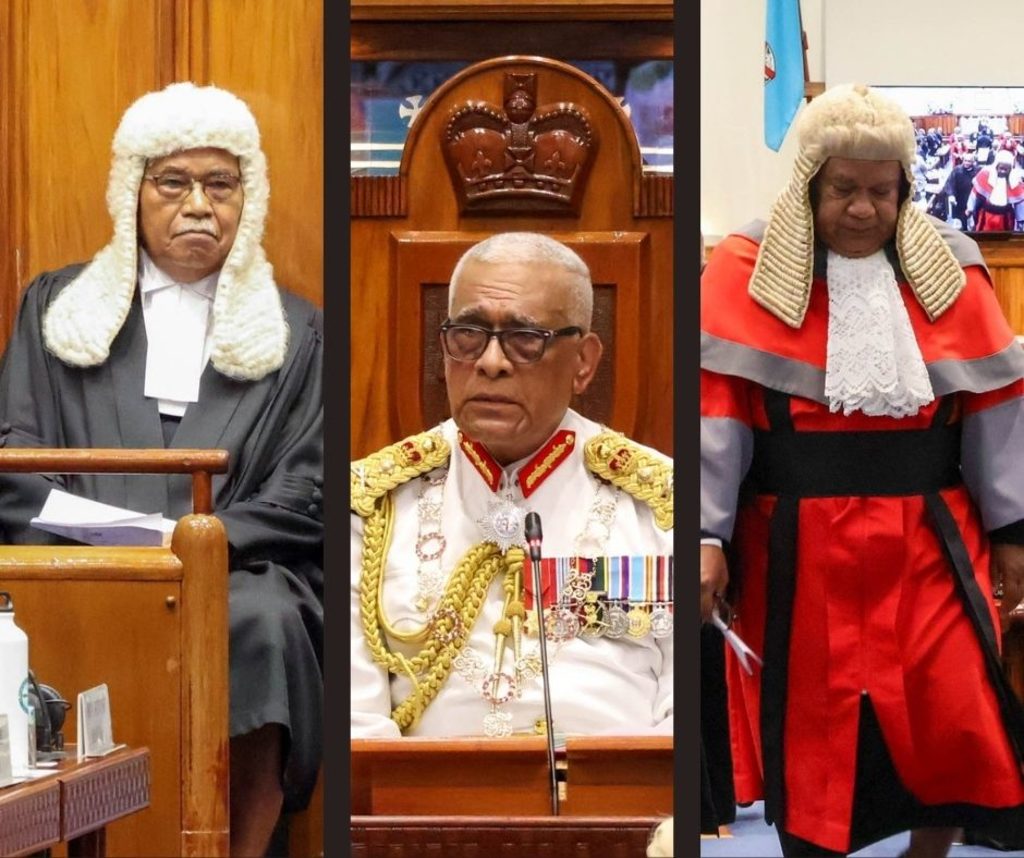
WHEN Fiji gained independence in 1970 and later declared itself a republic in 1987, it formally severed constitutional ties with Britain.
On paper, the colonial chapter had closed.
Yet more than five decades later, vestiges of that era remain embedded in our institutions, symbols and statecraft.
From the Union Jack on Fiji’s flag to the Westminster parliamentary model, from inherited common law traditions to military ceremonial customs, colonial influence continues to shape the architecture of governance in these islands.
This reality complicates how we understand decolonisation, not only in Fiji, but across the Pacific.
Earlier this month, United Nations Secretary-General António Guterres renewed calls to complete the unfinished business of decolonisation, in which he noted that 17 territories worldwide remain on the UN list of Non-Self-Governing Territories.
Among them are Pacific island states such as American Samoa, Guam, Tokelau, French Polynesia, New Caledonia, and Pitcairn Islands.
For these territories, decolonisation is often framed in two ways, independence or continued association.
But Fiji’s experience suggests that even sovereign states must interrogate what genuine decolonisation entails.
Independence versus decolonisation
Political independence is a legal event, decolonisation, however, is a societal process.
Fiji’s constitutional framework draws heavily from British parliamentary traditions.
Our legislative procedures, adversarial political culture, and even the ceremonial language of parliament reflect Westminster roots.
The annual state opening of parliament, complete with formal procession, speech from the head of state and carefully choreographed protocol, closely mirrors the United Kingdom’s state opening by the monarch, historically known as the Queen’s Speech, now the King’s Speech, which is delivered in the House of Lords at the Palace of Westminster.
The symbolism is unmistakable. The pageantry, the script, the very structure of executive priorities being formally read into the parliamentary record are inherited traditions rather than indigenous constructs.
The judiciary still largely operates within the common law system received from Britain, and much of our foundational legislation which originated during the colonial period, have been subsequently and numerously amended but rarely fundamentally redesigned.
Even the republic’s military customs which include drills, rank structures, uniforms and regimental traditions, continue to mirror British models.
These structures are not inherently problematic.
Indeed, they have provided continuity and institutional familiarity.
But their persistence to this day raises an important question about whether the Pacific has merely inherited colonial structures, or has it meaningfully reshaped it to reflect indigenous governance philosophies?
True decolonisation asks whether imported systems align with local values, or whether they subtly perpetuate external paradigms of power.
The complex legacy of tradition
The conversation becomes more nuanced when examining institutions often viewed as purely indigenous.
The Great Council of Chiefs, for instance, long regarded as the apex traditional leadership body in Fiji, was itself formalised by British colonial administration in the late 19th century.
It was established, no doubt, as part of a system of indirect rule and a mechanism through which colonial authorities governed via recognised chiefly structures.
This does not diminish the cultural legitimacy of chiefly leadership within iTaukei society.
However, it illustrates how colonial governance shaped even the institutions now seen as symbols of indigenous authority.
Decolonisation therefore requires grappling with uncomfortable truths and realising that some of what we consider “traditional state structures” were codified or reorganised within colonial frameworks.
The symbolism of the flag
The debate over Fiji’s national flag offers a visible illustration.
Retaining the Union Jack decades after becoming a republic has long and quietly sparked discussion about identity and sovereignty.
Flags are not mere fabric or pieces of cloth.
They are the nation’s DNA stitched into colour and emblem.
For some, the current design represents history and stability but for others, it symbolises incomplete psychological independence.
That debate mirrors a broader regional question of how Pacific states should reconcile colonial inheritance with indigenous resurgence that is so evident now and growing stronger each day.
Regional implications
For territories still on the UN’s Non-Self-Governing list, the struggle is more direct.
Without sovereign status, they cannot independently sign treaties or exercise full diplomatic agency.
In an era where climate change threatens entire coastlines, limited international voice has tangible consequences.
Yet Fiji’s example shows that sovereignty alone does not guarantee complete self-determination.
External economic dependencies, inherited legal doctrines and entrenched administrative systems can continue shaping policy long after formal independence.
Across the Pacific, colonial legacies influence land tenure debates, resource management laws and educational curricula.
Decolonisation therefore extends beyond referendums.
It involves revisiting constitutions, recalibrating legal systems, and embedding indigenous knowledge within governance frameworks.
Climate, strategy and agency
The Pacific today sits at the centre of renewed geopolitical competition.
Strategic interests from major powers intersect with local development priorities.
Territories such as Guam and the French-administered islands underscore how security considerations can shape governance structures.
For Fiji and other independent states, navigating this landscape requires confidence in self-defined national identity.
A decolonised mindset is critical in ensuring that foreign partnerships are entered into from positions of agency, not dependency.
Decolonisation, in this sense, is about intellectual and institutional autonomy, as well as the capacity to negotiate on equal footing while rooted in Pacific worldviews.
An unfinished journey
The Pacific has long championed the language of self-determination.
The “Blue Pacific” narrative asserts that island nations are large ocean states with collective strength.
Yet completing the decolonisation journey demands self reflection and it calls for examining not only territories still under external administration but also independent states that retain colonial imprints in law, governance, symbolism and institutional design.
In the Fijian context, the conversation is not about erasing history.
It is about deciding which elements of that rich and vibrant history serve our future and which require reimagining.
If independence was the first chapter, then decolonisation, in its fullest sense, remains the unfinished sequel.
This article was based on the UN Secretary-General Antonio Guterres’ remarks, delivered on his behalf by his Chef de Cabinet, Courtenay Rattray while penning the 2026 session of the Special Committee on Decolonisation – widely known as the C-24 – which underscored the continued relevance of the United Nations’ decolonisation mandate amid evolving global political realities.

