
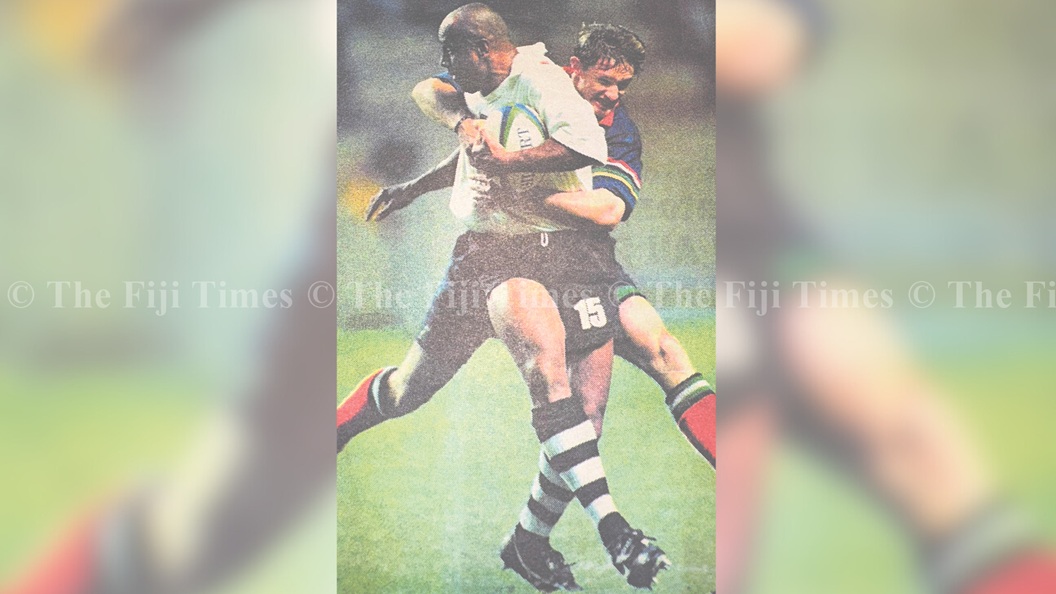
On October 1, 1999, The Fiji Times carried a report from France capturing an anxious moment in the Rugby World Cup camp, as the Fiji national rugby union team feared they had lost a key enforcer following their opening match.
The scare came after Fiji’s clash with Namibia, when news filtered through that forward Simon Raiwalui had broken a finger. Relief swept through the squad the following day when doctors confirmed it was only a sprain and cleared him to play.
Just 24 hours earlier, Raiwalui had been a fearsome presence on the field in Béziers, near the Spanish border — charging into contact like a furious bull in a ring. Each bone-rattling tackle he delivered on the Namibians was met with a thunderous “boom” from an adoring French crowd, who turned the stadium atmosphere into a rolling soundtrack of approval.
“We thought we had lost Simon Raiwalui,” coach Brad Johnstone had said at the time. “But the doctors had cleared him.”
After the match, the Fiji team returned to their hotel and went straight to bed. The next day was set aside as a rest day, though players still managed light gym work and a game of basketball in the afternoon.
Soon after, attention shifted to discipline — particularly the mounting penalty count that had threatened to undermine their campaign. Fiji had conceded 16 penalties against Namibia. Many stemmed from infringements at the tackle area, two came from high tackles by Jacob Rauluni and Viliame Satala, and another from a lineout lifting infringement.
“Seta Tawake gave away four penalties for playing the ball on his knees,” Johnstone had said, voicing frustration not only at his side’s indiscipline but also at newly introduced law changes.
“They just made that a couple of days before the game,” he remarked.
The updated rule barred props from lifting jumpers below the pants — contact on the legs or thighs resulted in an automatic penalty. Satala, who had received a yellow card for a high tackle, was not expected to face further action.
“The power of the yellow card ends with the game,” Johnstone said.
However, the Rugby World Cup disciplinary committee made it clear that sanctions for foul play would be severe. Detailed guidelines outlined suspensions ranging from seven days to life bans, depending on the offence.
Striking an opponent with the hand, fist or arm — including the elbow — carried penalties from seven to 84 days. The harshest punishment was reserved for physically abusing match officials, drawing bans from two years to life.
Had Satala been cited and found guilty of a high tackle, he could have faced a suspension ranging from seven to 56 days.
Not everyone agreed with the referee’s call. A French journalist at the match reportedly felt the yellow card was harsh.
“The Namibian player was too short anyway,” he had quipped.
Meanwhile, away from the bruising physical exchanges on the field, there was a lighter moment involving Nacanieli Marawa — better known as Seniora — who found himself in the good books of local police after hitching a ride in a police escort car that accompanied the Fiji team back to their hotel.

