
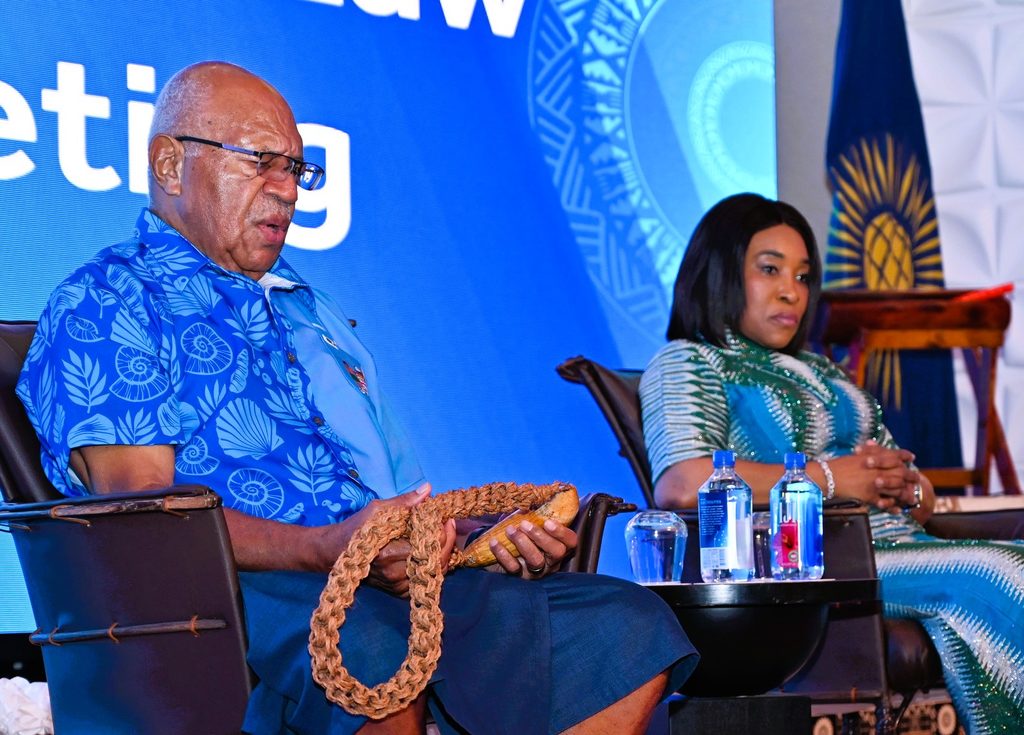
Civil society leaders have cautiously welcomed Prime Minister Sitiveni Rabuka’s strong endorsement of the rule of law at the Commonwealth Law Ministers Meeting in Nadi this week, but warn that public trust will depend not on language, but on lived experience.
In response to questions from The Sunday Times, Dialogue Fiji executive director Nilesh Lal and Fiji Council of Social Services (FCOSS) executive director Vani Catanasiga outlined what they see as the practical gaps between principle and performance in Fiji’s legal and governance systems.
Their assessments converge on a central theme that the rule of law is not measured by speeches or international commitments, but by whether ordinary citizens experience fairness, consistency and accountability in their daily dealings with the state.
Trust earned through practice
Mr Lal said he shared the Prime Minister’s view that the rule of law was central to public confidence in government.
“However, confidence is not built through rhetoric alone,” he said.
“It is earned through everyday experience: whether laws are applied consistently, whether institutions operate independently, and whether ordinary people can meaningfully access justice.”
He described public trust in Fiji’s legal institutions as “uneven”, noting that confidence weakens when institutions appear politicised or when enforcement is perceived as selective.
Among the reforms he identified as most urgent were stronger safeguards for institutional independence, transparent and merit-based appointments, predictable and timely case processing, improved resourcing of the justice system, and clear accountability when public power is exercised unlawfully or unfairly.
For many families, he added, the rule of law was not an abstract constitutional principle but a tangible reality experienced in policing, land and housing security, labour disputes, family violence responses and access to public services.
“People feel the benefits when complaints are taken seriously, when decisions are timely, and when processes are fair,” Mr Lal said. “Shortcomings show up as delays, inconsistent enforcement, lack of victim support, fear of retaliation, and the sense that rules are strict for some and flexible for others.”
Bridging the gap between law and life
Both leaders emphasised the role of civil society in closing the gap between formal law and lived reality.
Mr Lal said community-based organisations could strengthen legal empowerment through legal literacy programmes, referral pathways, paralegal-style support and accompaniment for victims. Civil society groups, he argued, were also well placed to document patterns of enforcement, track procedural delays and publish transparent, non-partisan “rule of law” scorecards.
He pointed to operational weaknesses — under-resourcing, weak internal accountability and limited transparency — as often more damaging than legislative gaps. Policy shortfalls, he said, included insufficient victim support frameworks, weak whistleblower protections and uneven implementation of existing safeguards.
Ms Catanasiga similarly framed public trust through the lenses of open government, accountability and accessible, impartial justice.
From FCOSS’s perspective, she said, public perception of institutions could be gauged not only through social media commentary but through community participation and engagement with government processes.
To measure this, FCOSS uses tools such as the Kacivaka Diagnostic Tool, which assesses openness and transparency within government agencies, and the Community Feedback Mechanism, an independent disaster reporting and feedback platform supported by nationwide networks.
Since 2022, findings from the Kacivaka assessments have pointed to what she described as a “prevailing climate of secrecy and silence” that limits public access to vital information. She also highlighted diminished capacity across government sectors for effective communication and engagement, as well as siloed approaches that fragment service delivery.
“These challenges directly undermine the principles of Open Government, Accountability, and Accessible and Impartial Justice,” Ms Catanasiga said.
Legislative urgency
While Mr Lal’s analysis focused on implementation and institutional culture, Ms Catanasiga pointed squarely to stalled legislation as a critical barrier to reform.
At a recent Law and Justice Reform Taskforce meeting at the Ministry of Justice, FCOSS called for the fast-tracking of the Code of Conduct Bill, the Access to Information Bill and the Accountability and Transparency Commission Bill.
The organisation has urged the Great Council of Chiefs representative on the taskforce, Ro Naulu Mataitini, to champion their swift passage in Parliament.
“These bills are crucial for strengthening open government and accountability,” Ms Catanasiga said, warning that without their enactment, Fiji would continue to face challenges related to the rule of law and public trust.
The Access to Information Bill in particular has long been seen by civil society as a cornerstone reform, intended to replace a culture of discretion with one of proactive disclosure and clear rights of access.
Emerging pressures: climate and digital governance
Beyond institutional reform, Mr Lal’s response broadened the discussion to emerging governance challenges, particularly climate change and digital transformation.
He argued that Fiji and the wider Pacific required stronger rights-based frameworks for climate-induced relocation, land access, housing security and livelihood protection. Participation, fair compensation and continuity of essential services must be guaranteed, he said, warning that climate mobility should not create “new forms of vulnerability”.
On digital governance, he called for stronger personal data protection, clearer accountability for misuse of data and improved cybercrime enforcement capacity — balanced carefully against safeguards for democratic freedoms.
“Public trust will decline if digital laws are seen as selective or punitive rather than protective,” he cautioned.
Ms Catanasiga’s concerns about transparency and accountability intersect with these emerging issues, as digital governance and climate adaptation increasingly test the capacity of institutions to respond coherently and openly.
Culture, democracy and consistency
Both leaders acknowledged the importance of Fiji’s cultural and traditional governance structures, but stressed the need for clear boundaries.
Mr Lal said traditional systems could complement formal justice mechanisms when they reinforced fairness and inclusion, but must not displace legal rights — particularly for women, children and vulnerable groups. Serious offences and rights violations, he maintained, must remain firmly within the formal justice system.
Looking ahead, he suggested that the strength of Fiji’s democracy would depend on transparency, consistency and meaningful participation in law-making.
“International commitments matter,” he said, “but the real test is whether a citizen’s lived experience improves.”
From commitment to credibility
Prime Minister Rabuka’s address to Commonwealth law ministers positioned the rule of law as the foundation of democracy and development. Civil society’s response indicates broad agreement with that premise coupled with a clear warning.
In the absence of transparent processes, enforceable accountability and accessible justice, rhetoric risks deepening cynicism rather than building trust.
The true measure of success will not be applause in conference halls, but whether communities across Fiji, rural and urban, maritime and mainland feel safe, heard and treated equally under the law.

